



Summary
Both India and the USA face a common challenge. Daily scheduling chaos, walk-ins, last-minute cancellations, and double bookings all contribute to a stressful and frustrating environment for both patients and staff members. To avoid such stressful situations, clinics should embrace a doctor appointment calendar system that acts like a backbone and enables clinics to follow the same predictable rhythm. When scheduling is structured, patient experience automatically gets improved. In this blog, I will discuss how a doctor appointment calendar system can become a silent partner for clinics and stabilize the entire daily operations, from controlling chaos to boosting patient satisfaction without any extra manual efforts. Continue reading!
Introduction
Clinics usually think of appointment tools as simple calendars. As soon as clinics start incorporating a structured appointment calendar system into their daily operations, they start to see the true benefits. Once the calendar system creates a stable rhythm in clinic interiors, the patient starts feeling its impact in the exterior world. Patients get clearer time slots and timely updates on every single step and last-minute confusion almost disappears. In India and the USA, clinics are still struggling with walk-in crowds, double bookings and constantly changing schedules.
Gradually, these gaps undermine patients’ trust, especially when patients expect punctuality, transparency, or easy access in the system. A well-structured doctor appointment system effortlessly eliminates these friction points. Patients arrive on schedule because they are aware that they have been given a specific time slot. Further, the doctor appointment calendar system eliminates waiting time and repeated reconfirmation calls to every patient. In essence, appointment calendars act as silent stabilizers of clinics and healthcare organizations. It perfectly aligns the daily tasks of doctors, staff and patients without extra manual efforts. Now, scheduling is not a daily struggle; instead, it provides a smooth and predictable experience that naturally elevates the overall satisfaction of patients and healthcare professionals.
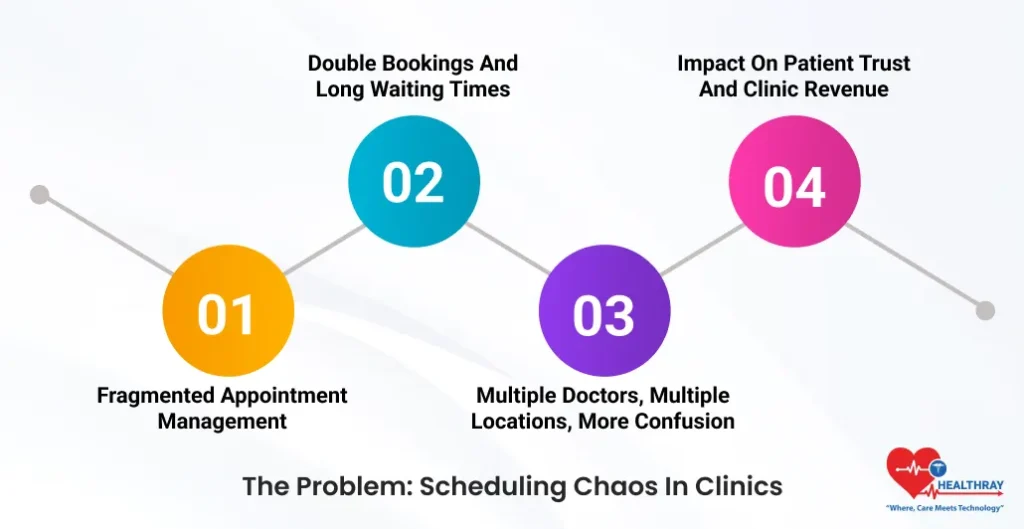
The Problem: Scheduling Chaos in Clinics
Let’s check out:
Fragmented Appointment Management
These days, the majority of clinics rely on phone calls, paper registers, WhatsApp messages, and ad hoc Excel sheets for managing appointments. Furthermore, these fragmented systems are not connected with each other. That’s the reason scheduling has become a continuous struggle for clinics. Additionally, the front desk staff have to deal with disruptions from availability checks and system errors that quietly build up.
Double Bookings and Long Waiting Times
When clinics use multiple channels for appointment management, double bookings become almost inevitable. Further, patients get the same slot that was previously reserved for another patient. This directly hampers waiting time. Moreover, patients have to wait longer, and clinics are busier. Ultimately, it perturbs the doctor’s plan schedule.
Multiple Doctors, Multiple Locations, More Confusion
Chaos gets more severe when there are multiple doctors, multiple location and in-clinic or teleconsultation slots running concurrently. Further, every channel maintains its own schedule and lacks a centralized view. Consequently, the absence of single sources of truth makes the planning reactive, not proactive.
Impact on Patient Trust and Clinic Revenue
Scheduling chaos is not just limited to operation chaos. Further, patients that repeatedly wait, face rescheduling at last minute or struggle with appointment booking eventually lose trust. Patient drop-offs, provider switching, and unfavorable reviews are often visible in clinics. Besides, missed appointments or unused time slots quietly reduce the productive hours of clinics. Clinics looks busy but actual utilization is low; ultimately, it impacts both revenue and growth.
How Does the Doctor Appointment Calendar System Reduce Double Bookings and Overlaps?
The double booking problem arises when multiple patients add slots on different appointment calendars or real-time availability is not clearly visible at the time of booking. Further, the front desk, call center, website and patient app maintain their own version for managing scheduling. Thus, the multiple patients reserve the same time slot for doctor consultation. Let’s find out how medical scheduling and appointment tools can minimize double booking and overlaps:
One Slot, One Rule: Centralized Control
A centralized appointment calendar system enforces a clear rule. Furthermore, the same time slot is only applicable to one reservation for all doctors, rooms, or other specific resources. As the patient confirms the booking front desk, website widget, call center, or patient app immediately blocks that slot. There will be no guesswork or parallel schedules.
Real-Time Sync That Prevents Overlaps
The core mechanism of the doctor appointment calendar system is real-time synchronization. Furthermore, when staff add emergency slots or doctors block time for any procedure, then these changes instantly appear in all views and booking channels. Thus, it automatically avoids overlaps without any manual coordination.
Controlled Overbooking, Not Accidental Chaos
Healthcare appointment software allows limited, rule-based overbooking for clinics. For example, the system provides 1-2 “walk-in buffers” for high-priority cases. However, the system is controlling the power; overbooking is intentional, not accidental. It circumvents awkward conversations like “sorry, that time slot is already reserved.” Moreover, patients get clear clarity, minimizing staff stress and clinic routines become foreseeable and hassle-free.
From Chaos to Control: Managing Multi-Doctor, Multi-Location Setups

As clinics add doctors, new specialties, and additional branches, manual calendar management crosses its limits. Further, managing schedules, shared resources, or changing OPD timings becomes cumbersome. In this stage, ad hoc tools will not work out. Let’s check how doctor appointment booking software for clinics resolves the challenges:
One Interface, Multiple Providers and Locations
A robust appointment calendar system supports multiple doctors, rooms, and locations in a single interface. Plus, it provides filtered views for all doctors or branches to help team members view their relevant schedules. Admin can easily configure doctor working hours, off-days, preferred slot duration, and room allocation without disturbing any existing calendars.
 PRO TIP
Shared Resources Without Scheduling Conflicts
In group practices and hospitals, multiple resources, such as ultrasound rooms and procedure theaters, are circulated among different departments and doctors. Further, appointment systems regard these resources as “bookable entities.” This ensures that nobody, not even from the doctors’ department, can book an appointment that has already been reserved.
One Update, Visibility Everywhere
The administrator can only update in one location if physicians wish to modify their schedules or if clinics wish to add more OPD. Central calendars are immediately reflected at all touchpoints, thereby avoiding the disastrous event of printed schedules, outdated charts, and conflicting information.
Harnessing Analytics to Fix Hidden Inefficiencies
Let’s check out:
From Guesswork to Real Visibility
The biggest advantage of digitalizing the appointment calendar is visibility. Instead of depending on gut feelings and assumptions, clinic managers can clearly perceive the data, such as no-show rates, cancellation patterns, average daily utilization, doctor-wise workload distribution, and the most popular time slots. This data provides valuable insights:
- Does monday morning always overloaded?
- Do any specific doctors face more no-shows?
- Are teleconsultation slots underutilized as compared to in-clinic visits?
Data-Driven Scheduling Improvements
When clinics can easily visualize these patterns, clinics can perform informed experiments such as adjusting slot duration, making the confirmation policies strict, and adding waitlists and shifting certain services to less busy hours. Most importantly, it helps clinics measure the impact of each change over time without making guesses.
Smarter Staffing and Resource Planning
Analytics are not just limited to appointments. This makes the staffing decisions more cognizant. Clinics can perfectly align nursing shifts, front-desk coverage, and diagnostics support with actual demand patterns, not on the basis of assumption. This helps clinics avoid the overstaffing or understaffing issues.
Turning the Calendar into a Strategic Tool
With this continuous improvement cycle, appointment calendars are not merely an operational necessity. It becomes a strategic tool that identifies clinical inefficiencies and optimizes workflows and helps clinics make tangible decisions for long-term growth.
 NOTE
NOTE
Implementing Change Without Disrupting Care
Even the best appointment calendar system fails if adoption is weak. Clinics should have a thorough understanding of the current scheduling procedure before initiating the implementation process. They should have precise information about how patients book, which channels they prefer, and how to deal with walk-ins and emergencies, which are common in clinics. Let’s check out what steps clinics should take:
Build Buy-In Before You Go Live
It is crucial for clinics to involve front-desk teams or doctors at an early stage. When they participate in designing templates, rules and slot structures, systems do not seem like “imposed tools.” Instead, it seems like a solution that eases all the challenges. It directly impacts smoother adoption.
Phase-Wise Rollout Works Best
A phase-wise rollout is usually more effective. Initially, clinics should begin with a single department or doctor, identify issues and refine their workflows. And gradually scale your system. Maintaining dual visibility is useful in this phase (digital and legacy). However, one rule applies: the digital calendar is a reliable source of information.
Step towards digital era with our healthcare solution
Revamp your hospital facilities and embrace change for better healthcare management. Ease in managing and organizing large medical datasets leads to effective analysis. Seize the opportunity now!
Train for Confidence, Not Just Clicks
Staff training should not be limited to clicking buttons of software. They should be capable of understanding how the new system reduces stress, decreases errors, and simplifies their daily operations. As staff starts building confidence, metrics such as waiting time or no-shows automatically get better. Over time, organizations naturally move on from traditional chaotic methods.
Conclusion
Scheduling chaos not only creates operational headaches, but it also directly impacts patient satisfaction and revenue. A doctor appointment calendar system replaces sticky notes, phone tags and overstuffed registers and provides a single live calendar that boosts the trust and confidence of the entire team. It converts the daily chores into a well-structured rhythm, brings noticeable improvements in patient experience and returns valuable hours to clinics.