





Summary
Scaling of clinics is not an expansion issue, it is a control issue. Growth appears to be shiny on the surface. New locations open. Patient numbers rise. Brand visibility improves. But there is another truth which operators are aware of. The expansion of clinics creates complexities at a rate higher than the rate of rewards. Processes stretch. Teams improvise. Decisions rely on systems and not on memory. That is where the majority of clinic chains lose their grip.
That is why multi clinic management software becomes the key to sustainable development. It does not hasten growth in isolation. Rather it balances the processes such that expansion does not disrupt the already functioning. When systems create consistency, clinics expand with confidence rather than caution.
Essentially, predictability produces a smooth scale. Doctors know what to expect. Staff follow the same flow. Leadership sees the same data across locations. Consequently, the performance remains predictable with increase in size. This blog describes how clinic chains can balance it and why digital systems can do it without stress.
Introduction
When one clinic is operating on memory, there will be ten clinics broken. Most clinics start with informal systems. A senior receptionist remembers patient preferences. A physician follows schedules in his or her mind. Daily discussions help a manager to solve the problems. First, this strategy is efficient. Over time, it becomes fragile.
As soon as a second or third location opens, cracks appear. Information fails to travel. Information fails to travel. Patients repeat histories. Employees have varied regulations. Leadership spends more time resolving confusion than planning growth. As a result, the owners of clinics begin to search for structures.
This is where Clinic Management Software will come in the discussion. Not as an indulgence, but as a need. The linked system substitutes processes with memory. Decisions rely on data instead of guesswork. Significantly, this transition is in favor of multi clinic management software as a grounding system and not a simple solution.
At this stage, scaling is no longer risky. Clinics proceed with no hope, but with certainty.
What Actually Breaks First When Clinics Start Expanding
Ambition does not result in failure to grow. It is not successful as the operations cannot keep up. The first thing to break is consistency. The handling of appointments is different. Billing rules differ. The follow-ups will be based on the person answering the phone. Over time, these variations multiply.
The other pressure point is that of people. Staff rotate between branches. Doctors consult at multiple locations. Without shared visibility, confusion increases. Tasks get duplicated. Errors go unnoticed. These are classic challenges of managing multiple clinic locations, although they often appear quietly.
In the meantime, leadership becomes deprived of real time observation. Reports arrive late. Decisions rely on summaries instead of live data. Because of this, managers respond but not lead. The clinics become bigger and more difficult to manage.
This stage signals the need for clinic management software that standardizes daily work while respecting clinical independence.
 NOTE
NOTE
Seamless Scale Depends on One Thing: Operational Uniformity
Clinic chains that scale smoothly share one trait. They impose standardized operations in different locations. Conformity does not imply inflexibility. It implies common rules in the scheduling, documentation, billing and reporting.
In this case, multi clinic management software has the defining role. It makes sure that all clinics have identical workflow automation, even in case of different teams. Staff know what to do. Doctors trust the system. Leadership sees consistent metrics.
Also, Digital clinic management eliminates the dependence on location data. With the system in place, data updates instantly, and changes reflect everywhere. Consequently, the performance of clinics remains predictable even during times of expansion. This real-time update ensures that clinics don’t have to manually write every time they are new, streamlining operations and improving overall efficiency.
Standardization also decreases the training work. New staff learn one system. Transfers become easier. Errors decline naturally. Over time, clinics spend less energy fixing problems and more time improving care.
Centralized Patient Records Are a Growth Requirement, Not a Feature
Patient experience often declines during expansion. Records scatter. Histories are never complete. Follow-ups get missed. These problems undermine trust in a short period of time.
This is why centralized patient records are essential for growth. As data remains unitary, patients transfer across branches without resistance. Physicians can retrieve entire histories in real time. Care decisions improve.
Besides, centralized data enhances the healthcare practice management software as it connects clinical and administrative operations. Billing aligns with treatment. Reporting stays accurate. Compliance becomes easier.
For clinic chains, patient continuity defines reputation. The systems serving the shared records help to make sure that growth promotes credibility rather than undermines it.
Why Cloud Visibility Changes How Leadership Runs Clinic Chains
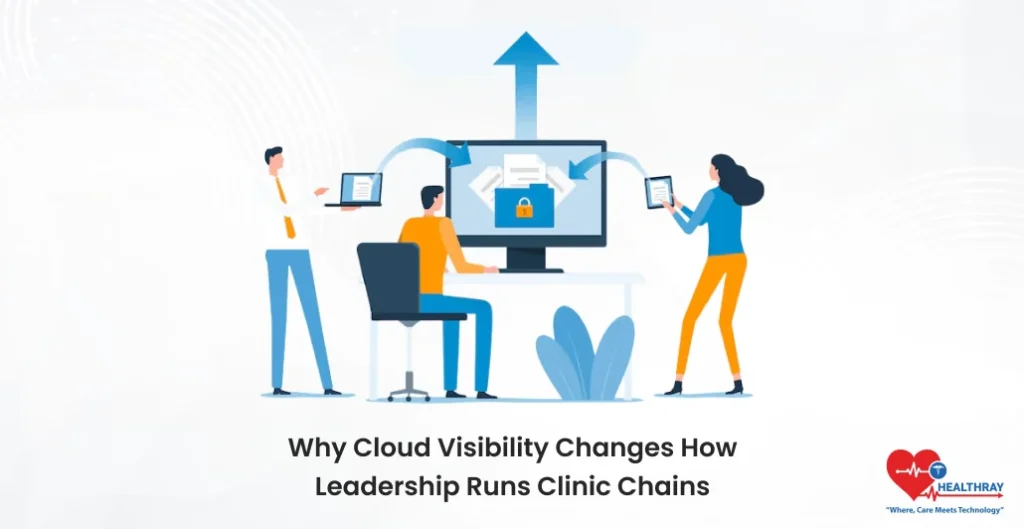
Leadership struggles most when visibility disappears. Managers are not able to control various places manually. Delays create blind spots. Decisions arrive too late.
A cloud based clinic management system changes this dynamic. The leaders monitor activity within branches in real time. The performance trends are evident early enough. Bottlenecks become visible.
Consequently, leadership shifts from firefighting to planning. Clinics coordinate the resources ahead of time. Growth feels controlled rather than reactive. This visibility strengthens software for growing clinic chains, which depends on timely insight.
 PRO TIP
Software for growing clinic chains must reduce decisions, not add them. Most of the tools claim to be flexible. Flexibility, as a matter of fact, brings about inconsistency. Clinic chains require systems which restrict variation. Defaults guide behavior. Rules enforce best practices.
Multi clinic management software is no exception to this. It simplifies choices. Staff follow defined paths. Errors reduce naturally. As time passes, discipline substitutes the need to be under supervision.
Patient Experience Breaks First When Systems Do Not Scale
Clinic chains often assume patient experience improves with brand growth. In reality, experience suffers first when systems fail to scale. Waiting times increase. Follow-ups become inconsistent. Communication gaps frustrate patients.
This is the case since experience relies on coordination. In the absence of multi clinic management software, coordination is based on human beings rather than on systems. Staff handle calls manually. Records stay scattered. Locations conflict in appointments.
However, digital clinic management restores balance. Systems guide interactions. Patients receive consistent communication. The follow-ups are automatic. Over time, trust builds because predictability replaces uncertainty.
In addition, effective systems secure clinical relationships. Physicians are concerned with care and not logistics. Patients experience continuity even when they have a visit to other branches. It is the stability that makes a seamless scale.
The Role of Centralized Operations in Brand Consistency
Brand consistency does not come from logos or signage. Instead, it is based on the daily running of clinics, where every interaction matters. Every touchpoint shapes perception and, over time, even a single poor interaction can spoil the reputation of an entire chain.
This is precisely where healthcare practice management software facilitates operational discipline. Scheduling follows shared rules, while billing stays uniform across locations. As a result, leadership imposes standards silently with multi clinic management software, allowing teams to work within defined structures. Performance improves steadily without the need for constant supervision. In the same way, adopting principles similar to construction web design helps translate this operational structure into clear, well-organized digital experiences that reinforce consistency across every clinic touchpoint.
On the contrary, unstructured clinics that grow in size become silos within an organization. The branches are autonomous. Leadership loses alignment. There is inconsistent performance.
Leadership imposes standards silently with multi clinic management software. Teams have their way of work. Performance improves without constant supervision. There is growth of brand value since reliability remains intact.
How Cloud-Based Systems Remove Location Dependency Completely
Geographical distance, however, becomes a source of agitation when systems rely on local storage or human updates. Reports arrive late, corrections take longer, and teams often end up using outdated information. In contrast, a cloud based clinic management system removes these limitations. Data updates instantly, access remains secure, and spatially distributed teams collaborate without delay.
Clinic chains are, therefore, more responsive to change. Consequently, new policies roll out immediately and updates reflect everywhere at the same time. Leadership stays informed continuously, which, in turn, supports software for growing clinic chains that demand flexibility without sacrificing control. Clinics expand geographically while operations stay unified.
Growth Without Structure Magnifies Operational Risk
Scaling, by nature, enhances both strengths and weaknesses. Effective clinics become stronger, whereas unorganized clinics struggle to survive rising volumes. This reality explains why many chains fail soon after their first success.
The challenges of managing multiple clinic locations often surface during rapid expansion. Employees have difficulties in coordination. Managers chase reports. Doctors repeat work.
Multi clinic management software however takes the pressure off. It standardizes workflows. It synchronizes data. And it also minimises reliance on personal memory.
When structure exists, growth becomes sustainable. Clinics expand in a systematic manner, teams evolve without interruption, and leadership focuses on direction rather than reacting to daily problems.
Why Implementation Matters More Than Features
Most clinics invest in tools; however, they often fail to focus on execution. Software exists, yet usage remains inconsistent. As a result, benefits stay theoretical rather than operational.
By comparison, the outcomes of a structured clinic software implementation roadmap look very different. Teams understand workflows clearly, training aligns with day-to-day activities, and adoption improves naturally over time.
Importantly, implementation defines success. The most excellent systems cannot work, when teams pass around them. Well-defined rollout plans eliminate abuse. Ownership stays defined.
Clinics with a focus on implementation transparency gain ROI more quickly and with less difficulty moving to different locations.
Cost Predictability Supports Confident Expansion
Scaling also requires financial clarity. Hidden costs disrupt planning, while pricing ambiguity postpones decision-making altogether.
Using a clinic software pricing guide early helps avoid surprises. Leadership aligns budgets with growth objectives, and investments remain proportional to anticipated results. In the long run, this clarity supports confident and measured expansion.
Also, clear-cut costs aid long-term planning. Clinics are confident in adding locations. There is a linear growth in technology and revenue.
This transparency enhances decision-making and contributes to long-term growth without expenses.
Experience Management Becomes Central at Scale
As clinic numbers increase, experience management shifts from intuition to system-based execution. Feedback flows upward, and follow-ups require automation to remain consistent.
A patient experience management solution, therefore, ensures uniformity across locations. Communication stays timely, feedback reaches leadership without delay, and improvement becomes a continuous process rather than an occasional effort.
Further on, systems record insights in an objective way. Leadership identifies trends in places. Data enhances experience, as opposed to assumptions.
Step towards digital era with our healthcare solution
Revamp your hospital facilities and embrace change for better healthcare management. Ease in managing and organizing large medical datasets leads to effective analysis. Seize the opportunity now!
Healthray Scaling Clinics Without Losing Control
Healthray takes clinic expansion as an operational problem and not a technical one. The platform facilitates the use of multi clinic management software by organizing daily activities in different locations.
The systems at Healthray combine scheduling, documentation and reporting. Teams have processes in common. Data updates centrally. Visibility remains constant.
Also, Healthray aids in organized growth with the introduction of the principles of hospital software implementation modified to the clinic. Rollouts stay predictable. Adoption does not vary.
In expanding networks, Healthray modular hospital information systems are flexible to adjust with the changing needs. Clinics add features without disrupting operations.
Lastly, the foundations of the hospital information management system software are effective data security, compliance and scalability across the clinical contexts.
Conclusion
Seamless scale comes from predictability, not speed. Well, being fast does not make one successful. Consistency does. There is one disruption clinics can withstand. They are not able to live with uncertainty. Doctors evolve in the condition of stable systems. When familiar with experiences, patients remain loyal.
The multi clinic management software should be able to sustain expansion without overloading the teams. It must get rid of guesswork. It should safeguard accuracy and efficiency at the same time. Scale becomes natural when systems are in line with actual workflows.
In case you have a clinic chain or plan growth, this is the high time to examine the way things operate nowadays. Schedule a free demo and marketplace and observe how Healthray facilitates a smooth scale via construction, clarity, and consistency.
Depend on systems that are going where your network of clinics is going rather than where it began. Growth rewards preparation.