
Summary
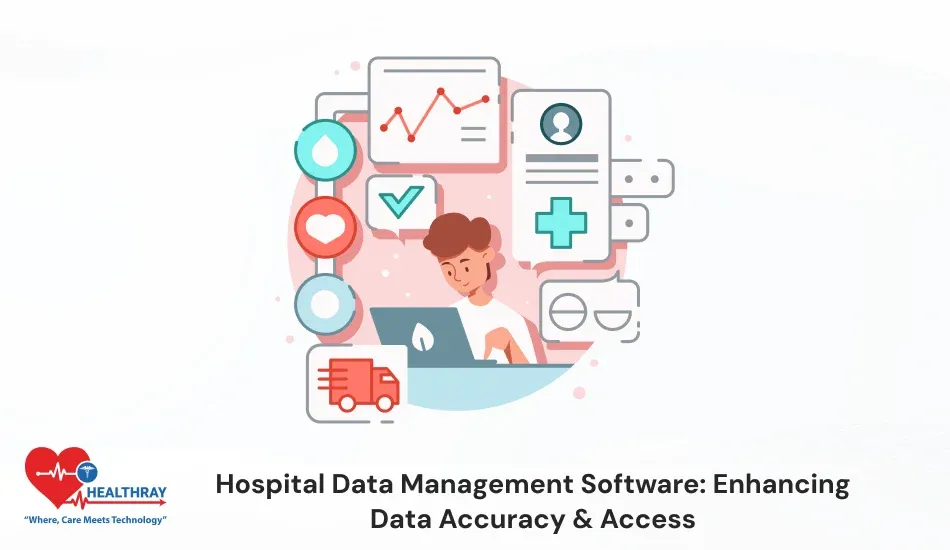
Hospital Data Management Software (HDMS) is a scalable and effective solution to enable hospitals to provide consistent, precise treatment to patients. This system averts manual errors that are common and propels efficiency to a remarkable level. In traditional systems, doctors are highly overwhelmed with paperwork. It becomes increasingly strenuous for doctors to uphold high standards of treatment in the practices. In this blog I will walk you through how hospital management data software automates standard workflows and optimizes care excellence. Keep reading!!!
Introduction
Data accuracy is critical in hospital systems. A small mistake can impact the patient’s treatment. In traditional software, hospitals save patient records, reports, billing and prescriptions in manual files at different systems. This raises the risks of data loss, duplication and errors. To combat such stressful situations, hospitals should use a hospital management system to keep all the information safe, accurate and easily accessible.
Hospital data management software is a smart system that connects all the departments such as OPD, IPD, lab, pharmacy, billing and administration into a single system. The most significant upside of hospital management software is real-time connectivity. Physicians, nurses, and employees can gain access to patient data from any location using approved devices. In a dynamic healthcare environment, compliant and accessible data is a key to attaining success. HDMS helps hospitals to achieve this goal.
How Can Hospital Data Management Software Reduce Waiting Time
1. Online Appointment Booking & Reminders
Hospital data management software helps patients to follow up with their doctors even while sitting at home. Further, this saves significant time from standing in queues and booking appointments. Automated WhatsApp reminders using tools like Getgabs help patients to visit hospitals at the designated time. Patients will arrive at the hospitals on time and won’t have to wait, which reduces the number of no-shows.
2. Quick Check-in & Paperless Process
Through Self check-in counters and mobile apps, patients can conveniently validate and confirm their medical records. Further, pre-filled digital forms spare paperwork. This puts an end to endless queues waiting at the front desk. Staff no longer depends on manual entries; this makes the entire procedure fast, precise, dependable, and hassle-free.
3. Centralized Patient Records
Mobile hospital software organizes the patient track record in a single dashboard. Doctors don’t need to check paper files to access past treatments, lab reports, prescriptions and allergies for commencing the treatment. This effectively reduces the postponement of medical treatment decision-making and strengthens collaborative efforts that drastically transform patient care delivery.
Why do Hospital Data Management Implementations Fail to Reduce Wait Times Despite Initial Success?
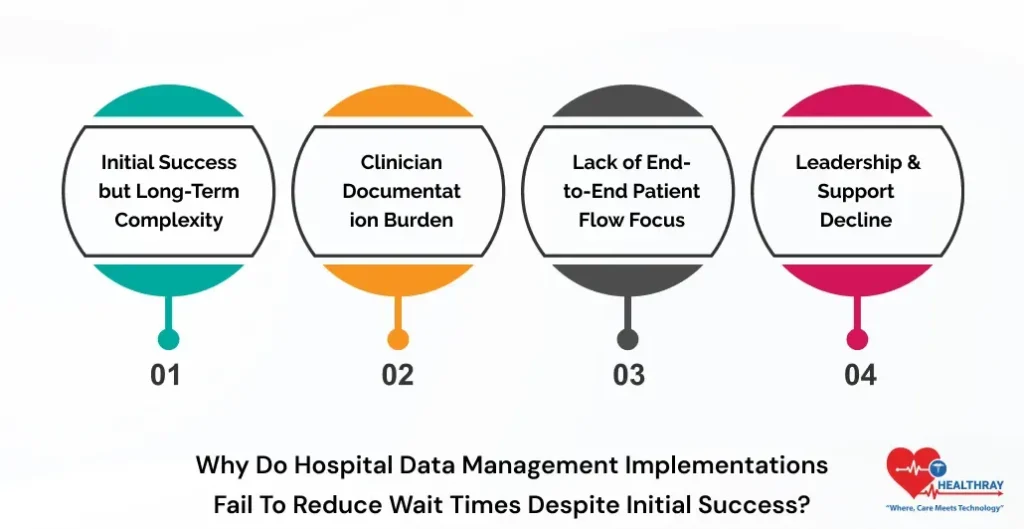
1. Initial Success but Long-Term Complexity
At the initial phase, Hospital data management solutions and electronic health record systems streamline documentation and workflow and simplify the waiting time. However, over time, the system gets complex due to extra features, billing requirements and reporting tasks that are added to the existing system. Due to this complexity, doctors and nurses take more time, which further enhances the waiting time.
2. Clinician Documentation Burden
As the medical staff starts using the system features entirely, doctors get more engaged in detailed data entry. Further, this documentation overload prolongs their consultation time. As a result, the patient continues to wait long and gradually the system’s initial favorable effects recede.
3. Lack of End-to-End Patient Flow Focus
Many hospitals just focus on single department optimization such as OPD or billing but they fail to consider the entire patient journey. Further, if hospitals fail to manage workflow from registration to discharge properly; this enhances delays in the practices. The lack of a holistic approach limits the standard level of efficacy.
4. Leadership & Support Decline
If leadership focus slows down after HMS system implementation or management gets changed, it slows down the system improvement efforts. Further, a leadership role is highly crucial. If practices lack strong leadership support, the team can’t leverage the full advantage of the new system.
How to Avoid These Pitfalls?
1. Continuous Training & Clinician Involvement
It is highly imperative for hospitals to launch regular training seminars and establish a team of clinician champions. Further, when doctors and staff are involved in design and improvement, then adoption becomes better and workflows become efficient.
2. Executive Buy-In & Long-Term Strategy
Top management’s continuous support is paramount for hospital success. Further, a clear long-term strategy, budget allocation and accountability ensure that the system remains sustainable and consistently reduces waiting time.
3. Real-Time Analytics & Flow Optimization
Hospitals can efficiently manage patient flow with real-time dashboards or analytics tools. Further, this helps hospitals conveniently spot roadblocks. Hospitals can restructure their staffing and scheduling to regulate the waiting time.
 PRO TIP
How does AI in HDMS Predict and Manage Patient Flow?
1. AI-Based Patient Arrival Prediction
AI Hospital data management software can instantly predict historical data (admissions, OPD visits, seasonal trends) and can determine the number of patients visiting at the particular time. Machine learning models can perform surge forecasts 6–24 hours before. Further, this allows hospitals to be prepared in advance and can easily control waiting time.
2. Length of Stay (LOS) Forecasting
AI can easily calculate a patient’s expected stay duration in accordance with diagnosis, age, treatment type and past records. Further, through this, hospitals can easily determine bed occupancy. This makes the bed allocation process more accurate and reduces unnecessary waiting. Also read our blog software used in hospitals to know more about it accurately.
How does HDMS Ensure Real-time Data Accuracy During High-Volume Patient Inflows?
1. Automated Validation Checks
HDMS includes real-time validation rules that detect errors at the time of data entry. Further, Hospital data management software flags and alerts duplicate patient entries, wrong vitals, or missing details. This prevents wrong data saving and maintains accuracy even during a high-volume patient rush.
2. Smart Duplicate Detection
During high inflow, hospital staff mostly get confused and create multiple registrations of the same patients. HDMS uses fuzzy matching and unique IDs to detect duplicate entries in the system. The system automatically matches similar names, phone numbers and IDs and avoids duplicates.
3. Master Data Management (MDM)
HDMS includes MDM that ensures every patient includes a unique ID in all the systems. Further, it properly links patients, staff and records and avoids confusion and data mismatches during high inflow.Additionally, DBA Managed Services support this process by ensuring database integrity, continuous monitoring, and performance optimization, helping maintain accurate and consistent data across all systems.
What Metrics Prove HDMS Investments Reduce Wait Times via Better Data Access?
1. Average Wait Time (AWT)
AWT is a direct metric that reveals the reduction in waiting time post-HMS implementation. Further, it accurately tracks the exact time of real-time dashboard registration and consultation. It reduces to 30-50% in hospitals, which is the clearest evidence of better data access.
2. Patient Throughput Rate
This metric determines the number of patients’ attendants per hour in each department. Through HDMS, doctors and staff get instant data access, which minimizes delays. Consequently, throughput increases to 25–40% and queues move fast.
3. Door-to-Doctor Time
In the emergency department, this is an important KPI. Further, it measures the time from patient entry to doctor consultation. With Accurate real-time data and bed availability insights, hospitals can reduce this time to 30–37%. Overall, it improves emergency response speed.
4. Pre- vs. Post-Implementation Analysis
Hospitals should compare the old and new data and validate the improvement in HDMS. Further, real-time analytics and audit reports clearly reveal the improvement in waiting time and workflow efficiency.
Learn more: How to Select the Best Hospital Contract Management Software?
How does HDMS Feature Engineering From Demographics and Labs Sustain Long-Term Accuracy Gains?
1. Feature Engineering
In HDMS ,feature engineering means converting raw data (demographics + lab reports) into valuable data inputs. Further, this processed data helps ML models to understand the patterns more accurately. This makes the forecasting method more trustworthy and uniform for the long term.
2. Demographics Data Transformation
Age, gender, and location features of HDMS are not utilized in simple form. It should convert into bins (age groups), ratios (age vs. disease count) and combinations (age × insurance). Further, this allows the medical team to comfortably capture changing population trends.
3. Lab Data Normalization & Trends
HDMS normalizes (z-score) the lab values to easily compare different ranges. Plus, it analyzes the trends. For example creatinine and sugar levels change in the 24 hours. Further, this helps clinics determine the real progression of patients, not just a snapshot.
4. Noise Reduction & Aggregation
Hospital data management software uses rolling averages and aggregated values (average vitals). This eliminates random fluctuation and errors. Further, the system gets reliable and stable signals that help clinics in maintaining long-term accuracy.
5. Drift Detection & Feature Optimization
HDMS can quickly determine which features are beneficial and which are not. Further, if data patterns get changed in clinics, then low-impact features are removed. Further, this saves the model from overfitting and long-term performance remains stable.
6. Contextual Data Combination
HDMS creates “clinical triplets” (lab + demographic + time). This clears the context in case one lab value poses a distinct meaning in different age groups. This approach significantly improves prediction accuracy.
 NOTE
NOTE
Conclusion
HDMS helps hospitals to maintain accuracy in the practices, especially when patient load volume is high. HDMS makes the entire system organized and easily accessible. This allows medical professionals to make fast and concrete decisions. HDMS platforms such as Healthray use advanced models (XGBoost) that accurately analyze demographics and lab data and make the forecasting process easier. Healthray helps hospitals improve patient experience and make their day-to-day practices efficient and patient-centric.