


Summary
LIMS and Hospital Information System (HIS) integration ensure seamless communication between the hospital and the laboratory. If they are not linked, LIMS can streamline complicated lab operations, but it cannot automate full clinical operations involving other departments. To leverage the full benefits of automation, it is essential to implement LIMS integration with HIS, so that other departments can instantly check patient lab reports and initiate the treatment without the need to wait for other approvals. Integration provides complete transparency of patient information in a single platform; doctors don’t have to manually check the patient’s lab reports. This minimizes manual errors and increases the reporting speed. In this blog, I will discuss why LIMS integration with a hospital information system is important and how it helps clinics in improving staff coordination and improves the workflow. Keep reading!!!
Introduction
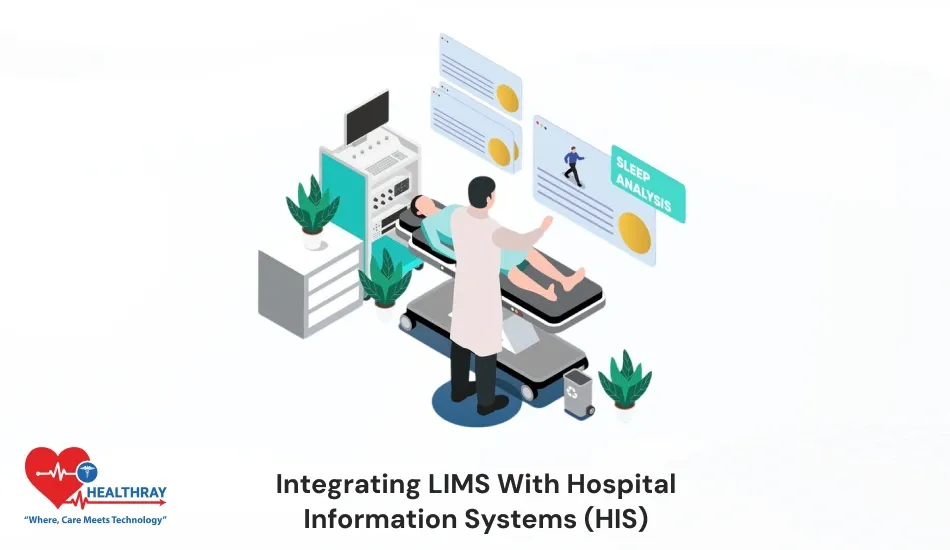
In modern hospitals, speed and accuracy are the most important factors. Patients are expecting faster diagnoses and treatment processes. But this is possible only when hospitals smoothly collaborate with different departments. The integration of systems becomes seamless with LIMS integration with HIS, making it critical in modern healthcare. In simple words, a hospital information system is the main brain that stores patient details, doctor appointments, billing, and medical history. On the other side, Laboratory Information Management System (LIMS) is a smart assistant that helps clinics in tracking the sample, managing the test and generating the reports.
If this system works differently, it will increase the workloads on medical operations. Doctors have to open different platforms to check lab reports. Lab staff have to enter the report manually. This will become hectic process and labs will take considerable time to generate results. To avoid such situations, labs should implement LIMS integration with HIS so that doctors can immediately view the reports and initiate the treatment. As the lab tests get completed, LIMS automatically generates reports and updates the same in HIS. This integration ensures patients get timely, accurate, and high-quality healthcare services, which is the primary goal of modern healthcare.
Why LIMS integration with HIS Matters?
When hospitals and labs are not connected to each other, daily operations become highly complicated. Further, clinics need to put efforts in order to accomplish simple tasks. This naturally increases the delays, as technicians take more time to generate reports and manually mail them to different departments.
What are other challenges labs face?
- Staff need to enter the same patient details multiple times.
- Manual entries increase errors and spelling mistakes and misleading information.
- Report takes several weeks for final approvals
- Process slows down
- Patient wait times increase.
- Fragmented system.
Additionally, this disconnection becomes bottleneck and clinics need huge efforts to handle such complicated scenarios. Therefore, LIMS and HIS integration is an indispensable requirement; without it, hospital functions slow down and increase disorientation in the system.
Key Benefits of LIMS integration with HIS
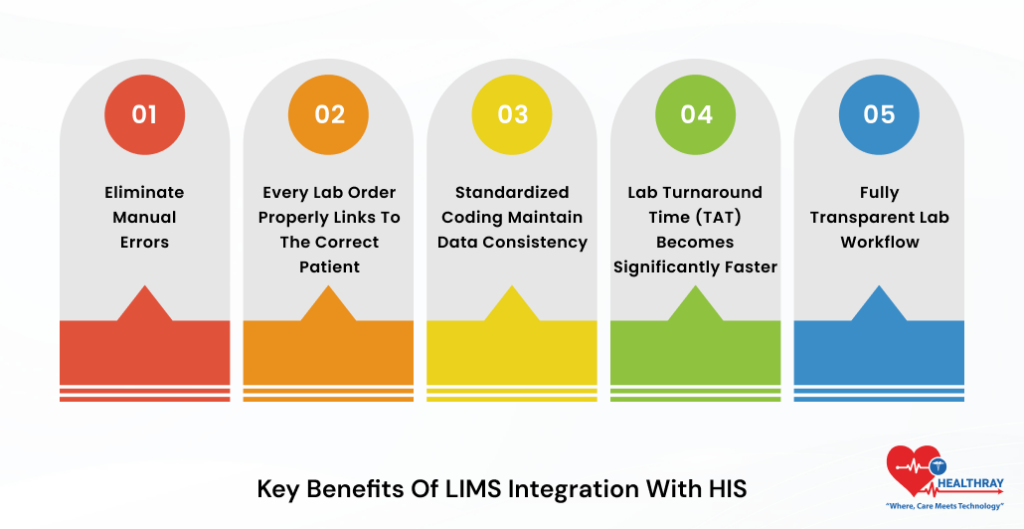
1. Eliminate manual errors
Clinics make small mistakes when they enter the data manually in the system. Further, a wrong digit, one misspelled name, and a wrong test code can hamper the operations and create unnecessary discord. Moreover, a small error can bring about serious implications. LIMS integration with HIS smartly resolves these problems, eliminating manual errors and ensuring accurate patient data.
How does implementing LIMS-HIS integration ease the complex process?
- Patient details automatically synchronized in the dashboard; no additional efforts required.
- Staff no longer need to enter the data manually in the system.
- Reports become more accurate and reliable.
- Avoid Wrong patient and wrong test mapping.
 NOTE
NOTE
2. Every lab order properly links to the correct patient
In traditional software, manual entries pose significant challenges. Further, lab orders get attached to the wrong patient profile. This misleading information can negatively impact patient care and treatment decisions. Additionally, it impacts lab credibility and patients will gradually be skeptical of your services. Traditional software will not work to circumvent such a situation. It’s high time to embed advanced LIMS and HIS integration to correctly link each patient lab result with the correct profile. HIS links patient ID, demographics, and visit details properly. Overall, LIMS-HIS integration ensures the following:
- Proper mapping of test results
- Take care of patient safety.
- Ensure data integrity
- Improves overall clinic trustworthiness.
3. Standardized Coding Maintain Data Consistency
The same test name may appear on multiple platforms. Further, this creates confusion and clinics face challenges with wrong code numbers. Standardized coding systems like LOINC or ICD-10 can easily resolve these problems. Standardized code creates a uniform language for both HIS and LIMS. Moreover, this code helps clinicians to accurately identify tests, diagnoses, or observations. LIMS integration with HIS works incredibly by mapping the correct codes with patient health symptoms. This helps clinics:
- Create accurate reports
- Maintain data consistency in every step.
- Ensure seamless collaboration among different departments.
4. Lab Turnaround Time (TAT) Becomes Significantly Faster
In traditional software, staff have to manually check the orders and enter every detail manually in the system. Further, this approach consumes plenty of time and creates unnecessary delays. LIMS integration with HIS can quickly resolve this problem by automating the workflow and speeding up lab turnaround time. As the doctors place a test order in HIS, it instantly reflects in LIMS without the need for any manual intervention. Upon test completion, results automatically update in HIS. Additionally, it enables:
- Expedites the report generation process.
- Improve treatment and care
- Resolve the patient issue in time
- Doctors can take timely decisions to initiate the treatment.
- Improves efficiency of the system.
5. Fully Transparent Lab workflow
Every lab department processes hundreds of samples per day. Further, if practices lack proper tracking, this enhances the chances of confusion and delays. Further LIMS data security software integration can make the workflows fully transparent. Staff can easily review in real time which cases are pending, which are still in processing mode and how many are completed. Conventional software lacks transparency; it becomes difficult for staff to check sample updates in real time. Additionally, automation helps staff:
- Eliminates manual follow-ups
- Slows down delays.
- Help staff stay organized.
- Ensure comfortable medical practices.
 PRO TIP
How LIMS–HIS Integration Actually Works
1. Connect Integration Systems with One Common Language
When two people speak different languages, it becomes so difficult to understand each other. In the same way, when hospital and lab systems work differently, it becomes too difficult to coordinate with the team. This will create confusion and delay the operations. Therefore, both hospitals and lab systems require a common language. HL7 or FHIR standards of LIMS software provide a structured and universally recognizable data format. Further, it ensures the system accurately transfers the patient details, orders, and results. Additionally, it enables seamless communication, prevents manual errors that impede the system workflow and significantly boosts system functionality.
2. Patient Details Automatically Reach Lab System
In conventional software, patients enter details such as name, age, and visit reason at the hospital reception. Same details the staff have to manually enter in the other system. This is a complete waste of staff time and chances of errors, spelling mistakes, and duplicate entries are higher. Further, LIMS compliance and standards integration with HIS automate that entire hectic operation. It takes a few seconds to update the patient records in all the systems. HIS instantly sends demographics and visit details to lims immediately. Moreover, lab staff can directly access the correct information.
3. Doctors Test Order Instantly Transfer to the Lab
In a manual paper-based system, the doctor first writes the report on paper and then sends the same copy to lab departments. This process is too long and creates confusion. Further, LIMS-HIS integration makes the entire medical practice fully digital and automated. Once the doctor places the test order in HIS, it instantly gets reflected in LIMS. Moreover, the urgency level automatically gets transferred to the right department. This ensures faster evaluation and accurate test management.
How Does Proper Terminology Mapping Avoid Data Mismatch?
The biggest risk in a disconnected system is wrong code mapping. Furthermore, in traditional software specialists have to enter medical code manually with every result. This causes confusion, and sometimes code gets accidentally mismatched with the original codes. If the internal code of the test varies in both LIMS and HIS, then the result gets attached to the wrong test.
Furthermore, this situation directly impacts diagnosis and treatment decisions. Proper terminology mapping prevents this issue by aligning correct code. Also, read our blog, best pathology lab software, to get a comprehensive idea about the right LIMS-HIS platform and how to select the best features according to your workflow.
Conclusion
For modern hospitals, LIMS integration with HIS is not just an option; it has become an essential infrastructure for seamless operations and high-quality patient care. Integration ensures the entire cycle of medical operations remains seamless and connected. Integration systems work as a backbone for data-driven healthcare. Platforms like Healthray provide future scalability and interoperability support and make every data point interconnected and measurable.