

Summary
Pharmacy software is propelling patient interaction to the ultimate dimension. It blends revolutionary technology with individualized care. Pharmacy software boasts elegant features such as automated notification systems, digital records, convenient payment methods and real-time collaboration with doctors. These features simplify patients’ daily healthcare-related tasks, such as booking appointments, managing medication, collaborating with doctors during the treatment journey and paying the bill conveniently on the application. Patients can check their past records, current health status, and doctor recommendations and get timely updates whenever required. This naturally boosts patient engagement through PMS. Keep reading!!!
Introduction
In 2026, pharmacies are more than just dispensing facilities within the healthcare ecosystem. However, it has become a strong touchpoint of patient care. In India, pharmacy centers are evolving with technologies. Nowadays, pharmacies are becoming more practical, agile, and attentive to patients. In today’s digital age, patients seek more than medical care. They also envisage a positive experience. They are seeking transparency, accurate communication, and personal attention from the health institution. Pharmacy management systems play a significant role in settling these situations. Pharmacy software is making the healthcare practices more accessible, centralized and amiable. It is not just a technological upgrade; it’s a transformation of patient relationships.
Furthermore, pharmacy software blends comfort with care. Empirical insights help pharmacists understand the patient’s behavior. This not only improves operational profitability but also elevates patient conviction. In simple words, when patients are actively invested in their healthcare journey, then naturally outcomes become more satisfactory and commitment is cultivated for the long term. In this blog, I will discuss patient engagement through PMS and operational efficacy and help pharmacists cultivate a lasting rapport with their patients. This will enable you to comprehend how pharmacy software can improve long-term engagement and health outcomes.
Why Patient Engagement Matters in Pharmacy Operations
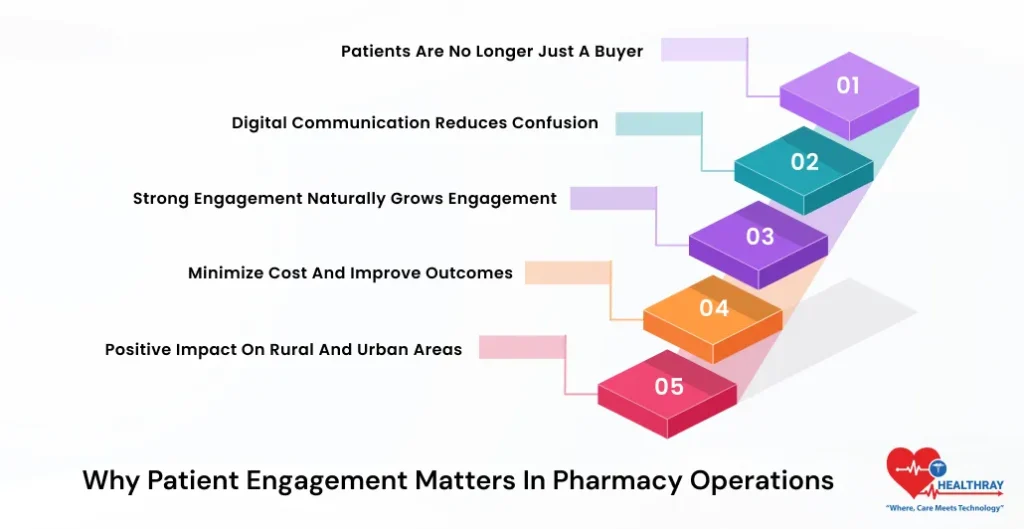
Patients are no longer just a buyer
Nowadays, patient expectation is changing. They no longer stick to the same routine of standing in long queues to buy medicines. Further, patients are now proactively engaged in their journeys. They want deep information about their disease, treatment and medicines. Moreover, patients want to know the medicine type, their duration, its side effects and precaution measures to take during the treatment phase. However, fulfilling patient expectations is no longer a concern for the pharmacy department in 2026. Pharmacy workflow automation software provides proper information to patients about medication, its price, ingredients, allergic symptoms, side effects, and reminders and personalized support. Thus, it makes the entire patient journey more trustworthy and engaged.
Digital Communication Reduces Confusion
Digital communication enhances the clarity between both the patient and the pharmacy owner. Furthermore, sms alerts send refill reminders. The app notification sends them details about intake time and prescription updates. E-prescription completely eliminates the handwritten errors. In the traditional system, doctors write prescriptions with pen. It becomes difficult for patients to precisely understand the instruction. Moreover, pharmacy software allows patients to clearly understand every instruction. This helps patients to take medicines at the proper time. Overall, pharmacy software reduces confusion and makes the treatment cycles more dependable.
Strong Engagement naturally grows Engagement
When patients get timely reports, concise interaction and personalized attention. This automatically connects patients with your services. Further, clinics don’t need to put in some extra initiatives to impress the patients with their services. Patients receive tremendous benefits from strong engagement. They feel comfortable using your services. In the traditional system, pharmacists engage more in paperwork; they don’t have time to understand the medical needs of every patient. Moreover, pharmacy software deeply understands every patient’s needs. And, provide them a convenient way to fulfill all their needs, such as sending refill reminders and providing health tips and delivering fast service.
Minimize Cost and Improve Outcomes
Pharmacy software helps patients to follow their healthcare regimen properly. Furthermore, pharmacy software sends a notification if a patient misses the medication on any particular day. This naturally elevates the outcomes. Better adherence naturally minimizes the risks of complications and emergency visits. Beyond that, patients’ rigorous adherence to their regimen creates a positive impact on healthcare status. Moreover, when patients are capable of curing disease at an early stage, it minimizes the cost of complex treatment in later parts of their life. Pharmacy management services applications boost patient engagement by cutting costs on complex treatment and upgrading the excellence of care.
Positive Impact on Rural and Urban areas
AI-driven pharmacy software is not just limited to big cities. Furthermore, it is a powerful platform for rural areas and small dispensaries as well. Urban area healthcare clinics are taking advantage of fast service and data automation. On the other hand, rural clinics are enhancing their efficiencies through inventory control, digital records and patient reminders. Technology is not restricted to size and location. It provides a powerful platform to all clinics regardless of their scope and geographical location. Thus, pharmacy software helps urban and rural clinics improve care quality by providing convenient options and support for consistent care.
 PRO TIP
Proprietary Framework: The 5E Patient Engagement Model
Healthray’s unique 5E model includes Empower, Educate, Engage, Execute, and Evolve. It allows pharmacists to use the software strategically, with quantifiable progress being made at each stage.
E1: Empower
Its goal is to provide full healthcare control to patients throughout their journey. Nowadays, patients avoid standing in long queues. Due to busy lifestyles, they don’t have sufficient time to visit pharmacy centers. Furthermore, the self-service patient portal allows them to refill the order anytime. Check their prescription. And, track their medical histories conveniently. AI-powered “Refill Mode” thoroughly analyzes their medical symptoms and routines. And designs the prescription as per that. Overall, it minimizes patient waiting time and naturally boosts engagement.
E2: Educate
Its goal is to provide the right information to patients according to their specific health needs. Nowadays patients ignore generic leaflets. Furthermore, AI precisely analyzes the patient’s symptoms, age, season and local habits and prepares healthcare instructions based on that. AI sends the voice text to patients in their preferred languages and provides them precautions that they need to implement as per their medical conditions. Personalized education makes the patient acutely aware. Also, it strengthens the patient’s adherence to their medical care routine.
Learn more: Transform Your Workflow with AI-Integrated Pharmacy Management Software
E3: Engage
Its goal is to keep smooth and continuous communication between the patient and the pharmacy department. Currently, patients are relying on different platforms. Few patients prefer WhatsApp, and few are interested in mobile apps. Some patients are comfortable with voice calls. Omnichannel platforms can conveniently connect all the platforms in a cohesive dashboard. Pharmacists are no longer required to switch platforms to respond to very patient needs. AI can answer simple questions of patients such as dosage, duration, and reason behind side effects, etc. Additionally, it forwards any serious concerns to the pharmacist. Overall, it makes improvements in response, reduces waiting time and avoids unnecessary friction in the routine.
E4: Execute
Its goal is to convert engagement into real actions. This means medicine should reach the patients at the right time without delays and mistakes. Furthermore, a smart delivery system provides fast services in urban areas and also improves access in rural locations. Medication interaction alerts save the patient from the wrong combination. Plus, scanned labels clearly demonstrate the dosing and safety instructions. This minimizes delays. Reduces error in the practices. And patients get exemplary and peaceful experiences.
E5: Evolve
Its main objective is to never let the pharmacy system remain static. AI models continuously analyze patient behaviors and collect feedback to upgrade the system. Through real-time surveys, chatbot reviews and usage data, prescription digitalization software can predict what is working best and what areas still need improvements. Further, AI deeply analyzes these powerful insights and makes the reminders, content and services even more personalized. This constant optimization maintains the patient’s engagement through the journey and makes it stronger and more meaningful over time.
 NOTE
NOTE
Emerging Trends in Patient Engagement Through PMS
In 2026, the pharmacy system will not just be limited to reminders. It will become a completely integrated digital framework. Let’s find out some interesting trends:
Voice AI Expansion
Voice AI Expansion features give patients access to a friendly virtual receptionist. This AI receptionist will automatically handle the routine questions of patients, such as drug accessibility, intake schedule, renewal status and store hours. In traditional hospitals, patients have to wait for hours to resolve their queries. But in modern PMS ,patints no longer have to wait for calls to resolve their queries. AI bots will instantly provide them answers. Therefore, PMS minimizes work pressure on pharmacists. They can emphasize more on complex cases and patient consultation and improve the service quality of the pharmacy operations.
Wearable integration
Wearable integration directly connects pharmacy software with a patient’s daily routine. Further, wearable devices such as smartwatches and Fitbits can easily log patient daily data such as heart rate, sugar levels and activity information and send them reminders in case any statistic is going above a certain threshold. They will also suggest smart nudges to them to keep their lifestyle healthy. Further, if a patient misses any dose, the system will send automatic alerts to patients. This will create strong adherence to medication and overall make the health monitoring accurate and proactive in nature.
Conclusion
Pharmacy software builds a strong connection between patient and pharmacist. And provide immense support to patients as per their needs. It automates routine tasks and saves time for staff. Platforms like Healthray are improving patient engagement through PMS in a measurable way. Clinics that are adopting pharmacy software in 2026 gain a clear competitive advantage.