

In This Blog
All the tools you need to develop a connected clinic strategy that works across every channel – and keeps every patient coming back for care over the long term:
- Which channels to light up – and which to prune before they silently cost you patients
- How to unify patient data across all touchpoints without losing critical context in the middle of your journey
- How consistent messaging builds trust and compliance with patients in every single interaction
- What does journey continuity look like when patients switch channels in the middle of a visit with no warning
- What KPIs show your omnichannel investment is really working across the whole clinic
Most clinics believe they offer an omnichannel patient experience. They do send texts, run portals, and take calls. Yet, when patients book online then change their plans over the phone, there’s a problem. The front desk knows nothing about that online booking, so they see the patient as a stranger. This disconnect matters because no-show rates for patients range from 14% to 50%. These missed appointments cost the healthcare industry close to $150 billion yearly. An actual omnichannel experience depends on just five key choices – no extra tools needed, and not about adding more channels. This guide explains all five steps so you get a solid plan to put into action today.
Decision 1: Channel Activation – Where Does Your Patient Base Actually Live?
Using random communication methods at clinics leads to info gaps, operation issues, and staff burnout. So, when healthcare execs make a plan for omnichannel strategies, they should limit, not increase, communication methods. Having too many channels could cause confusion – more mistakes in handing tasks, repeated record entries, and frustrated patients feeling like they need to start from scratch each time they reach out.
Actionable Framework:
- Evaluate current patient population demographics and determine how they like to be engaged.
- Match each demographic profile to certain top-notch communication tools, but limit them to specific ones.
- Also, for less urgent data, such as clinical check-ins and routine follow-ups, use asynchronous channels.
- Keep synchronous channels for critical admin/billing functions.
- Finally, follow this rule: One channel for in, One channel for out, No exceptions.
 NOTE
NOTE
Software Requirement: When choosing clinic management software, opt for built-in, two-way communication tools rather than separate third-party widgets. Integrated systems ensure seamless data sharing, and a unified dashboard allows admins to monitor all active channels, preventing anything from slipping through the cracks.
Decision 2: Data Unification – How Do You Build One Record Across Every Channel?
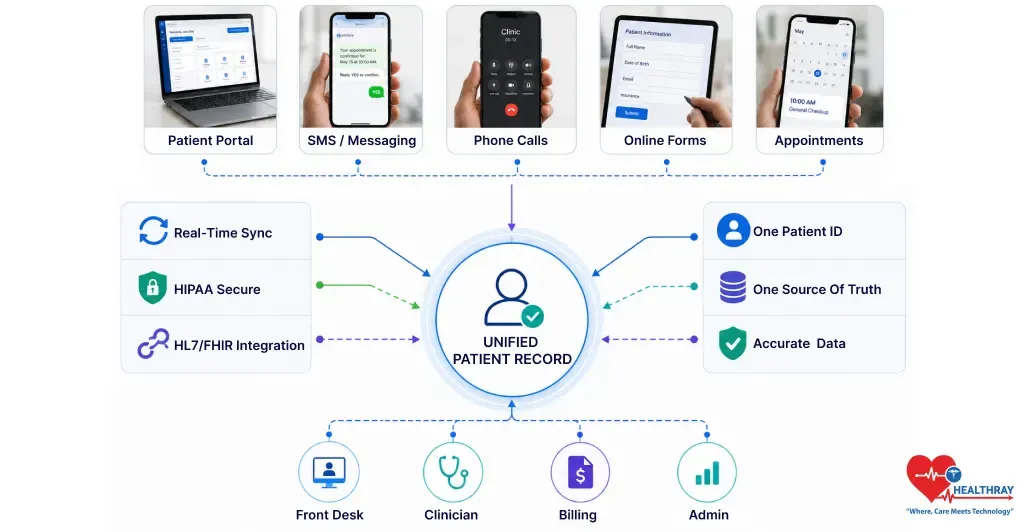
A true omnichannel patient experience breaks down when a phone agent can’t see a patient’s ongoing web chat, or when a receptionist loses progress on forms patients have already filled out. Learning how to unify patient communication across channels is essential: every touchpoint should update a central patient record in real time so no information is lost. Achieving this often requires smooth clinic data migration to merge legacy records with new inputs without losing context. Every staff member, regardless of channel, needs access to the same up-to-date record in real time, ensuring uninterrupted, consistent care.
Actionable Framework:
- Enable real-time synchronization across all digital channels and your EHR system.
- Deploy deterministic identity resolution at all entry points for clean patient data unification.
- Connect patient emails, mobile numbers and logins for the patient portal to a single identifier.
- Configure any data fields that should contain the same values for insurance validation purposes in real time, and log them on all channels.
In 2024, the CMS Interoperability and Prior Authorization Final Rule came out to enhance health info sharing and give patients easy access to records from any provider or payer. A single data system is not only a best practice, but a necessity when it comes to clinics.
 PRO TIP
Software Requirement: For your system to work, it needs to be live and compliant with HIPAA rules using HL7 or FHIR API standards. This ensures everyone across all staff computers stays updated in real time. Any change in patient info should show up instantly everywhere, including updates on insurance validation too.
Decision 3: Message Consistency – How Do You Maintain One Voice Across Every Channel?
Patients don’t trust hospitals when their text messages read more like legalese than personalized communication on their portal. This subtle failure can push them toward alternative providers. Delivering a consistent tone and accurate information across all channels is essential for a successful omnichannel patient experience, ensuring that patients’ trust in the care they receive remains intact. Without this continuity, even quiet distrust can drive them elsewhere.
Actionable Framework:
- Develop a centralized library of pre-approved communication templates managed within the software.
- Create messages into 3 distinct workflow groups: Administrative, Clinical, and Billing.
- Define Access Control on Your Software Dashboard for Each Group.
- Allow staff to personalize messages within approved and compliant guidelines.
| TEMPLATE | WHO CAN EDIT | RISK IF IGNORED |
| Admin | Front desk | Failure to visit, confusion in patients |
| Clinical | Clinical staff only | Hazardous risk, misinterpretation of outcomes |
| Billing | Billing team only | Complaints, legal exposure |
Software Requirement: Global token tools – instant changes to all templates with one phrase change. There’s no need for manual edits and you don’t leave any compliance gaps. A user ID and the time that the edit was made is also recorded with each edit. This way, the compliance team always has a complete audit trail on demand.
Decision 4: Journey Continuity – What Happens When a Patient Switches Channels Mid-Journey?
For true omnichannel performance, a clinic needs to keep patient info consistent through every channel switch. Patients shouldn’t have to repeat themselves or start over from the beginning. While having a presence on multiple platforms is a start, an omnichannel clinic goes further in delivering an omnichannel patient experience. It ensures all platforms share info seamlessly – forms, messages, previous actions – without any loss of context automatically.
Actionable Framework:
- Build cross-channel triggers that fire off partial patient digital actions.
- Automatically send a secure SMS link if the online intake form is not completed within 24 hours.
- Give front-desk staff real-time browser screen-pops on each inbound call.
- Show full digital history to live agents as soon as a patient goes to voice.
Patients expect nothing less than premium-quality digital services. According to a recent ONC study, about 92% of hospitals in the United States currently offer secure messaging between healthcare providers and patients. This means that delivering an effective digital experience is no longer a privilege, but a necessity. The implementation of clinic profitability software allows clinics to identify inefficiencies, improve operational performance, and increase revenue as well.
Software Requirement: Your routing engine must send full session details to the screens of your staff immediately; otherwise, even a minor delay would mess up everything for the customer. It must also allow you to establish rules for triggering specific cross-channel follow-up responses based on the partial completion of certain tasks performed by your patients.
Decision 5: Performance Measurement – Which Metrics Actually Prove Omnichannel ROI?
Clinics that emphasize omnichannel engagement tend to be monitoring the wrong metrics such as open rates, messaging, and number of clicks per channel. However, knowing how much clinic software ROI is generated depends on tracking things like retention, lower no-show rate, and efficiency rather than just the above metrics. Nevertheless, using these metrics alone does not indicate whether or not an omnichannel strategy succeeds. Such an approach leads to an unreliable measurement gap.
Actionable Framework:
Patient Retention Rate (PRR): Monitor how your multi-channel efforts reduce the patient attrition rate to compete with others. An increasing PRR indicates that you have managed to create value through the connected experience and foster loyalty among them, while a decreasing PRR is an indication of some friction in your system.
First-Contact Resolution (FCR): Measure how frequently patient queries are fully resolved in a single contact across all channels. This measure would be low when channel connectivity fails, resulting in patients’ repeat statements – a concern that is easily quantifiable and addressable.
Channel Shift Efficiency: Managing everyday activities such as booking, medication information, and payment issues through more affordable digital channels rather than expensive telephone calls will reduce costs. The more shifts made, the lower the cost per contact, making the return on investment very obvious.
Software Requirement: Choose those systems that will take care of the whole journey of the patient through various communication channels, as opposed to those that only give reports in isolation. Ensure also that the system has capabilities of setting objectives on PRR, FCR, and Channel Shift efficiency. This will ensure that it becomes clear when these objectives are not achieved.
Learn more: HIPAA-Compliant Clinic Software: Why It Matters and What Happens When It Doesn’t and find out how compliance features help clinics avoid risks and improve the patient experience.
Final Verdict: Why Five Decisions Shape the Entire Patient Experience
Miscommunication not only causes frustration but also financial loss. Imagine how often a patient is asked to repeat themselves or complete redundant paperwork because one department doesn’t communicate with another. Each such episode chips away at the trust you worked hard to build. Issues mount quietly without notice.
The five steps – selecting the channels, determining the flow of information, developing the messaging strategy, streamlining the patient experience, and monitoring success – are interrelated parts of a larger process. In other words, every decision influences the next. When the right channels are selected, more valuable information is exchanged. When information flows smoothly, the patient journey becomes easier. And when the experience feels seamless, retention improves and problems get resolved faster.
In practice, this is where platforms like Healthray often come into the picture for clinics, not as an add-on, but as a way to bring communication, records, and workflows into one connected system so these five decisions can work together instead of in isolation.
Therefore, create an omnichannel patient experience that patients actually expect. Since every clinic will be reminding them, the one that stands out is the one that feels like it remembers them.