



Summary
Healthcare runs on trust. Every prescription, diagnosis, and treatment is dependent on the safe movement of information across systems. In India, the vast volume of digital records being handled by the hospitals is such that healthcare data security India is now an everyday operational issue as opposed to a technical afterthought. Cyber risks are only increasing, but patient expectation is increasing at a higher rate.
This blog details how hospitals, clinics, and specialists can keep sensitive data safe without putting care on hold. It is focused on practical systems and real workflows and proven safeguards. In place of fear-driven messaging, clarity, consistency and control are dominant in the discussion.
Introduction
Hospitals all across India are now relying on digital platforms to manage their care delivery. Records no longer reside as inside paper files or locked cabinets. Instead, they pass through networks, devices and cloud environments. As a result, clinical safety and operational confidence are directly affected by healthcare data security India.
A modern Hospital Management System integrates the departments, doctors, labs and billing teams into one digital structure. While this improves coordination, it increases responsibility. Every access point is a possible vulnerability if teams ignore protection. Therefore, hospitals need to make security part of the care, and not an add-on that is technical in nature.
At the same time, doctors want speed. Administrators have a desire for visibility. Patients want privacy. Security must be able to support all three without friction. That balance is the definition of success in the digital era.
Understanding Healthcare Data Security India in New Age Hospitals
Healthcare data security India goes beyond passwords and antivirus tools. It brings into scope how information enters systems; how teams access it; and how long records remain available. Most importantly, it determines who controls data at each stage.
Hospitals deal with personal identifiers, medical histories, insurance information, as well as diagnostic reports. Each part is legally and ethically responsible. Where systems are unstructured, there are gaps. Further those gaps invite cyber threats in Indian healthcare which includes ransomware, unauthorized access.
However, good security is not the enemy of work. On the contrary, with structured controls, one gets rid of confusion. Staff know where data lives. Doctors trust records. Patients feel protected. Security becomes invisible but effective.
What Patient Data Protection Means to Doctors and Hospitals
Patient data protection is the process of ensuring that only authorized professionals have access to sensitive information. Doctors must have the ability to access reliably without risk of exposure. Hospitals need governance, without micromanagement. In balanced systems, both are provided.
Secure access roles determine who can view, edit, or share records. Audit trails are used to record activity automatically. As a result, accountability improves but without confrontation. Over time, this clarity builds up healthcare data security India across departments.
Cyber Threats to the Indian Healthcare and their Real Impact
Cyber threats in Indian healthcare are more due to the reason that hospitals run round the clock. Attackers use the sense of urgency, outdated systems and broken workflows. Phishing emails, ransomware attacks, and insider misuse doesn’t do harm.
Once there is a breach, the cost of recovery goes up. Clinical schedules collapse. Trust erodes. Legal scrutiny intensifies. Therefore, prevention is more important than response. Data breach prevention in hospitals begins with visibility. Leaders must know where and who touches data. Without that knowledge, defenses are still weak.
Beyond the disruption of operation, cyber threats in Indian healthcare causes long-term damage to the reputation. Once the patient data is exposed to the public, the confidence level reduces drastically. Patients are reluctant to divulge information. Doctors question system reliability. Referring partners by reconsidering associations Recovery is much more than technical fixes
Furthermore, the level of regulatory scrutiny is heightened following breaches. Hospitals are audited, penalized and legally obliged. Administrative focus turns from care improvement to compliance defense. This diversion is energy draining for leadership. Growth plans slow. Innovation pauses.
At the same time, healthcare is the target of attackers, because of the high resale value of data. Medical records contain information on identity, insurance and clinical history. Unlike financial information, this information cannot be easily reset. As a result, cyber threats in the Indian healthcare sector require preventative thinking and not reactive patching.
Ultimately, hospitals that view cybersecurity as governance and not IT responsibility are resilient. Prepared organizations limit exposure and respond more quickly and maintain continuity even in the face of pressure.
Data Breach Prevention in Hospitals Starts With Awareness
Teams tend to underestimate everyday risks. Shared passwords, unattended terminals and unsecured devices are entry points. Awareness training fills in these gaps. Awareness also creates accountability. When the staff are aware of the consequences, they are careful in their actions. Simple habits matter. Locking screens. Verifying requests. Reporting anomalies early. Over time, these actions develop a security culture. Technology is supportive of it but people are the ones defending it. Data breach prevention in hospitals is made stronger when vigilance is routine rather than enforced.
 NOTE
NOTE
Secure Electronic Medical Records First Line of Defense
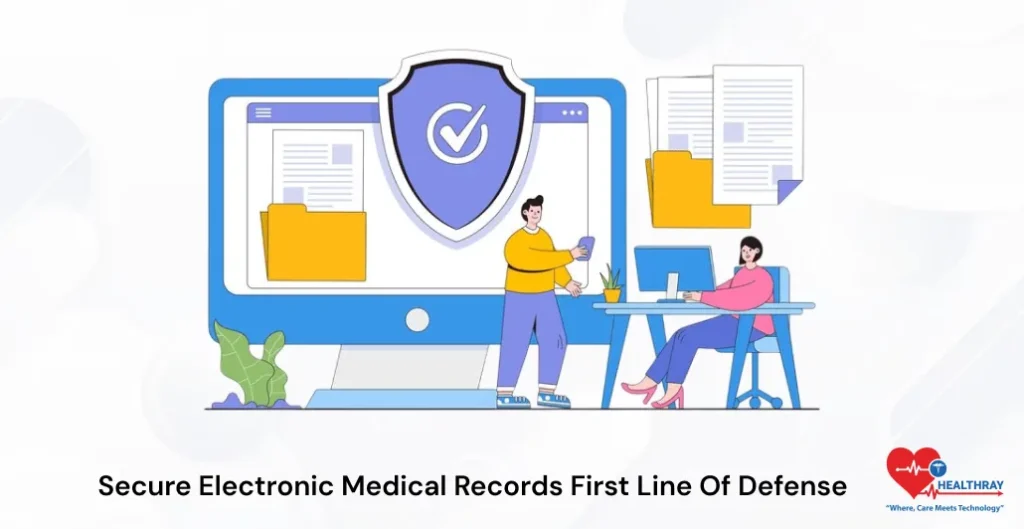
Secure electronic medical records are the foundation of digital healthcare. These records centralize patient histories, while enforcing access controls. Doctors take information out on the spot without violating confidentiality.
An online hospital management system helps this structure by standardizing the movement of records from one department to another. In place of the isolated files, data is synchronized. Errors reduce. Accountability improves. Secure electronic medical records also facilitate compliance. Regulations require traceability and consent. Well-designed systems fulfill these needs and do not slow down workflows.
Secure electronic medical records are the backbone of digital safety in hospitals. When records are kept secure, each downstream process is kept in place. Access controls determine who can see what. Encryption protects data while it is stored and transferred. Audit logs make a clear record of every interaction. These layers interact with each other to prevent silent misuse.
In addition, secure electronic medical records decrease the need for informal workarounds. Staff stop sharing the credentials. Data access is role based, not convenience-based This structure reduces internal risk – often, these are the things that do more damage than outside attacks. Over time, consistent record security helps build compliance readiness and strengthens patient data protection without interfering with the work of the clinical team.
Secure Medical Records for Doctors Without Workflow Interruptions
Doctors demand speed during their consultation. Secure medical records for doctors provide information without having to log in again and again, or verify data manually. All in all, the security handled by smart authentication is silent. As a result, clinicians are concerned with care and not system navigation. Trust grows. Thus, healthcare data security India strengthens on a natural process.
Doctors like to be quick and sure. Secure medical records for doctors have to support both. Single sign on, role-based views, and rapid retrieval help keep the momentum going. Security remains invisible when systems respond on a very fast time scale: As a result, doctors are concerned with decisions, not with accessing data, and hospitals have robust healthcare cybersecurity standards.
Step towards digital era with our healthcare solution
Revamp your hospital facilities and embrace change for better healthcare management. Ease in managing and organizing large medical datasets leads to effective analysis. Seize the opportunity now!
Cloud Security in the Healthcare Sector and the Role of Secure Hospital Softwares
Cloud security in healthcare helps to be flexible without compromising control. Hospitals scale up services, store backups and allow remote access securely. However, protection is architecture, and not location.
Secure hospital software provides encryption of data at rest as well as in transfer. Access permissions; limits exposure. Monitoring tools identify unusual activity at an early stage. Together these elements form resilience. A health care management system that has security first principles ensures that the benefits of the cloud are balanced with compliance requirements.
Cloud adoption is bringing a change in the way hospitals store and access data. That change requires discipline. Cloud security in healthcare relies on controlled access, encrypted transmission and continuous monitoring. Moreover, secure hospital software implements these safeguards automatically. Systems are in place to limit unauthorized entry. Data is protected when it is shared between departments and locations.
In addition, cloud-based platforms increase resilience. Backups remain isolated. Recovery plans stay ready. When there are incidents, the hospitals are able to quickly restore operations. Secure hospital software also standardizes updates so that exposure from outdated systems is reduced. As hospitals are digitally scaling, cloud security is a strategic advantage rather than a risk, as long as governance remains strong.
 PRO TIP
Cybersecurity Risk Management Healthcare Teams Need to Adopt
Cybersecurity Risk Management Healthcare – It requires planning, not panic. Hospitals need to evaluate risks and ownership and review controls on a regular basis. This way, reactive decisions are prevented. Policies define acceptable use. Training is a way to reinforce discipline. Monitoring is the validation of compliance. Within this continuous review process, AI pentesting adds another layer of assurance by proactively uncovering vulnerabilities before they turn into real incidents. Over time the risks decrease and the confidence increases. Healthcare data security India is better when security is considered governance rather than IT overhead by leadership.
Cybersecurity risk management healthcare team needs to think proactively. Waiting for alerts is an indication of failure. Risk assessments: Risk assessments identify weak points at an early stage. Access reviews restrict unnecessary privileges. Incident simulations, often run as a structured breach and attack simulation against realistic attack scenarios, prepare teams for the real scenarios. These actions decrease the panic in the face of real threats.
In addition, collaboration is important. IT teams cannot work alone. Clinical staff, administration, and leadership need to be on the same page. Clear escalation paths to prevent confusion. Documentation is a way of maintaining consistency. Over time, cybersecurity risk management healthcare becomes routine and not reactive. Hospitals with a culture of risk thinking are responding more quickly, recovering more cleanly and protecting patient data protection more effectively.
Healthcare IT Solutions That Support Healthcare Data Security
Healthcare IT solutions bring protection into normal business. They secure the connection between records, labs, billing, and communication. Instead of having separate tools, unified platforms minimize exposure. A patient management system facilitates scheduling, billing and communication security. Access remains role-based. Logs remain complete.
The effects of healthcare IT solutions on security are directly related. Fragmented tools are more gaping. Unified platforms limit exposure. Systems designed for healthcare data security India brings access control, monitoring and compliance reporting under the same roof. This integration provides simplicity in oversight.
Furthermore, healthcare IT solutions are scalable with the growth of hospitals. As the number of patients increases, the controls of security change, without the need to redesign. Doctors access records in a secure manner. Administrators keep it in the loop. The compliance remains identical from one place to another. When technology is an aid to governance rather than a difficulty to be overcome, then healthcare data security India gains strength in a natural and sustainable way.
How Healthray Promotes Healthcare Data Security India
Healthray does not think of security as a checklist of features, but as a responsibility that security operations need to fulfill. Hospitals that use Healthray enjoy clarity thanks to the way the platform incorporates protection into workflows. Every interaction is role, permission and accountability respectful.
Healthray’s safety hospital software provides for data to never float without ownership. Records stay encrypted. Access remains intentional. Activity logs remain visible by administrators. As a result, teams function confidently as opposed to cautiously.
Moreover, Healthray promotes healthcare cybersecurity through technological alignment with hospital realities. Doctors get access fast, without exposure. Administrators keep a check on compliance, without friction. IT teams ensure control without being constantly in control.
Cloud security in healthcare is practical with Healthray due to structured protocols for systems. Backups remain protected. Disaster recovery plans remain tested Data continuity facilitates continuous care.
Most importantly, Healthray makes the healthcare data security India strong by making security routine. Teams follow processes by nature. Systems guide behavior. Trust develops silently over time. mature healthcare organizations, structured governance including dedicated compliance leadership roles, often reflected in benchmarks like data protection officer salary, strengthens accountability and oversight.
Conclusion
Digital healthcare delivers speed, scale and efficiency. However, without some protection, these same strengths become risks. Healthcare data security India now determines how hospitals earn trust in the digital era.
Security never requires complexity. It requires intention, alignment, and reliable systems. Hospitals that invest in secure electronic medical records, structured access, and cybersecurity risk management healthcare frameworks are protecting more than just data. They protect relationships.
Doctors can work confidently when records are kept secure. Patients feel secure when their privacy is respected. Administrators are calm leaders when systems are resilient.
If continuity, clarity and trust are important to your hospital, then now is the time to build on security foundations. Choose platforms that secure care without slowing it down.
Because in healthcare, trust never gets back easily when it is lost.