


In This Blog
Clinics don’t struggle with emergencies because they lack doctors – they struggle because their scheduling systems don’t reserve capacity for unexpected demand.
- This is where online slot booking for clinics changes the equation by building emergency-ready structure into daily scheduling itself.
- Why booking appointments online for physicians makes additional time available that even most clinic managers are unaware of.
- Understanding the staffing issue, and why technology is the only true solution.
- Why does your scheduling system tell you what patients are coming next before they arrive?
- What does “clinical resilience” really mean on a chaotic Tuesday morning?
The 10:40 Am Stress Test: Why Manual Systems Fail Under Pressure
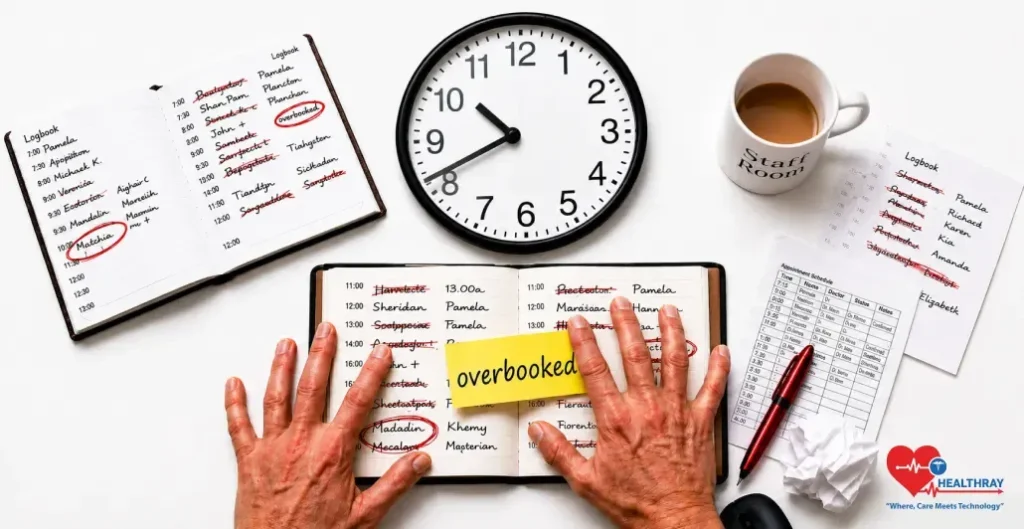
At 10:40 AM, the clinic is already behind schedule. Consultations are delayed, phones are ringing nonstop, and rooms are fully assigned. Now a patient arrives with chest pain. The question is no longer medical – it is operational: can the clinic create immediate capacity within its schedule or not? This is where things can go either way depending on your scheduling process.
Under the manual scheduling system, the problem becomes even worse because at a time when the receptionist is struggling to schedule new appointments, re-schedule cancellations, and deal with the insurance questions, the task of finding a doctor and an open room will be a difficult one.
What most clinic managers overlook when implementing manual clinics is the need to overbook in anticipation of patients not turning up. The logic here is quite sound. Using a well-designed doctor appointment system can help prevent this chaos by making schedules clear and accessible in real-time. However, this leaves no margin for error when an actual emergency walks through the door. Every second your clinic’s receptionist is too busy making calls is another second that she fails to notice the blood draining from her patient’s face.
This issue is not about understaffing; it is purely a system design problem, which is why scheduling architecture in clinics needs serious reconsideration.
How Online Slot Booking For Clinics Creates A Reliable Safety Buffer
Modern digital scheduling is more than a convenience – it’s a real asset. A well-structured system allows clinics to adapt quickly to emergencies without disrupting workflow. The table below compares both scheduling methods during emergencies.
| SCENARIO | MANUAL SCHEDULING | ONLINE SLOT BOOKING |
| Emergency Arrival | Staff manually finds gaps, calls doctors, reshuffles | Emergency slot assigned in under 30 seconds |
| Crisis Intake | Paper forms filled under pressure | Digital intake pre-submitted with patient context |
| Notifying Delay | Individual calls to patients | Single SMS sent to all affected patients |
| Clinician Availability | Verbal coordination across clinic | Real-time dashboard shows workload |
| Traffic Forecasting | Guesswork based on experience | Data-driven prediction of peak hours |
Hidden Emergency Slots: The scheduling system enables clinic management to allocate time slots that remain hidden from the online booking system. Understanding doctor appointment automation is also important for clinics when planning such advanced scheduling capabilities. Reception staff keep these slots hidden from patients and quickly assign them during emergencies.
Proactive Gap Management: Your booking history reveals important patterns over time. For example, you know that between two to three patients cancel their appointments on Tuesday at 11 AM, and also that fewer appointments usually take place in the afternoon on Fridays. With such information, you can plan ahead and leave these gaps open for emergencies.
Controlled Patient Flow: When routine visits are spread out over the course of the day, there will be less noise and fewer people in the waiting room – and one in which your employees can spot if anyone seems sick, rather than juggling standing patients while answering phone calls.
 NOTE
NOTE
Helping Staff Prioritize Emergencies Instead Of Phone Calls
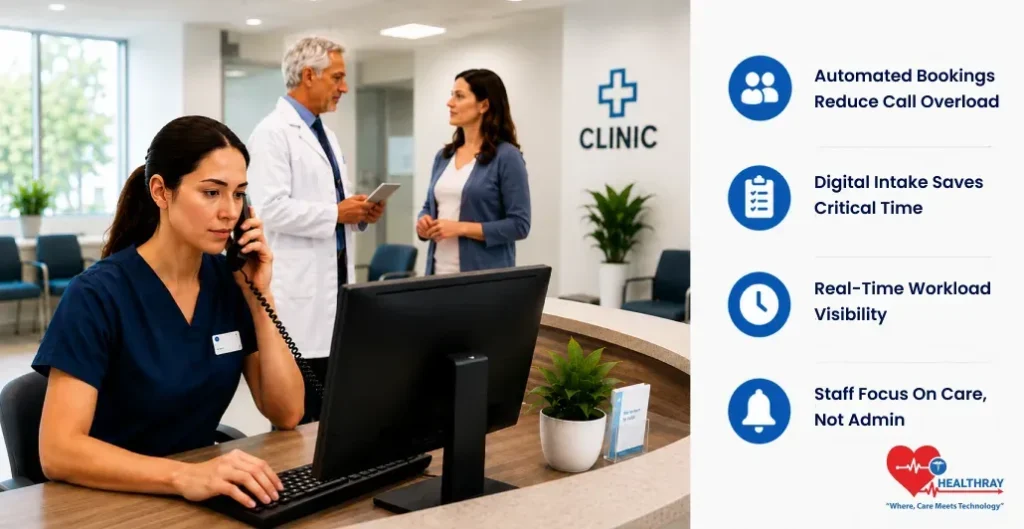
In times of crises, the issue is not only whether there is a slot available but also whether there is someone capable of managing the situation.
In clinics that operate with manual appointment scheduling systems, the reception area is always occupied – talking on the telephone, flipping through appointment books, and trying to figure out which physician can take a slot between 11:15 and 11:45. With a doctor consultation booking system, this entire process becomes automated and much faster during emergencies.
According to the PSNet primer on ambulatory care safety published by the Agency for Healthcare Research and Quality, two of the main reasons for a missed or delayed diagnosis are care fragmentation and delayed access to information. Researchers estimate that about 5% of US adults experience a missed or delayed diagnosis each year, often due to delayed access to information. This happens when overwhelmed front desk staff manage manual phone bookings while urgent cases wait at the counter.
That makes all the difference in the world. When the patient has provided their symptoms, medical history, allergens, and insurance information online prior to visiting the office, the physician isn’t waiting for any paperwork. They are reviewing the medical record prior to even seeing the patient. In a case of heart attack or asthma, those extra few minutes are not just useful; they’re vital.
With online slot booking for clinics, patients book appointments automatically, so there’s no need for manual calls, confirmations, or cancellation texts, which also reduces no-shows. Front-desk staff can shift from administrators to clinical coordinators, focusing on monitoring and responding to needs. A clear view of each physician’s workload also allows quick and seamless patient redistribution with a single click.
Keeping Your Doctors Focused And Clearing Their Mental Headspace
But there’s one downside of manual scheduling which remains quiet and underreported: The toll it takes on a doctor’s cognitive energy before the emergency even hits.
The physician who walks into their office on a day where they have a poorly planned, manually scheduled, double booked schedule has their disadvantages well set from the get-go. They are aware that the afternoon is overcrowded. They are aware that the waiting room is impatiently waiting. And they are aware that, with any little issue arising that day, everything will fall apart.
This condition, known as “lobby guilt,” is the low-grade stress associated with the knowledge that there are 20 people lined up outside your door, and every single appointment will be under pressure. This leads to poor diagnoses, decision fatigue, and the inability to take the time needed in analyzing a complex or difficult case.
When online slot booking for clinics handles regular appointments, it keeps the schedule organized and predictable. The doctor is prepared for what to expect and can focus fully on care delivery. When a crisis hits, an automated group message – such as a simple SMS broadcast to all patients about a delay – helps prevent the formation of a patient backlog. There is no angry crowd in the lobby and no cascade of complaints at the reception desk.
 PRO TIP
Using Your Booking Data To Stay Ready For The Next Patient Surge
Reactive treatment tends to be the standard operating procedure for clinics. Problems arise, and you solve them. Top clinics don’t just react to booking trends – they use them to predict problems in advance. As a result, these clinics are not just surviving but thriving thanks to this foresight.
Every booking made through healthcare appointment software creates a trail of information, which helps clinics identify patterns and prepare for future patient surges. Within days and months, clear trends emerge in your clinic data. You identify hours with emergency spikes and days with frequent no-shows. You also spot periods of low demand where you can add scheduling flexibility.
Learn more: Key Advantages of Cloud-based Doctor Booking System Over Traditional Systems, including real-time accessibility, faster scheduling updates, and improved emergency coordination for modern clinics.
According to the Centers for Disease Control and Prevention’s (CDC) National Center for Health Statistics data brief regarding the features of office-based physician visits, chronic diseases make up 39% of all office-based physician visits. In other words, out of every ten patients who visit your clinic, almost four will come back in a predictable manner. They come back periodically. Their patterns can be monitored. You can program your scheduling software accordingly before the rush.
Turning Booking Data Into Predictive Clinic Operations
With visibility into who is swamped and who isn’t, there’s no more guesswork involved – it’s a matter of knowledge. For example, even patients searching for care options like how to find a therapist in Seattle increasingly rely on digital healthcare systems that provide real-time transparency in availability and scheduling. This shift in perspective helps you plan staffing, prepare for flu season, and leave room for unexpected patients.
Readiness is more important than occupancy. Instead of focusing only on filling all slots, clinic managers should measure how well the clinic handles emergencies when they arise. Planning for 85% occupancy with 15% emergency capacity ensures that urgent cases don’t disrupt the entire day. To see this in action, explore our scheduling system’s emergency capacity features.
To Sum Up: Emergency-Ready Clinics Start With Better Scheduling
Emergencies will not reveal the activity levels of a medical clinic – emergencies reveal how prepared a clinic truly is. Online slot booking for clinics helps ensure that clinics remain ready because schedules are organized in advance of any emergency situation.
The presence of hidden emergency slots, digital intake forms, automatic delay notifications, and visible scheduling enable clinicians to make immediate adjustments to their schedules without disrupting the whole system. Rather than scrambling to adjust their already full schedules, they can focus entirely on the individual needing immediate attention.
With clinics receiving a large number of patients for both emergencies and routine visits, scheduling becomes one of the critical components of their safety framework. Clinics with efficient handling of emergency patients are not necessarily the most active clinics. They are the ones whose processes function smoothly under stress.