



Brief Summary
PACS-RIS integration quietly and effectively transforms radiology workflow. When images, patient data and reports work in the same flow, it naturally reduces unnecessary delays and manual errors. Radiologists get images along with clinical context. This makes the reporting fast and consistent. In high-volume diagnostic centers, PACS-RIS integration is a strong foundation of efficiency, clarity and reliability. In this blog, I will discuss how PACS-RIS Integration enhances diagnostic efficacy and how radiologists can put their focus on accurate interpretation and timely diagnosis. Let’s begin!!!
Introduction
In the diagnostic centers, PACS and RIS run concurrently, but they are incomplete until they are combined. In a modern diagnostic environment, efficacy depends upon a silent coordination. PACS-RIS integration is critical for effective coordination. It does not have any unnecessary complexity. When PACS or RIS work differently, the operation becomes extremely slow. Radiologists spend their valuable time searching images, verifying patient details and handling unavoidable interruptions.
PACS-RIS integration naturally closes these gaps. From patient registration to image acquisition and reporting, every step is digitally connected. Images automatically get aligned with patient data or clinical history. This helps radiologists review studies with full context. For high-volume diagnostic centers, PACS-RIS integration is not an optional feature; it is an indispensable requirement. It removes unnecessary integration steps from the workflow to make it simple, reliable and efficient. Keep reading this blog to know more about PACS-RIS integration and how it is helpful to simplify your daily operations. Also read our blog role of RIS in hospitals to gain practical insights.
Demystifying PACS and RIS Foundations
PACS: The Digital Image Vault
PACS captures, stores, and shares high-resolution images from various modalities, including CT, MRI, and X-ray. Furthermore, DICOM standards ensure image quality remains intact. Hanging protocols allow doctors to compare multiple views. Also, this is essential for accurate diagnosis.
RIS: Workflow Command Center
Radiology information systems manage the entire workflow from patient intake to billing. Furthermore, it keeps the exam protocols, inventory tracking and analytics at a single dashboard. Also, it creates a peaceful environment, as there is no confusion in the practices. All data are visible and circulated following proper rules and guidelines. Modality worklists load the patient data beforehand, minimizing the chances of errors.
The Silo Trap Exposed
When PACS and RIS work independently, then the problem automatically starts. Additionally, radiologists encounter challenges when searching for previous images, double-booking appointments, and facing compliance issues that pose risks. Are you still facing challenges in 2026? It’s now the right time to upgrade the old software. The traditional system will no longer help you serve the heavy responsibilities. Further, manual coordination wastes considerable time and puts extra pressure on staff. Why endure more? PACS-RIS integration breaks the silos, synchronizes the data in real time and makes the overall operations smooth, fast and error-free.
Boosting Diagnostic Speed and Precision
Let’s dive in:
Expedites Real-Time Workflow
When PACS and RIS are properly united, then workflows become fast naturally. From order entry to final report, it takes few minutes to complete. It is more highly effective than the traditional system, where work seems laborious and is more prone to errors. Further, RIS technicians confirm the acquisition instantly. Also, radiologists get instant alerts for urgent cases like ER trauma. Delays are over!
Prioritize Critical Cases; No More Confusion
It is highly imperative for hospitals to prioritize critical cases. As delay makes the complex case more severe. Furthermore, the cloud radiology information system automatically highlights urgent cases, allowing radiologists to focus on essential concerns. No more missing priorities!
Smart Image Interpretation through AI
Modern PACS-RIS systems embed AI that helps radiologists detect anomalies. Further, it flags suspicious areas and PACS views are readily available. Moreover, oncology and cardiology scans do not lack any subtle findings.
Better Clinical Decisions, Less Ambiguity
AI not only sends alerts but also delivers clinical context. Plus, prior images, comparison views and trends are available in just a single click. Hence. Diagnosis becomes more confident and accurate!!
Clear Cut Reduction in Turnaround Time.
Reporting speed improves as manual handoff minimizes. Further, RIS helps radiologists deliver faster reports and expedites the treatment. Overall, it makes the patient satisfaction level high and reduces the stress of doctors from the daily bustle.
Numbers that Demonstrate Performance
Industry benchmarks reveal that integrated PACS-RIS setups help hospitals achieve 25–40% faster TAT. Further, it enhances patient throughput and sharply reduces outpatient imaging centers’ backlog. Still depleted with the traditional system? It’s time to revamp your system!!!
 PRO TIP
Cost Savings and Strong ROI
Let’s check out:
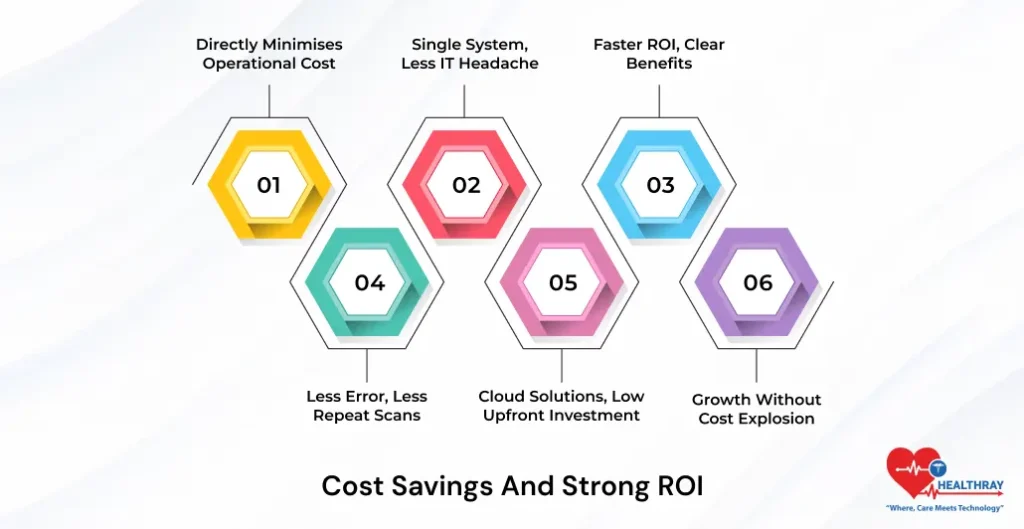
Directly Minimises Operational Cost
PACS-RIS integration minimizes the need for film or physical storage. Furthermore, it reduces redundant exams, helps them supervise the daily operation and keeps costs in control. Moreover, in the traditional system, hospitals don’t have the ability in their hands to run the system. Fortunately, modern RIS gives them the flexibility to cut down operational costs wherever necessary. You no longer need to spend more!!
Single System, Less IT Headache
It is highly expensive to maintain different systems. Agree? Furthermore, integrated setup allows single-system maintenance, thereby significantly reducing IT overhead. Simple systems, smart savings!
Faster ROI, Clear Benefits
Efficiency gains are so strong that clinics and hospitals can discover ROI in usually 12–18 months.
Less Error, Less Repeat Scans
Without integration, there is a 10–15% chance of needless repeat scans. Further, PACS-RIS reduces synchronization errors and saves from recurring costs. Overall, it saves time and money and helps radiology build an innovative way of life.
Cloud Solutions, Low Upfront Investment
Scalable cloud-based PACS-RIS eliminates heavy hardware costs. Furthermore, the system can gradually grow even without investing in heavy hardware expenditures. Easy, flexible and future-ready!
Growth Without Cost Explosion
As patient volume increases, expenses do not spike proportionally. Furthermore, smart scalability represents smooth growth, controlled cost and better long-term returns.
 NOTE
NOTE
Patient-Centric Improvements
Let’s check out:
Shorter Waiting Time, Better Patient Experience
PACS-RIS integration makes the scheduling smart. As the doctors and machines become available, the system automatically allocates slots. Furthermore, this minimizes the no-shows to around 15%. Further, patients get reports and results instantly on the portal. They no longer need to visit hospitals to collect reports. Therefore, it minimizes waiting stress to a great level. Also, know more about RIS trends prevailing in 2026.
Smooth Appointment Management
Automated reminders and smart scheduling simplify patient coordination. Consequently, it minimizes confusion and organizes the visit more effectively. Thus, fostering a higher level of satisfaction among staff and patients.
Data Safety Builds Trust
Full audit trails track every access and ensure HIPAA-compliant workflows. Furthermore, it minimizes errors and the risks of misdiagnosis. A key component in encouraging patients to stick with your services should be trust. Indeed!!!
Accurate Reports, Better Clinical Confidence
Integrated data signifies correct patient info, correct images, and correct assessments. Furthermore, when data is clean, the diagnosis process naturally becomes reliable.
Game-Changer for Remote Care, Rural Clinics
Cloud-based PACS-RIS allows mobile reporting; this is perfect for telemedicine, especially for rural area clinics, where accessibility is still a major concern. With RIS, distance is no longer a barrier. It is helpful for rural patients to consult with doctors online, eliminating the need to travel miles.
Faster Patient Triage With Voice AI
Voice AI receptionists can efficiently handle initial queries and triage. Further, this helps staff minimize unnecessary loads and get quick guidance. It is a highly effective feature of smart care that eliminates the need for handling multiple calls on a daily basis. Moreover, AI can efficiently manage all the queries of patients with proper and acceptable responses.
Step towards digital era with our healthcare solution
Revamp your hospital facilities and embrace change for better healthcare management. Ease in managing and organizing large medical datasets leads to effective analysis. Seize the opportunity now!
Blueprint for Flawless Rollout
Let’s find out:
Gap Analysis Deep Dive
Deeply analyze the existing workflows and identify bottlenecks through heatmaps. Firstly, understand the problem and then check the proper solution to cope with it. No need to rely on guesswork; think practically and execute the system flow accordingly.
Smart RFP Evaluation
Don’t make decisions just on the basis of RFP evaluation. Also, underscore uptime, scalability and extensibility-like factors. It is important to choose a future-ready system.
Minimise Risks with Sandbox Testing
Stimulate peak load sandbox testing before making it live. Furthermore, by testing real-world pressure, this will help you determine performance beforehand. Thus, helping radiologists avoid ambiguity in the later part, as they are aware of system performance and how to deal with it in the future if any issue arises.
Hypercare Phase, Zero Downtime Focus
24/7 support is critical for initial rollout. Further, the hypercare phase immediately resolves the issues and helps teams raise their confidence level. Smooth starts matter!
Continuous Improvement Process
Continuously optimize the workflow with AI-driven insights. Further, don’t just think of running the system; also make efforts to evolve it. This is the secret of long-term success.
Build Role-Based Dashboards
Every profession has different roles in the system. Definitely the data needed is also different. Technicians need data of queues, and radiologists need data of relevant prior studies. When information reaches the right person at the right time, naturally it improves focus and speeds up the practices. Confusion automatically disappears!!
Conclusion
PACS–RIS integration is a strategic necessity for clinics that are highly concerned about speed, accuracy and patient experience. Clinically, integration represents faster turnaround times, less errors and easy access to prior studies. Overall, PACS–RIS integration provides a smooth, end-to-end diagnostic pipeline that simplifies the work of clinicians, admins and patients.