



Summary
Radiology information systems will subtly alter clinic operations in 2026 without making any noise, but they will have a significant impact. RIS Trends 2026 will go beyond scheduling and reporting. It will predict bottlenecks, guide clinicians and convert scattered data into meaningful actions. As imaging volume rises and expectations become strict, weak workflows will begin feeling pressure. Modern cloud radiology information systems will address these pain points through AI-assisted intelligence, seamless integrations, and patient-centric orchestration. In this blog, I will discuss some top RIS trends 2026 that will help hospitals cope with stressful scenarios and also help them to become leaders. Keep reading!!
Introduction
Have you ever wondered why the radiology department encounters challenges with delay? Imaging order arrives at time but report generation takes a huge amount of time. Patients keep on waiting; doctors mostly indulge in follow-ups, and the radiology team is entangled in spreadsheets, phone calls, or multiple systems. The problem is not about imaging; it’s about workflow. 2026 is not just another year for radiology. It’s a turning point. Now the real question is, “Is your radiology information system capable of handling such pressure?”
Nowadays, radiology departments are struggling with scheduling delays, fragmented workflows, repeat data entry, and report turnaround time. AI tools are arriving in the market but still integration is weak. Clinics are adopting cloud platforms but still having doubts with data security. Patients want quick reports, doctors want clarity, and administrators want scalability. Do you think this is possible with a traditional system? Absolutely not!!! Here is the beginning of RIS trends. In the coming years, RIS will not only handle workflow, but it will also embed intelligence in the system. AI-native, intelligent queues, actionable reports, and coordinated patient journeys are all on the horizon. Radiology will cease to be a reactionary system; it shall become more predictive. This shall permit physicians to preemptively understand certain scenarios in a judicious manner, allowing appropriate steps toward timely actions. Let’s check out some interesting RIS trends 2026.
RIS Trends 2026: AI-Powered Workflow Automation
Radiology department is a common pain point. Furthermore, clinics must identify urgent cases on time, generate routine reports, and avoid missing any subtleties in the system. When workload increases, then the entire focus shifts to interpretation rather than process. Now the question is: Can AI reduce this pressure? AI-powered radiology software is a highly effective tool to handle such stressful situations. Let’s find out how AI can resolve radiologist problems:
Focusing on Urgent Case
The biggest stress of the radiology department is identifying case priorities. Further, radiologists often get confused about how to prioritize complex cases and what the best way is to provide patients fast and effective treatment. The AI co-pilot instantly flags the urgent cases, helping radiologists not to neglect any critical case lines. Also, accuracy becomes better. With radiology information software, hospitals can easily achieve 90% accuracy in their workflows. Overall, it minimizes the mental load of the radiologist. When noise becomes less, then focus will naturally shift to diagnosis.
Smart Reporting & Reduced Friction
Traditional reporting requires heavy manual efforts for creating templates, performing comparison and prior studies. Don’t you think this is time-consuming? Generative AI models and visual language tools help radiologists to execute their operations smoothly. Further, it minimizes friction, reduces the number of clicks and makes the reporting fast and consistent. Result: Faster TAT and better confidence.
Agentic AI & Privacy-First Learning
Handing over the protocoling and prior studies is still the biggest challenge. What happens if this work is completed automatically? Further, Agentic AI automatically manages protocols and priors without losing clinical context. Plus, it learns federated learning from multiple sites without sharing data.
Precision Imaging: Ahead of Diagnosis
AI work is limited to imaging, but it is also adept at identifying future risks. With AI platforms, you can predict cardio risks with routine scans. Further, Precision imaging tools extract risk scores from mammograms like routine scans. It can easily predict cardio event outcomes, which is not possible with traditional systems. It makes the diagnosis predictable to help radiology with early symptoms and guide the patients accordingly.
 PRO TIP
RIS Trends 2026: VR/AR for Advanced Visualization
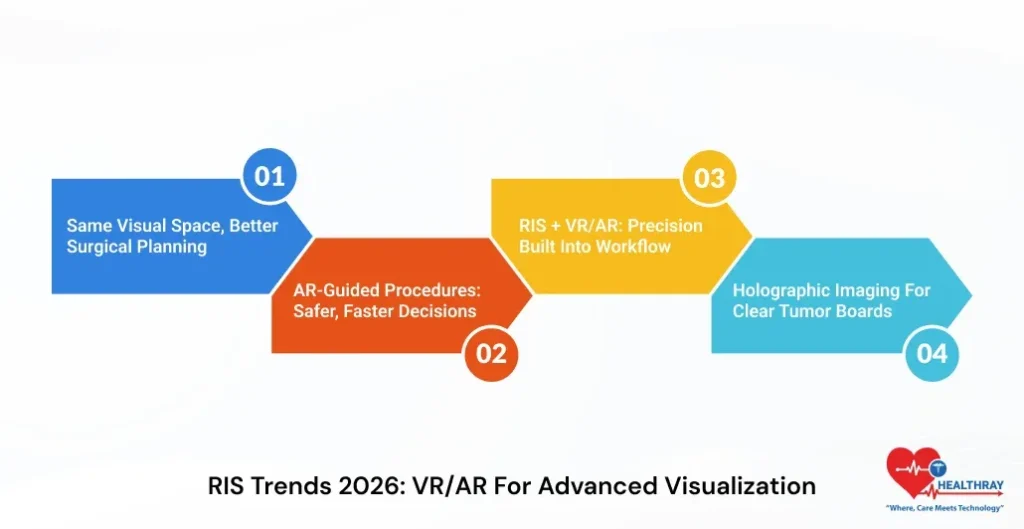
It is difficult for clinics to understand complex anatomy on traditional 2d screens. Also, it makes the surgical planning perplexing and difficult as well. Do you feel depth in flat images? It is not possible with the traditional system. Here VR radiology plays a strong role and helps you take practices to the next level! Let’s check out:
Same Visual Space, Better Surgical Planning
VR provides a real feel through immersive 3D models. Further, radiologists can visualize depth and understand the anomalies more accurately. Further, Digital radiology workflow software helps radiologists or surgeons plan virtual space. Thus, it minimizes confusion, provides more clarity and helps them make more precise decisions.
AR-Guided Procedures: Safer, Faster Decisions
Imaging anatomy during a live procedure is highly risky. However, with a cloud radiology information system, you can directly view the anatomy. Further, AR guides biopsies and interventions through real-time visual overlays. Thus, it minimizes radiation exposure, reduces procedure time and enhances accuracy. Also, it improves patient safety and provides better ways for radiology to keep the patient information in its entirety. Win-Win situation!
RIS + VR/AR: Precision Built Into Workflow
When visualization tools are available in different departments, this will break the workflows. Right? Modern RIS directly embed VR/AR such as interactive annotations, real-time edits, and oncology ablations, along with enhanced precision. Everything in the same workflow without the need for context switching!!!
Holographic Imaging for Clear Tumor Boards
Tumor boards practically come with misunderstanding risks. Different views, different interpretations!. Further, Holographic displays CT or MRI data in a unified 3d view. This facilitates clear communication between radiologists, improves alignment, and solidifies treatment decisions. Overall, VR/AR visualization provides an incredible experience to radiology and helps them thoroughly analyze the problems to take future action successfully.
 NOTE
NOTE
RIS Trends 2026: Quantum Computing Integration
Noise and low resolution are the biggest challenges of MRI and CT reconstruction. Is it possible to get images without compromising quality? In the traditional system, it is practically impossible to maintain quality at every step. However, with RIS, radiologists can maintain quality even if the scenarios are challenging. Quantum algorithms accelerate the reconstruction, minimises noise and increase clarity in the system, even with limited resources.
Faster Processing, Less Radiation Risk
If the complex imaging data process is dragging on, this will naturally boost patient wait times. What about radiation safety??. Further, quantum machine learning is adept at handling large datasets. This enhances the possibilities of sensing and naturally minimizes radiation exposure.
Hybrid Quantum Workflows: More Accuracy in Radiomics
Radiomics predictions are highly effective when they demonstrate high accuracy. Further, the combination of Quantum and classical systems works incredibly well. It enables early fault-tolerant QPUs hybrid workflow; this makes the outcome prediction exceedingly favorable and precise.
RIS With Quantum Cloud: Get Ready for 2026
Technology becomes more powerful when it conjugates with workflow. That’s the reason RIS platforms are adopting quantum cloud access for denoising, simulation and advanced analytics. In the coming years, quantum-enabled RIS will become a strong differentiator.
Step towards digital era with our healthcare solution
Revamp your hospital facilities and embrace change for better healthcare management. Ease in managing and organizing large medical datasets leads to effective analysis. Seize the opportunity now!
RIS Trends 2026: 5G & Edge Computing Advances
The biggest problem in Teleradiology is latency; if there is a delay in the imaging process, ultimately decision-making takes significant time. In emergency situations, there are no wait options. Right?. 5G sub ensures 100 ms latency, whereas RIS smoothly handles a 4K imaging feed. Plus, edge computing nodes perform on-site preprocessing of scans, ensuring fast, secure and standardized data.
Boost in Rural Coverage and Ambulance Connectivity
Remote areas highly face challenges with connectivity. What happens if the signal abruptly stops while the ambulance is in motion? How will you tackle this situation? Reconfigurable Intelligent Surfaces (RIS tech overlap) can extend network coverage, especially for rural ambulances. You no longer need to worry about location. With RIS, you can easily transmit imaging data without any disruption.
Faster Stroke Decisions with MEC
Every second matters in cases like stroke. With RIS, clinics can keep the patient data ready prior to treatment. Furthermore, Multi-access Edge Computing (MEC) integrates ambulance data and accumulates stroke data in advance. This helps radiologists maintain QoS even in dead zones and helps them make life-saving decisions more quickly. 5G and edge computing make radiology location independent, real-time, and emergency-ready.
RIS Trends 2026: Sustainability & Green RIS
These days, radiologists are shifting their focus to sustainability and accuracy. High-energy machines and radiation Do they provide a greener option??. Further, Eco-friendly scanners like photon-counting significantly reduce CT radiation dose and helium-free MRI systems reduce dependency on rare resources. Result? Safer scans and responsible imaging!
Green Cloud & AI Efficiency: Less Energy, More Impact
As we know, data storage and processing energy are intensive. What if the cloud gets more intelligent? Green cloud infrastructure, through AI-driven optimization, minimizes energy consumption by up to 40%.
Low-Power Edge & Greener Teleradiology
Carbon footprint of remote imaging often gets neglected. Further, low-power edge computing minimizes energy consumption in teleradiology workflow, reduces carbon emissions, and supports sustainable remote care. In general, Green RIS is becoming a foundation of future-ready and ecologically conscious radiology. Also, read our blog role of RIS in hospitals to know more about its benefits.
Conclusion
Radiology information systems are not just limited to scheduling and reporting. It has become an intelligent, interoperable command center. It connects AI, cloud, PACS, EHRs and advanced visualization tools to make the data flow smooth and organized. Only imaging departments that view RIS as a strategic asset rather than just software will take the lead in the upcoming years.
I hope the blog above, RIS trends 2026, gives you some useful information. If you have any questions, please get in touch with our Healthray team.