


Summary
The quality of scans or turnaround time is no longer the sole aspect of competition between radiology departments. Rather, they compete on patient pre-imaging, in-imaging and post-imagining feelings. Late attendance, nervous patients and lack of follow-ups quietly erode revenue and trust.
The Radiology CRM system alters that dynamic. It changes the way patients react by making phone calls to demanding, computerized and human interaction. More to the point, it contributes to the minimization of no-shows, better workflows, and constant patient experiences.
This blog describes how radiology CRM systems enhance engagement, where this system fits with radiology information system software, and why patient-first communication is the new definition of modern imaging care.
Introduction
Radiology has gone into a value-based era. Hospitals and clinics are no longer that successful in terms of the scan volume. In its place, leadership measures experience, efficiency and continuity of care.
However, this does not remove confusion to patients. Instructional instructions are late. Reminders of appointments are generic. Follow-ups fall through the cracks. Over time, this gap leads to no-shows, repeat calls, and frustration on both sides.
That is where the radiology CRM system comes in. It is an engagement layer over the RIS system, PACS and scheduling tools. Instead of storing information it triggers communication.
To connect engagement with outcomes, many organizations start by reviewing performance through a RIS ROI calculator, which highlights where missed appointments and communication gaps impact revenue.
In simple terms, a radiology CRM system transforms patient touchpoints into a structured journey instead of scattered interactions.
Understanding a Radiology CRM System Beyond the RIS
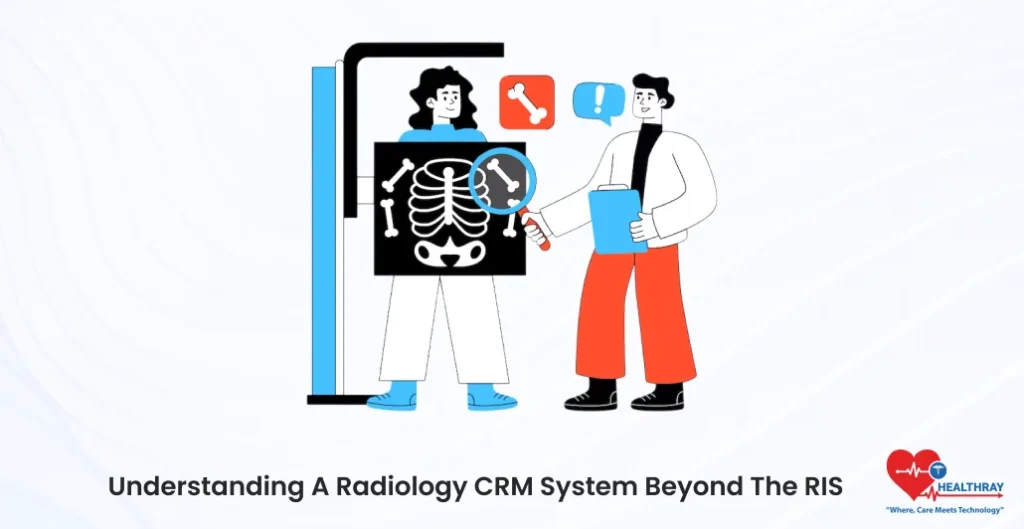
There is already a radiology department that is operating on a solid clinical basis. Radiology information system software deals with orders, schedules and reports. RIS PACS systems archive and send images. Nonetheless, both of them do not dwell on the experience of the patients.
“A radiology CRM system bridges that gap.”
The radiology-based CRM focuses on patient interactions, unlike a more traditional system of CRM employed to make sales or referrals to a healthcare facility. It deals with reminders, messages, follow-ups, and feedback without being very far apart with the radiology information system PACS environment.
Think of it this way. The RIS system is aware of what occurs clinically. The CRM will determine the hearing method and timing of the patients.
Due to the functions of CRM systems that facilitate outreach, staff does not have to use so much time to seek confirmations. Radiology workflow optimization, therefore, enhances without the inclusion of headcount.
Why Patient Engagement Breaks Down in Radiology
Radiology has short but regular contacts with patients. An unusual challenge arises out of that brief exchange.
Before imaging, patients become anxious. Instructions confuse them. There is indeterminateness of results timelines. In the event of failure of communication, there is escalation of no-shows.
Several factors drive this breakdown:
- Separated tools in RIS system and front-desk communication.
- Staff varying manual reminder processes.
- Poor accessibility to patient journey mapping.
This leads to teams responding rather than averting issues.
A radiology CRM system addresses this by standardizing patient communication strategies. Each reminder, update and follow up is not based on a memory, but logic.
 NOTE
NOTE
Key CRM System Functions That Strengthen Patient Engagement
A cloud radiology information system works because it focuses on action, not storage. Although functions of CRM systems differ, a number of capabilities are most important in imaging workflows.
Automated and Personalized Communication
Reminders that are generic are no longer effective. Patients respond when messages feel relevant.
A radiology CRM system enables automated communication for radiology appointments using patient-specific data. Messages consist of pre preps, type of modality, and the direction of arrival.
Consequently, the number of patients who miss appointments decreases and the level of trust increases.
RIS Patient Portal Access
A contemporary RIS patient portal links patients with appointments, reports and directions. Together with the CRM logic, portals cease to be a static dashboard and turn into an engagement tool.
The patients verify details by themselves. There is less inbound call work by staff. With time, digital patient engagement is the rule, and not an exception.
Two-Way Messaging
Patients ask questions. The old systems do not recognize that fact.
A radiology CRM system encourages two-way communication, which means that patients can respond, reschedule or request clarification. As a result, clinics do not lose their appointments.
Patient Journey Mapping in Radiology
In radiology, patient journey mapping is of more importance than in most other specialities. The process begins prior to arrival and may take a long time after the scan.
A radiology CRM system maps each phase clearly:
- Pre-appointment education
- Appointment confirmation
- Day-of reminders
- Post-exam follow-ups
Due to the standardization of this flow, offered by the CRM system template, patients experience the same communication with the staff, irrespective of where they are or whether the staff is available.
Over time, patient journey mapping reduces friction. Clinics will receive fewer complaints, fewer problems with arrivals, and better scores on satisfaction.
 PRO TIP
How No-Show Reduction Becomes the Core Benefit
The no-shows are more damaging than revenue. They mess up schedules, waste staff time and delay care.
The CRM system of radiology decreases no-shows through early involvement of patients. We receive automated reminders which come at the appropriate time. Two-way messaging captures intent. Rescheduling becomes easy rather than avoided.
Because patient communication strategies stay consistent, clinics stop guessing who will show up. They gain predictability.
The model upholds quantifiable results. By viewing data on engagement dashboards, organizations tend to attribute improvements to improvements in digital patient engagement and not to alterations in staffing.
CRM and Radiology Workflow Optimization
Radiology workflow optimization improves when engagement aligns with operations.
A radiology CRM system integrates with RIS system workflows and RIS PACS environments. Scheduling updates trigger messages automatically. Status changes notifies patients automatically.
Meanwhile, healthcare CRM software development teams increasingly design CRM layers that respect clinical workflows instead of interrupting them.
Due to this, front-desk teams will take less time in handling calls. Technologists see better-prepared patients. Radiologists enjoy a better daily flow.
Benefits: How a Radiology CRM System Improves the Patient Journey
Only when patient engagement has become a tangible perceived advantage on the ground do incentives have a positive impact. A radiology CRM system is valuable since it serves patients and teams without adding friction.
A significant advantage can manifest itself in a short period of time, namely, a reduced number of missed appointments. When patients receive timely, personalized communication, they feel guided rather than rushed. Consequently, there are less gaps in the daily schedules at clinics.
Clarity also offers another benefit. Easy steps decrease pre-imaging anxiety. Patients come ready and this reduces the check-in time and enhances throughput. As a result, optimization of radiology workflow becomes quantifiable, as opposed to hypothetical.
Engagement also strengthens loyalty. Patients who receive consistent follow-ups and clear updates trust the system. Over time, that trust translates into repeat visits and referrals.
Moreover, the radiology CRM system assists in compliance. Controlled access and secure messaging ensure patient information and are convenient. Such a balance is relevant in the contemporary healthcare CRM system implementation.
Implementation Best Practices for a Radiology CRM System
Technology is effective when it is goal oriented in its implementation. The success of a radiology CRM system lies in the ability of the teams to take a strategic approach to rollout, instead of going into a crash in configuration.
Define Engagement Goals Early
All clinics desire improved interaction although objectives vary. Others are interested in no-show reduction. The others have the goal of enhancing patient feedback or referrals.
The CRM system functions and configuration are directed by clear objectives. Lack of that visibility leads to teams using functionality insufficiently.
Ensure Seamless Integration with RIS and PACS
The radiology CRM system should be closely related to radiology information system software and RIS PACS applications. Integration is used to make automatic communication when the schedule is updated.
With integrated systems, employees will not make duplicate entries. As a result, there is never a disruption in the workflow all with the help of AI-powered radiology software.
Prioritize Training and Adoption
Success depends on training. The finest healthcare CRM software development will never be effective when the staff members shun it.
Teams should understand how patient communication strategies support their daily work. When staff quickly feel that time is saved, adoption is enhanced. Adoption accelerates when staff witness fewer inbound calls within the first few weeks.
The Future of Patient Engagement in Radiology CRM Systems
The engagement process with patients keeps on changing. The radiology departments are no longer appreciating CRM platforms as responders to solutions.
Machine learning applications already assist in intelligent communication. Predictive logic is used to point to patients who will cancel or even miss appointments. Interaction causes adjustments accordingly.
Sophisticated platforms also interface with AI-based radiology software, connecting operational intelligence and patient outreach. This congruency produces a proactive interaction framework as opposed to a reactive one.
The future is also determined by the adoption of the cloud. There is a lot of interest these days in cloud migration for RIS and this naturally would expand to CRM platforms. Cloud-based CRM for imaging center patient engagement allows scalability across locations without complex infrastructure.
As a result, this will make radiology CRM systems more of engines of engagement, as opposed to support tools, with the expectations.
Healthray: Supporting Engagement Without Complexity
Healthray is straight forward in engagement. The system is a radiology CRM system that is supported on the platform through the no-show reduction, workflow visibility, and patient confidence.
Healthray is focused on formal communication, as opposed to crushing teams. The automated reminders, two-way messaging, and engagement dashboards are complementing the current RIS system and radiology information system PACS environments.
Healthray is also used to measure the impact of engagement by organizations. As teams examine patterns based on the information like those in a RIS ROI calculator, they observe the effect of engagement on operational change.
Healthray allows long term value, as opposed to feature pushing. The issue of engagement is enhanced as systems remain instinctive and predictable.
Conclusion
Radiology is no longer an isolated profession. Patients want to be informed, attentive, and assured throughout the process.
A radiology CRM system offers such a structure. It turns the process of communication into an integrated experience. Clinics minimize no-shows, enhance satisfaction, and secure workflow without burdening employees.
Most significantly, interaction becomes deliberate. In situations where communication is consistent with care, patients feel that they are supported and not controlled.
To organizations that are willing to enhance patient engagement, reserve a free demo and investigate how Healthray a CRM strategy provides an effective next step that does not compel change overnight.