


Summary
Centralized RIS converts multi-branch radiology centers into a connected network. Radiologists can intuitively deal with patient data, scheduling, reporting, and billing from a single dashboard. This naturally reduces confusion or duplication in the system. A radiologist can access studies from multiple sources, which enhances turnaround time and quality remains exemplary on all levels. Centralized RIS provides competent care at the distributed centers, where radiologists get full awareness and agility. On top of that, management gains real-time visibility. They are able to make informed and logical conclusions. Overall operations become less stressful, more expandable, and adaptable to changing circumstances. In this blog, I will discuss how centralized RIS helps radiologists manage multiple branches and how they can pare down their hectic operations amidst chaos.
Introduction
Managing multi-branch radiology centers nowadays is just like a silent battle. The machines continue to run, patients arrive, and each branch operates at its own pace. If medical practices lack a strong system, then confusion naturally arises. At this point, the role of the centralized RIS system becomes apparent-quiet, steady, and reliable. Centralized RIS creates a single source of true information. Patient data, appointments, reports, and billing are all controlled by a single system. With centralized RIS, all branches follow a defined process to execute the daily practices. This blocks errors, expedites turnaround time and liberates radiologists from stringent tasks.
Centralized RIS converts multi-branch chaos into discipline. A radiologist can view the same patient history and is able to compare reports without skipping on qualities. RIS provides a clear picture to management about the branch performance, where the bottlenecks are, and where the scope of growth is broader. Ultimately, RIS integration with EMR transforms multi-branch radiology from a dispersedsetup to a well-orchestrated network, where radiologists can scale the system and supervise accordingly without taking on the travail of daily headaches.
Challenges in Multi-Branch Radiology Centers Operations
Data Silos Across Branches
In multi-branch radiology, every center has its own standards rules and regulations. Furthermore, it causes data fragmentation ,reports slows down and consistency is not just limited to policy documents.
Scheduling Confusion
Manual coordination is an invisible problem. Furthermore, appointments get booked in tandem, modalities remain idel and billing mismatches quietly leak the revenues.
Compliance: Same Rule but Different Practices
HIPAA standards should be centralized. Future, implementing different processes at every branch will create risks. That’s why radiologists get only stress at the time of audits.
Training Gap Across Locations
The learning pace of each branch staff member varies. Furthermore, this makes the workflow adoption slow and the no-show rate increase up to 15–20%.
Data Weight
High-volume imaging site generates more than 1TB of data. Further, on-premise storage quickly overloads without any centralized archiving.
Lack of Remote Access
Radiologists depend on CDs and VPNs. Further, during emergency cases, this dependency delays the diagnostic process.
Fragmented Inventory Management
Traditional systems disconnect contrast agents and consumables tracking. Moreover, stockouts frequently occur when demand is at its highest.
Scaling Without Operational Control
Branches grow but still the system lacks synchronization. However, growth continues, but overall control gradually deteriorates.
 PRO TIP
Solving Data Migration Hurdles for Multi-Branch Radiology Centers
Legacy Data Complexity
Old on-premise RIS systems operate on defunct formats. Further, this legacy multi-branch data makes the migration complex and creates vulnerabilities during direct data transfer.
ETL-Based Data Mapping
Centralized radiology analytics dashboards use ETL tools to accurately visualize DICOM headers and HL7 messages. Further, this process maintains 99% data fidelity.
Parallel System Migration
To avoid downtime, the new RIS operates in parallel with the old system for 4-6 weeks. The following gradually shifts live traffic without creating any discontent in the future.
Controlled Traffic Routing
Each branch makes a gradual migration. That’s the reason daily operations remain uninterrupted and staff gets time for adjustment.
Migration Audits Before Go-Live
Vendor-provided audits verify data completeness. Furthermore, Digital transformation in radiology helps flag duplicate records, missing studies, and gaps automatically.
Post-Migration Performance Checks
RIS software compares TAT and error rates post migration. Moreover, if any site encounters risks, the rollback plan is already at hand.
Risk Management for High-Volume Sites
RIS software puts extra validation layers for High-risk and high-volume branches. Thus, keeping the clinical impact negligible.
Secure Data Anonymization
Data anonymization tools prepare safe datasets for AI trainings without taking the downsides of patient privacy or compliance.
Integration with PACS and EMR
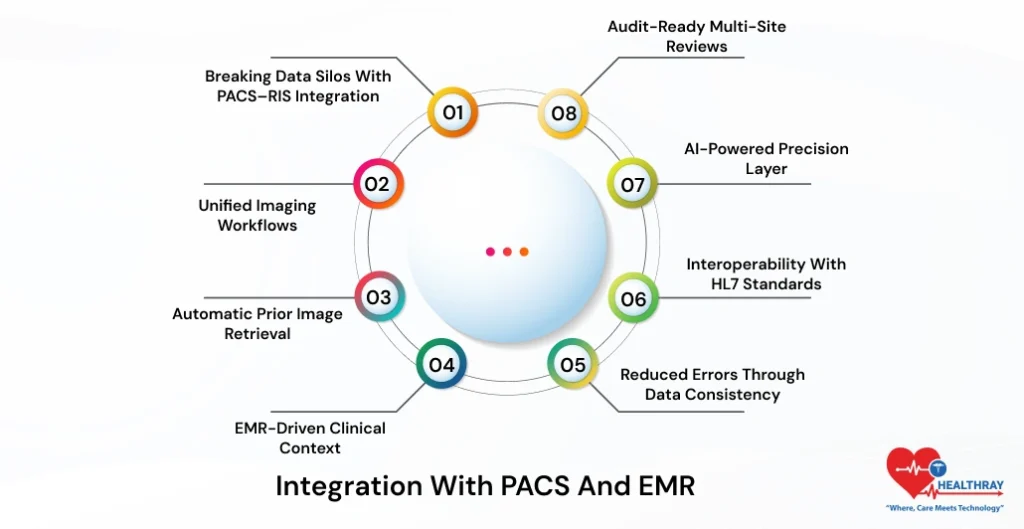
Breaking Data Silos with PACS–RIS Integration
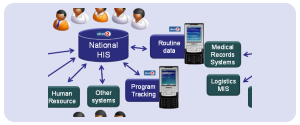
PACS and RIS integration breaks the data silos. Furthermore, it automatically synchronizes orders, images and reports. Thus, providing end-to-end visibility across all branches.
Unified Imaging Workflows
PACS–RIS synergy makes the workflows seamless. From Image acquisition to reporting, everything unfolds in a continuous rhythm without any manual intervention.
Automatic Prior Image Retrieval
Prior studies auto-populate. Further, it simplifies the multidisciplinary image comparison in oncology and cardiology cases. Overall, it solidifies the diagnostic comparisons.
EMR-Driven Clinical Context
Through EMR integration, radiologists get full clinical context. Further, this reduces interpretation errors and makes the reports clinically more meaningful.
Reduced Errors Through Data Consistency
Patient demographics and order details are directly pulled from the EMR. Also, RIS software eliminates manual re-entry and reduces mismatches and correction cycles.
Interoperability with HL7 Standards
Radiology medical software makes sure that HL7 standard systems interconnect with each other flawlessly. Further, this setup ensures scalability. And ensure future readiness for enterprise-level growth.
AI-Powered Precision Layer
AI analyzes studies and discovers potential issues. Thus, it supports radiologists in making decisions without interrupting the workflows.
Audit-Ready Multi-Site Reviews
Integrated systems automatically maintain audit trails. Moreover, multi-site evaluations, quality assessments, and adherence checks have become highly structured. And they leave no friction in the system.
Key Benefits Of Multi-Branch Radiology Centers
Faster Turnaround Times
Unified workflows eliminate manual handoffs. Further, this directly impacts 25–40% faster reporting, where cases move smoothly without any unnecessary delays.
Remote Reporting Flexibility
Remote reporting allows radiologists to handle night shifts and peak volumes without indulging in physical site visits. Further, it minimizes overtime to a remarkable extent and evenly distributes the workflows.
Improved Patient Experience
Patients get seamless record access, minimizing repeat scans. Further, online portals help clinics easily manage multi-branch appointments. The experience appears to be seamless rather than dysfunctional, unlike what radiologists find in conventional systems.
Lower Operational Costs
Centralized storage and reduced hardware needs help organizations achieve 20–30% cost savings. Further, Cloud scaling at ~$0.10/GB makes growth predictable and budget-friendly.
Scalable Infrastructure
Digital radiology workflow software easily absorbs volume spikes. Furthermore, the RIS system never gets slowed down even during seasonal rushes or when you extend the system by adding a new modality.
Predictive Analytics for Demand
Built-in analytics forecast modality-wise demand. Further, management gets prior information on where the pressure arises. Thus, helping them make proactive strategies beforehand and control the most awful scenarios.
Reduced Revenue Leakage
Unified AR aging tracks system-wide claims. Therefore, it helps hospitals reduces Missed follow-ups or delayed reimbursements and revenue flow becomes stable.
Expansion Without Staffing Stress
RIS software can effortlessly amalgamate teleradiology partnerships. Thus, helping clinics easily expand the network. Overall, growth becomes pragmatic rather than oppressively heavy.
 NOTE
NOTE
Patient Engagement Modules
Self-Scheduling Patient Portals
Patient portals allow self-scheduling. This helps patients book appointments at multiple branches on the basis of patients’ availability or modality.
Cross-Branch Appointment Visibility
All branches’ real-time availability is displayed on a single screen. Furthermore, this minimizes repeat calls and unnecessary hospital visits. Patients can consult with doctors without even having to travel across distances.
SMS Reminders with Preparation Instructions
RIS software sends automated reminders along with exam preparation instructions. Additionally, this minimizes no-shows and also helps patients stick to their healthcare routine.
Built-in Navigation Support
The Google Maps integration guides the patients to the exact branch location. Furthermore, this naturally reduces late arrivals and confusion.
Seamless Post-Exam Feedback Collection
After examination, Ris software sends automated feedback requests. Furthermore, the system captures patient experience without manual follow-ups.
NPS-Driven Performance Dashboards
Patient feedback directly feeds into NPS dashboards. Further, radiology medical software quickly flags underperforming sites for corrective actions.
Multilingual Patient Interfaces
Multilingual support creates support for urban and semi-urban populations. Further, patients can interact in their preferred language. RIS handles patients who speak different languages, unlike traditional systems, so radiologists don’t have to translate every instruction.
Inclusive Engagement at Scale
From diverse cities to expanding networks, patient engagement modules maintain consistency and inclusivity in the system.
Step towards digital era with our healthcare solution
Revamp your hospital facilities and embrace change for better healthcare management. Ease in managing and organizing large medical datasets leads to effective analysis. Seize the opportunity now!
Best Strategies for Gaining Optimization
Standardized Protocols Across Branches
Define common protocols for all branches. Furthermore, rule-based scheduling templates make the workflow uniform and reduce confusion in the practices.
Smart Scheduling Optimization
Use analytics-driven scheduling. Further, this optimizes slot utilization and avoids gridlock during peak hours.
Performance Benchmarking
Use radiology analytics dashboard for longitudinal performance comparison. Further, clear benchmarks help clinics identify underperforming areas.
Staffing Adjustment Using Heatmaps
Heatmaps help clinics understand patient inflow or modality demand. Further, by analyzing these data, staffing becomes more efficient and flexible.
Regular Compliance Audits
Conduct quarterly audits to maintain the regulatory compliance. Further, it helps clinics determine issues at the early stage.
Continuous User Feedback Loops
Collect radiologists’ and technologists’ feedback regularly. Further, this adapts workflows as per ground reality.
Hybrid Cloud–On-Prem Strategy
Hybrid cloud–on-prem setup is the best option for regulated markets like India and the USA. Moreover, sensitive data remain local and scalability is retrieved from the cloud.
Future-Proof Integrations with APIs
Develop custom APIs through experienced integrators. Further, this approach makes the system versatile for AI expansions and new technologies.
Conclusion
Centralized RIS turns multi-branch radiology centers from disconnected structures to cohesive, high-performance enterprises. Furthermore, RIS breaks data silos and automates workflows. Also, AI-driven insights make the decision-making fast. Radiologists get complete patient context, thus making care quality consistent and reliable across all locations.