



Summary
The radiology department is nowadays facing a silent struggle. High imaging volumes, tight reporting deadlines, and never-ending administrative tasks keep the radiologist away from patient care. Traditional RIS heavy infrastructure and frequent maintenance are enhancing the stress level. In this blog, I’ll talk about how cloud radiology information systems transform operations and offer practical solutions to radiology teams’ daily struggles. In addition, I will discuss how it reduces reporting pressure and shifts the operational system to work for doctors rather than the other way around. Keep reading!!!
Introduction
Radiology departments are managing a tough balance, such as high imaging volumes, tight reporting timelines, and increasing compliance pressure. Is your current Radiology Information System (RIS) reducing the pressure or enhancing it? Just think if radiologists spent their valuable time handling medical documentation, scheduling coordination, and system downtime. How will the radiologist deal with patient care? Study clearly reveals excessive administrative workloads are the major cause of clinician burnout.
And it directly impacts patient dissatisfaction. The primary reason for this problem is not workloads but outdated radiology systems. Traditional, on-premise Radiology Information Systems (RIS) rely on heavy infrastructure, frequent maintenance, or limited scalability. As the diagnostic demands increase, the system slows down, workflows break and the radiologist deals with high-pressure workloads. In this situation, the cloud radiology information system emerges as a smarter and future-ready solution. Simply put, radiologists will prioritize accurate diagnosis or high-quality patient care when technology is intelligent. Thus, it makes the system secure, scalable, and truly human-centric.
Why “Secure” Matters in Cloud RIS
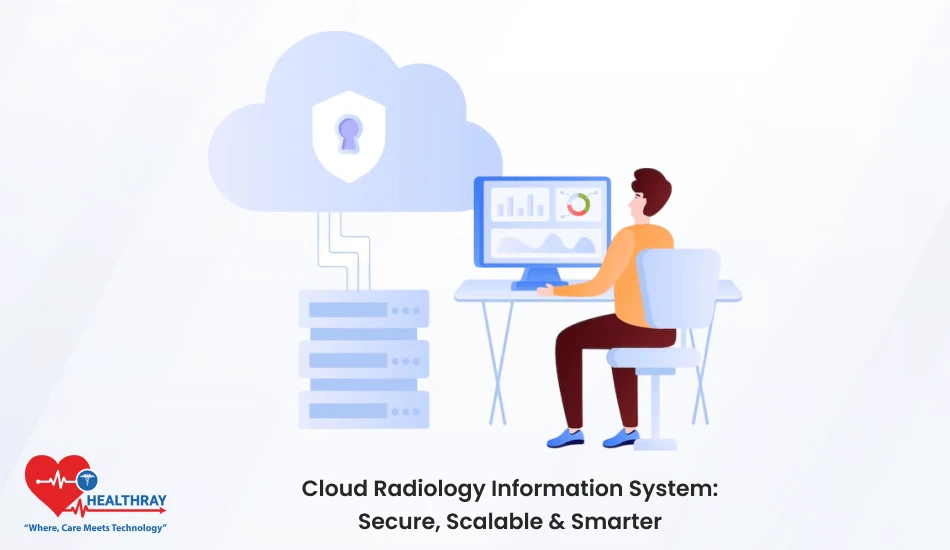
When Protected Health Information (PHI) moves away from hospital boundaries, security naturally becomes a major concern. Further radiology teams not only deliver reports, but they also handle patient trust. Modern Cloud RIS systems incorporate security into every layer rather than merely offering it as an add-on. Let’s check how the cloud radiology information system handles security:
Secure Data in Motion
TLS/SSL encryption protects data transferred from Cloud RIS, regardless of image modality, RIS-to-PACS, or EHR data exchange. Further, this means the image while transitioning is completely imperceptible, even if there is an unauthorized attempt.
Protected Data at Rest
Not only at moments, AI-powered radiology software ensures security even at the storage level. Additionally, cloud databases and storage volumes encrypt patient data for security. Simply put, whether patient data is on a rest or travel form from one platform to another, in every situation, data is confidential and secure.
Right Access for the Right Role
As we all know, each team’s role and information requirements vary within the hospital ecosystem. For instance, radiologists need clinical images or reports, the billing team needs codes or invoices and admins require system-level visibility. Further, cloud RIS role-based access ensures every staff member can browse data that are necessary for their role. They have no access aside from that.
Less Exposure, More Accountability
Clearly defining access automatically reduces unnecessary data exploration. Plus, every action of the team is traceable in the hospital ecosystem. Further, this builds strong faith among team members, which naturally improves accountability, without any extra monitoring pressure.
Audit Logs & Complete Traceability
Every system activity is logged, so clinics don’t have to be afraid about intrusion and data leakage concerns. Further, audit logs are not just for compliance; they are also meant for building trust. Whenever hospitals undergo investigation or regulatory audit, the clear traceability keeps the radiologist worry-free.
Compliance-Ready by Design
Mature Cloud RIS vendors design the system in alignment with HIPAA, GDPR, and regional privacy laws. Further, regular security audits, certifications, and best practices ensure compliance is not an arbitrary consideration; instead, it’s a core part of the system.
Privacy with Performance Balance
When premise de-identification or pseudonymization amalgamates with AI workflows, then cloud RIS creates a perfect balance. Further, it keeps the clinic’s usability intact, without compromising patient discretion. This is the core reason many top hospital sectors are adopting cloud radiology information systems, as this is not merely an IT investment but a strong foundation of clinical confidence.
 PRO TIP
How Cloud RIS Scales With Imaging Growth
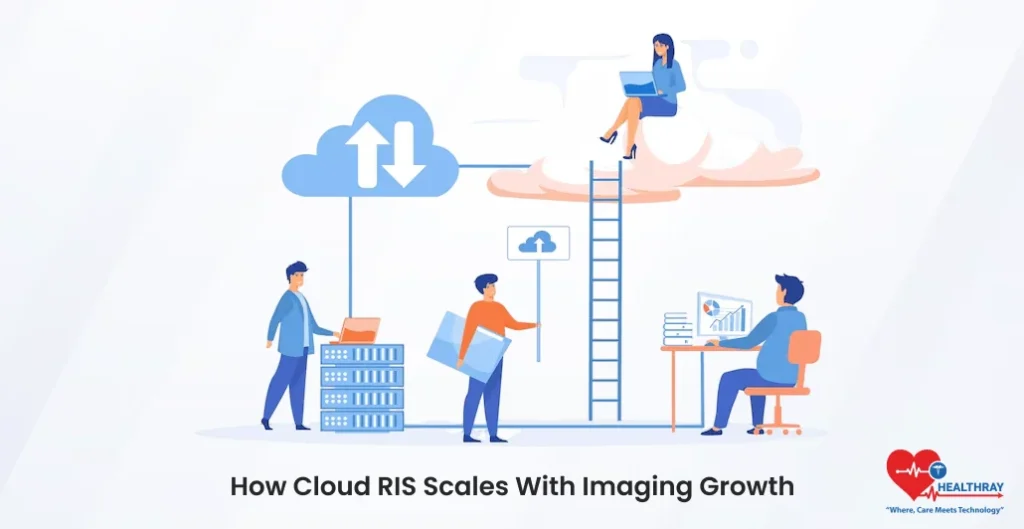
These days, radiology is not just limited to managing images. Further, high-resolution modalities, multi-phase studies, and AI-generated series imaging data grow exponentially. Alongside this expansion, the true question is: Does your RIS system scale? Traditional on-premise RIS and PACS mainly struggle at this point, where capacity planning, hardware upgrades, and peak-time performance become bottlenecks. Let’s check how cloud RIS scales with your imaging growth:
Elastic Storage & Compute Power: Grow Without Infrastructure Stress
The primary benefit of cloud RIS is that processing power and storage automatically scale with increasing imaging volume. It evades the need of buying a new server, planning space and worrying about downtime. System adjusts in silence without interrupting the workarounds.
Multi-Site & Tele-Radiology Ready: One Platform, Many Locations
Whether it’s multiple hospitals, diagnostic centers, or remote radiologists, a single Cloud RIS seamlessly integrates with it. Logical data segmentation keeps the governance and privacy intact and collaboration smooth. Distance no longer creates a barrier; instead, it elevates productivity.
Faster Updates & Continuous Innovation: Always Current, Never Disruptive
The meaning of upgrades in on-premise systems is planning, downtime, and stress. Cloud RIS quietly introduces the frequent feature updates and security patches. Progressive tools continuously help radiology teams maintain smooth workflows without interruptions.
Scale When Opportunity Knocks: Faster Time-to-Value
Whether clinics need to expand to new regions, are planning to launch a satellite imaging center, or want to build a teleradiology network. Cloud RIS quickly “turns on” the new sites. RIS serves as the foundation for quick growth, predictable costs, and instant value. Cloud RIS is not solely destined for handling workloads; it is highly centered on future imaging growth as well.
 NOTE
NOTE
Cloud RIS and Business Strategy: Beyond IT Modernization
A cloud radiology information system is not just a technology upgrade; it is an amplifier of radiology business strategy. When clinical infrastructure limitations are minimized, then staff naturally shift their focus on partnerships, clinical expertise, and service expansion. With this shift, radiology providers can confidently launch new service lines.
Enabling New Radiology Service Lines: Nighttime & Overflow Reading Services
Small hospitals and diagnostic centers usually encounter reporting backlogs during night shifts or peak hours. Cloud RIS allows radiology providers to offer nighttime and overflow scanning services remotely without having any physical setup or configuration.
Subspecialty Reporting Across Regions: Expertise Without Geographic Limits
It is impossible for clinics to allot subspecialists at every location. Cloud RIS exceeds the geographical boundaries where cardiac, neuro, and oncology subspecialists can remotely handle multiple regions’ cases. It improves quality reporting and enhances referrals.
Population Health & Screening Programs: Scale Preventive Imaging with AI
Large-scale screening programs such as those for TB, breast cancer, and lung screening demand high volume and fast triage. Through Cloud RIS centralized workflows and AI-based triage, radiologists can efficiently manage population health initiatives without creating burdens on systems.
Strategy First, Infrastructure Late: Growth Without Hardware Barriers
When infrastructure is no longer a bottleneck, then expansion is not just about buying servers; rather, it is about building the right partnerships and clinical capacity. Further, Cloud RIS radiology ascends the leader higher than IT modernization and fosters true business growth.
Step towards digital era with our healthcare solution
Revamp your hospital facilities and embrace change for better healthcare management. Ease in managing and organizing large medical datasets leads to effective analysis. Seize the opportunity now!
Making Radiology Smarter with Cloud-First Intelligence
The future of radiology is not merely moving to a cloud platform. It’s all about making the system smart. Cloud-first RIS intelligence integrates into the core workflow, where technology guides the radiologists.
AI & Triage: Critical Cases, First Priority
In smart cloud RIS, AI is not just an external layer. Further, it’s a natural part of the worklist. AI automatically suspects stroke or pulmonary embolism (PE) or critical chest findings and instantly flags them in the routine cases. As a result, high-acuity patients get faster attention without manual sorting.
Faster Reporting with AI Assistance: Less Clicking, More Thinking
AI is not only bound to performing triage, but it also lightens the workloads of radiologists. Measurements and key findings are already presented in structured reports, emphasizing significant prior studies from the archive. This expedites the comparative reading and improves reporting consistency.
Intelligent Orchestration of Worklists: Right Case, Right Radiologist
Cloud RIS determines the authority and timing of reading examinations using machine learning models or smart rules. This decision is entirely based on subspecialty expertise (neuro, MSK), referring hospitals’ SLAs, and our radiologist availability. It is not based on random allocation.
Balancing Quality with Productivity: Smart Allocation, Sustainable Workload
Cloud radiology information system also considers weakness, time-of-day preferences, and workload balance. Cloud RIS enhances productivity and also supports radiologist wellness and reporting quality. Overall, cloud-first intelligence accelerates radiology workflows while also making them more thoughtful, consistent, and patient-centered.
Conclusion
A modern cloud RIS protects patient data at every layer. With built-in security frameworks, radiology teams can confidently operate the system without compromising compliance ,privacy and data quality. A secure radiology information system helps the radiologist team cope with current challenges and also empowers them in leading the data-driven, AI-augmented healthcare to the next phase and also enables technology growth and clinical excellence in the ecosystem.