



Summary
Pharmacy margins hardly fall on one day. Rather, they wear away serpentinely with little inefficiencies that are easy to cope with in the short-term but costly in the long-term. Profitability is eroded gradually by pricing pressure, disproportional demand, and slow moving inventory and missed visibility. The reaction of many pharmacies is to negotiate more with vendors or to push the volume but such measures hardly ever address the root cause.
Pharmacy profit analytics changes the discussion at this point. Rather than making a hunch as to where money flows, analytics brings insight. It demonstrates what sells, what hangs and what devalues silently. More to the point, it also links the daily decisions to the long-term consequences. When leaders perceive patterns over reports, margin protection turns out to be proactive as opposed to reactive.
Overall, pharmacy activities are not complicated with analytics. It simplifies them. It substitutes guesses with reality and stress with organization. In the case of hospital and clinic pharmacies, such transparency can be the distinction between existing on the edge of a margin and thriving well there.
Introduction
The situation is constrained in pharmacies, large and small. Increasing procurement prices, uncertain demand, and operational blind spots puts pressure on the decision-makers continuously. However, price cuts or hard sales seldom stop the problem at the source. As a matter of fact, the majority of margin issues start with low visibility.
A current day Pharmacy Management System captures sales, inventory movement and transaction every day. But that data is not used, without analytics. Leaders are aware of the problems but have a problem locating them. Consequently, it leads to decisions that are based on experience and not evidence.
In this case, precisely in this place, pharmacy profit analytics re-conceptualizes the challenge. Analytics converts common information into directions. It reveals what products have value, where to find inefficiencies and how current decisions impact future margins. Rather than firefighting issues, pharmacies are put in control.
When the margin pressure seems to be the same, do not panic because there is a solution. The solution does not require additional work by teams. It requires more acumen to act as leader. Analytics provides such an insight in a calm and consistent fashion.
Why Traditional Pharmacy Reporting Fails to Protect Margins
Reports are already being generated in the majority of pharmacies. Marketing reports, inventory and reports by month are everywhere. As much as these reports seem informative, they are usually received late enough to save margins. By the time leaders realize that there is a problem, it is too late.
Conventional reporting is retro-reflective. It describes the circumstances but not the reasons why it took place or how to proceed further. As a result, no leakage of margins is detected. Stagnant inventory builds up. Stock turnover drops. The pricing decisions remain out of touch with demand.
The pharmacy profit analytics is different. It emphasizes patterns when they are created. It links the sales trend analysis and the procurement behavior. This leads to leaders acting rather than reacting.
The Cost of Delayed Visibility in Daily Pharmacy Decisions
Lateness of visibility engenders indecisiveness. Lack of clarity in teams will result in overstocking to be on the safe side. When leaders are not insightful, they take long before corrections are made. These habits creep up and increase expenses.
Moreover, analytics restores timing. With better operational insights, pharmacies align actions with reality. The process of making decisions is less tense since evidence is used. The provision of margin protection becomes regular rather than an emergency procedure.
Pharmacy Profit Analytics Changes How Decisions Get Made
Experience is not substituted with analytics. It strengthens it. When pharmacy profit analytics comes on board in day-to-day operations, decision-making changes to non-reactionary correctional moves. Leaders cease to ask what has gone wrong, but instead ask what is changing.
This shift matters. Forecasting of demand is better in planning. Pricing visibility keeps the margins in line with the market movement. The sales trend analysis helps to identify new opportunities, even before the rivals pay attention to them.
More importantly, analytics builds consistency. Teams across roles follow the same signals. Discussions shift towards actions. Over time, confidence replaces guesswork.
Moving From Gut-Based Choices to Evidence-Led Actions
Gut instinct plays a role in pharmacy management, yet instincts struggle at scale. Analytics helps in being judgmental. When data confirms trends, leaders act decisively.
Actions heeded minimize indecisiveness. Overstock declines. Slow-moving inventory becomes visible. Decisions feel aligned rather than debated. This in tandem safeguards margins without additional work.
Pharmacy Analytics Software Creates Margin Awareness at Every Level
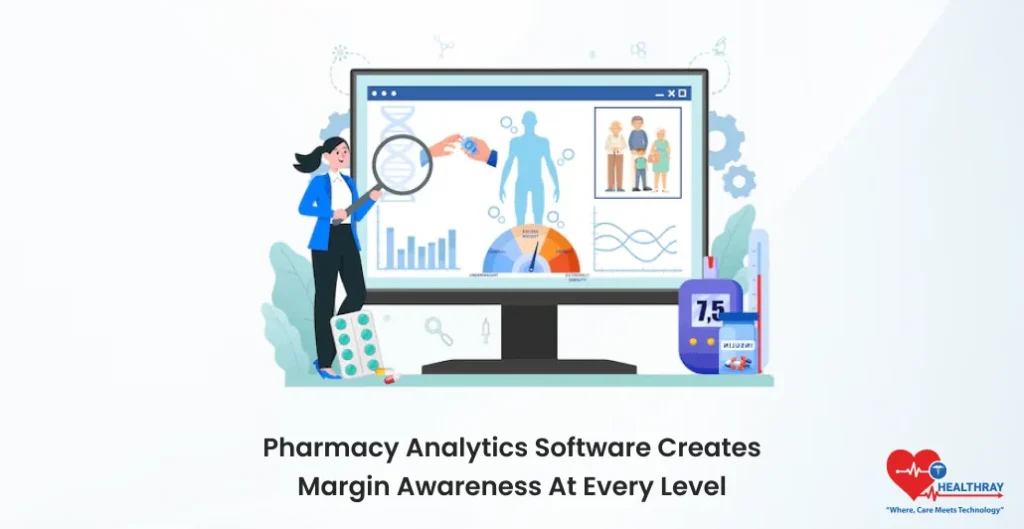
Pharmacy analytics software bridges the gap between day-to-day operations and financial performance. It does not stand alone with workflow. It is in conjunction with dispensing, procurement, and reporting processes instead.
And with the analytics being embedded in the regular systems, the margin awareness becomes viral. Teams know the impact of actions on profitability. Leaders are able to track stock turnover and pricing visibility without having to do it manually. All in all, this common knowledge enhances accountability.
Consequently, analytics would be integrated into the culture of operations. Margin protection ceases to be an operation of finance and becomes an ordinary practice.
Pharmacy Business Intelligence Reveals Where Profits Actually Leak
Deficits are not very dramatic. They creep in unnoticed with little inefficiencies day in day out. Pharmacy business intelligence has brought to light such drains that have been hidden by connecting the functions through data.
Stagnant inventory becomes apparent. The sales trend analysis indicates the falling demand at the beginning. Before it grows, margin leakage is evident. Pharmacies do not implement widespread cost-cutting but implement targeted corrections.
Identifying Margin Leakage Before It Becomes a Habit
Habits shape margins. When the inefficiencies become normal, they become more difficult to reverse. Business intelligence breaks this cycle. It points out the deviations at an early age and promotes adjustments on time.
The responsiveness of the leadership keeps losses at bay. In the long run, this sensitivity introduces resiliency in pharmacy.
Demand Forecasting Brings Stability to Procurement and Pricing
Unpredictable demand makes margins unstable. Overstock wastes capital. Stockouts frustrate patients. Demand forecasting creates balance by aligning procurement with real consumption patterns.
Pharmacies expect demand with analytics and do not pursue it. Pricing visibility improves alignment between cost and margin. Procurement decisions feel planned rather than rushed.
 PRO TIP
Analytics Supports Multi-Location Margin Control
Having multiple locations complicates the matter of management of margins. In the absence of shared visibility, there is vast variation in performance. Analytics brings together wisdom throughout the system.
With multi store pharmacy software, the leaders also monitor the trends in the center without overriding local demand. This equilibrium does not compromise flexibility. Margins remain safe throughout the locations, not only at flagship stores.
Using Data to Improve Pharmacy Performance Without Overburdening Teams
Teams often fear analytics because they associate it with extra work. Analytics makes workload less in practice. It also gets rid of manual tracking and multiple reviews.
The best approach to using data to enhance the performance of the pharmacy is when the information will emerge naturally in the current workflow. Teams are concerned with care and systems are concerned with analysis. Through time, the operations become light instead of heavy.
Step towards digital era with our healthcare solution
Revamp your hospital facilities and embrace change for better healthcare management. Ease in managing and organizing large medical datasets leads to effective analysis. Seize the opportunity now!
How Analytics Improves Pharmacy Profit Margins Over Time
Decisions are better when their margins are better. That connection often gets overlooked because profit discussions focus on price rather than behavior. In reality, how analytics improves pharmacy profit margins becomes visible only when patterns guide action consistently.
Analytics find out the points of slowness in stock turnover and acceleration of demand. As a result, procurement is more in line with consumption. Decisions on pricing cease being based on generalized assumptions and become based on actual movement. Thus, these minor adjustments over time accumulate to stable margin growth.
Besides, analytics assists with the prioritization of effort by the leadership. Teams do not work on everything but rather work on what really influences profitability. That focus reduces noise. It also gives the impression that he performs better with structure than pressure.
Sales Trend Analysis Turns Daily Transactions Into Strategy
Each sale is informational. Without analytics, such information goes away in forms of reports. Sales trend analysis converts transactions to insight with pharmacy profit analytics.
Trends indicate changes in seasons. Promotions show real impact. Demand forecasting gains accuracy. Consequently, pharmacies will cease responding to trends in a reactive manner and begin planning in advance. This is a margin safeguard, and it does not enhance inventory risk.
Notably, trend analysis does not require complexity. A clear visual and consistent metrics are natural in guiding the leaders. Decisions feel intuitive because data supports them quietly.
Pricing Visibility Prevents Margin Erosion Before It Starts
The pressure of pricing hardly comes out of the blue. It develops over time as the procurement cost varies and the demand changes. Without pricing visibility, pharmacies adjust too late.
Analytics brings clarity. It indicates where the margins are becoming thin and where they are safe to make adjustments. Leaders balance competitiveness with sustainability. Consequently, margin leakage reduces without alienating patients.
Stock Turnover Reveals the True Cost of Inventory Decisions
Inventory ties up capital. Margins are hit under the carpet when stock turnover is slow. Analytics is what reveals this slackening.
Slow moving inventory surfaces clearly. Teams recognize objects that consume money but not value. Redistribution or adjustment follows naturally. Over time, inventory becomes leaner and more responsive.
This field enhances the cash flow. It also lowers the stress during procurement cycles. The leaders do not feel restrained but in command.
Using Data to Improve Pharmacy Performance at Scale
Expanding enhances the strengths and weaknesses. Scaling increases inefficiency in the absence of structure. With the help of data to enhance the performance of pharmacy, growth will be deliberate.
Analytics will help in ensuring uniformity in places and teamwork. Leaders track operational insights centrally. Shared intelligence keeps local decisions informed. Consequently, performance would enhance without micromanagement.
Informs operating on data change at a quicker pace. They are also able to take shorter time to recover after disruption. Such resilience helps in cushioning against fluctuations in the environment.
Learn more: AI Inventory Forecasting for Pharmacies
Analytics Strengthens Pharmacy Customer Retention Through Availability
Patients remember availability more than price. Late prescriptions are a trust killer. Analytics supports pharmacy customer retention by ensuring products remain available when needed.
Monitoring the demand patterns, the pharmacies minimize the stockouts. By managing slow moving inventory, they free space for essential items. Consistency builds reliability. Reliability builds loyalty.
Retention improves quietly. Patients come back unreminded. Physicians make an uninhibited referral. Margins enjoy stable volume as opposed to aggressive acquisition.
Pharmacy Profit Analytics Across Multiple Stores Requires Shared Insight
Multi-location pharmacies have an additional complexity. In the absence of consolidated analytics, the performance is very diverse. Pharmacy profit analytics supported by multi store pharmacy software creates shared visibility.
Leaders compare performance without bias. Best practices spread quickly. Weak spots receive attention early. Consequently, margins stabilize across locations rather than depending on individual managers.
The collective wisdom substitutes for divided decision-making. Operations feel connected. Growth feels controlled.
Healthray – Turning Pharmacy Analytics Into Margin Discipline
Healthray takes analytics as a pharmacy operational efficiency tool and not a reporting tool. The platform integrates the pharmacy profit analytics into daily workflows so that insights can be taken.
Data flows continuously. Dashboards reflect reality. Leaders monitor demand forecasting, pricing visibility, and stock turnover without manual effort. The teams work as opposed to working blindly.
Healthray assists the analytics in the larger pharmacy management system to align the insights with the dispensing, procurement and reporting. This support eliminates data silos. Decisions feel coordinated.
 NOTE
NOTE
Conclusion
Pressure is not an enhancer of margins. They improve through predictability. When decisions follow insight, outcomes stabilize naturally.
Pharmacy profit analytics provides clarity out of uncertainty. It substitutes conjecture with orientation. Leaders plan confidently. Teams operate calmly. Expansion is sustainable but no longer a stressor.
When the margin pressure does not change, this is an indication of a visibility gap, but not a failure and analytics fills that gap. Schedule a free demo with Healthray and get a feel of how organized insight can transform daily pharmacy data into sound margin growth.
Prefer readiness to respond. Your margins will follow.