



Summary
Retail and hospital pharmacy software purposes and workflows are fundamentally different. Retail pharmacy software mainly focuses on fast billing, smooth inventory management and customer retention, where speed and sales efficiency are highly critical. On the other hand, hospital pharmacy software works in complex environments such as IPD, ICU and HMS integration, where patient safety, regulatory compliance and timely dispensing are essential parameters. Both software have different features, scalability and pricing models. Therefore, it is highly imperative to choose the right software for your pharmacy setups that is compatible with your long-term growth, efficiency and ROI. In this blog, I will clearly explain the key difference between retail software and hospital pharmacy software to help you select the right software as per your business model. Keep reading!!
Introduction
Depending solely on the traditional pharmacy system may not be the best option in the fiercely competitive and technologically innovative healthcare market of today. Manual payment methods, disassociated storage structures, and slow prescription processing not only raise the operational cost but also hamper the pharmacy’s scalability and profitability. In 2026, the pharmacy center should adopt a futuristic and technologically innovative pharmacy management system for sustainable growth.
However, the one-size-fits-all approach to pharmacy software is no longer viable in 2026. Both retail pharmacies’ and hospital pharmacies’ software serve a critical purpose in healthcare facilities, but their daily administration, procedures, and compliance requirements are entirely distinct. Due to this misunderstanding, a lot of hospital administrators and pharmacy owners utilize the same software for various configurations, which has a detrimental effect on ROI and long-term efficiency. Retail and hospital pharmacy software features, pricing models and scalability requirements are fundamentally different. Whether you are running a standalone retail pharmacy or a multi-specialty hospital, choosing the right software is the foundation for advancement, conformity and profitability.
Operational Environments of Retail Pharmacy Software
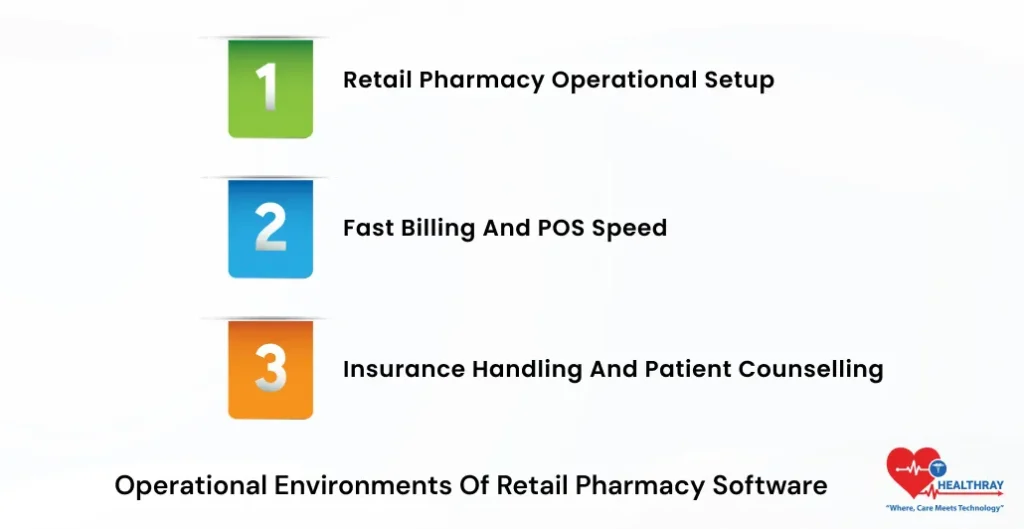
Retail pharmacy operational setup
Retail pharmacy software relies on community-based environments such as standalone medical stores or chain pharmacies. Further, retail software focuses more on handling walk-in customers, OPD medications and OTC sales. Let’s understand about retail software features:
Fast Billing and POS Speed
In a retail pharmacy setup, billing and speed are fundamental considerations. Further, if there is high customer footfall during the billing, the process becomes slow. Meanwhile, customers have to stand in long queues, and at last customers get irritated. Advanced pharmacy software makes the POS transaction incredibly quick. Additionally, it accelerates the prescription procedure, cuts down waiting time and provides hassle-free experiences to customers.
Insurance Handling and Patient Counselling
Retail pharmacy software simplifies the handling of insurance and patient counseling and makes it highly structured. Further, retail pharmacy software is adept at processing insurance approval and discount promotions. This minimizes the billing consternation. Additionally, counseling tools allow pharmacists to deeply understand the prescription. Thus, it helps pharmacy centers boost patient trust in your products and services. Patient feels more comfortable, which naturally increases repeat visits.
Operational Environments of Hospital Pharmacy Software
Hospital Pharmacy Operational Setup
The environments of hospital pharmacies are extremely intricate and laden with duties. Hospital pharmacy software is constructed for inpatient facilities. It helps doctors, nurses and the admin department to seamlessly connect with each other and share the pertinent information where individuals need it. Multi-branch pharmacy system software specifically focuses on medicine preciseness, correct dosages and patient safety. A small error can trigger serious medical complications. Let’s understand more about hospital software features:
HMS, EHR and Clinical Integration
Hospital pharmacy software deeply connects with HMS, EHR and clinical systems. It synchronizes all the work processes, such as prescriptions, administration documentation, and patient data in real time. It reduces the need to enter the data manually in the system, as hospital software automates all the basic tasks that previously took considerable time. Also, it improves coordination and minimizes medication errors that severely hamper patient security.
Controlled Drugs and Unit-Dose Management
As we know, in hospital setups, the most sensitive process is managing prescribed drugs or unit dosages. However, the pharmacy system automates all the crucial steps, such as initial preparation, centralized formulation and unit-dose distribution. This helps pharmacists provide exact doses to every patient. It meticulously analyzes controlled substances and ensures full regulatory compliance and patient welfare in the system.
Major difference in scope
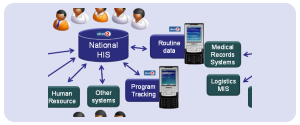
Retail pharmacy software is designed for a standalone business model. On the other hand, hospital pharmacy software is a part of the entire ecosystem. Hospital management software is featured in HIS and fosters seamless collaboration among multiple departments.
 PRO TIP
Workflow of Retail Pharmacy Software
Fast-Paced Workflow
Retail pharmacy workflows primarily emphasize fast dispensing and quick service. Further, the pharmacist takes on more than 1000 prescriptions every day, where every second is precious for consumers. Rapid distribution and quick assistance directly contribute to customer happiness, recurring visits and overall profitability. That’s the reason the retail software contribution here turns critical.
Scan, Bill and Deliver
Retail pharmacy daily operation relies on the scan, bill and deliver model. Retail pharmacy software scans the prescription and checks the insurance eligibility and helps patients clearly understand the dosage and medicines. In simple words, retail pharmacy software automates all the steps of the system. This minimizes processing time and reduces workload stress on pharmacists.
High Volume, Low Complexity Handling
Retail pharmacies generally collaborate with a high volume of patients, and their work routine is less complex. In the traditional system, retail pharmacists handle prescriptions in manual registers and enter the receipt details in excel sheets to prepare monthly reports. This process was hectic and prone to mistakes. Further, pharmacy software automatically synchronizes the label creation, partial fills and chronic medicine. This minimizes the workload on pharmacists for refill prescriptions and naturally improves the patient’s adherence to their regimen.
Workflow of Hospital Pharmacy Software
Multi-Step Workflow
Hospital pharmacy workflows are highly structured and multi-layered. Further, every medicine goes through multiple verification processes and approval from the team before dispensing. Every procedure is carried out carefully in hospitals, including doctor instructions, clinical evaluations, dosage confirmation, and nurse coordination. This process consumes significant time but maintains patient protection and treatment accuracy at the maximum level.
EHR Orders and Clinical Verification
Hospital pharmacy software receives direct electronic orders from EHR. Further, it minimizes the need for executing the operation manually. Clinical Decision Support (CDS) system automatically validates drug combinations, right levels and treatment security. Overall, this smart verification process lowers the potential of medication lapses and makes patient care more secure and trustworthy.
Unit-Dose Preparation and Floor Delivery
Following verification, the hospital pharmacy prepares unit doses, ensuring that each patient receives the precise dose. Then medicine reaches the ward through a trackable delivery system. Further, this closed loop locks down medicine mix-ups and missed pills. This naturally improves treatment preciseness and patient confidentiality.
Real Difference of Integration Depth
Retail pharmacy software mainly revolves around POS and internal process management. On the other hand, hospital pharmacy management software requires bidirectional HIS integration. This helps the pharmacist seamlessly synchronize the patient status, lab reports and real-time notifications.
Cost structure of Retail Pharmacy Software
Retail Pharmacy Software Starting Cost
Retail pharmacy software starts with a monthly subscription. Further, entry-level plans are economical and pharmacy centers can scale them as their business progresses.
Pricing Scalability Based on Users & Features
As user numbers increase, pharmacy centers add specialized functions such as analytics, reports and automation. Then, prices rise in accordance with the new features. This flexible model is an optimal option for small- and mid-sized pharmacies.
Retail ROI Through Error Reduction
In a retail setup, the main source of ROI is reduction in billing and dispensing errors. Further, software reduces the inaccuracies and saves it from annual losses. This was practically impossible with the traditional system. However, AI in pharmacy software facilitates faster billing processing.
Step towards digital era with our healthcare solution
Revamp your hospital facilities and embrace change for better healthcare management. Ease in managing and organizing large medical datasets leads to effective analysis. Seize the opportunity now!
Cost structure of Hospital Pharmacy Software
Hospital Pharmacy Software’s Upfront Investment
Hospital pharmacy software is integrated with multiple departments and compels workflows. Therefore, the implementation cost of hospital pharmacy software is high.
HIS Integration & Annual Maintenance Costs
In a hospital setup, total cost is not just limited to software. Implementation, customization, and yearly maintenance costs for HIS also fall under the purview of pharmacy centers. This is included in the overall budget.
Hospital ROI Through Safety & Compliance Gains
For hospital software, ROI relies on a sharp reduction of medication negligence, regulatory enforcement and 340B program savings. This helps pharmacists create long-term financial impact.
 NOTE
NOTE
Conclusion
The retail and hospital pharmacy software differences get clear from their daily operational demands. Both the software working environment and the responsibility level are different. Retail systems focus on fast billing, smooth POS and inventory agility; on the other hand, hospital pharmacy software focuses on clinical integration and patient safety. It is crucial for healthcare providers to select their software on the basis of their workflow. A right alignment is the foundation of long-term effectiveness, safety and ROI.