


Summary
In hospital pharmacy, it’s highly challenging to manage IPD and OPD care simultaneously. Different workflows, manual processes and disconnected systems bring forth the difficulties of miscommunication, holdups and stock disorganization. Pharmacy Management System (PMS) bridges that gap by amalgamating inpatient and outpatient pharmacy operations on a single platform. Real-time inventory, role-based accessibility and HIS-EMR interaction improve PMS accuracy and make the coordination a facile task. In this blog, I will discuss how PMS for hospital pharmacies provides better control over the operation. Also, I will cover how clinicians will get clear clarity of executing the practices and can make the patient experience convenient, confidential and trustworthy. Keep reading!!!
Introduction
Hospital pharmacy is a balancing act. Where one side includes inpatients such as wards, ICU, and emergency. Here every dose timing is critical, and the slightest delay can affect the patient outcome. And the other side includes outpatients that bring prescriptions from the OPD department and expect fast, error-free dispensing. Both care models are working independently but only pharmacy departments are facing the maximum difficulties. Moreover, when systems are disconnected, the confusion becomes almost inevitable. In India, many hospitals still have fragmented IPD and OPD pharmacy workflows.
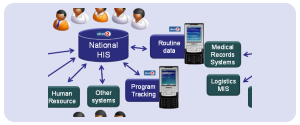
They usually face challenges with manual indent, OPD billing mismatch, and the last-minute suddenness of inventory shortage. Pharmacists are taking on the workload pressure of coordination, apart from executing their day-to-day routine work. To keep the patient care smooth amid this chaos becomes a huge challenge for pharmacists. Here, the Pharmacy Management System bridges the gap and provides incredible solutions to clinics. PMS is a digital bridge that connects inpatient and outpatient care operations into a single flow. With Role-based access, real-time inventory visibility, and HIS-EMR integration. PMS makes the pharmacy a high-support platform and active partner for patient care.
The Growing Need for Integrated PMS in IPD and OPD
Hospital Pharmacy: A Daily Pressure Environment
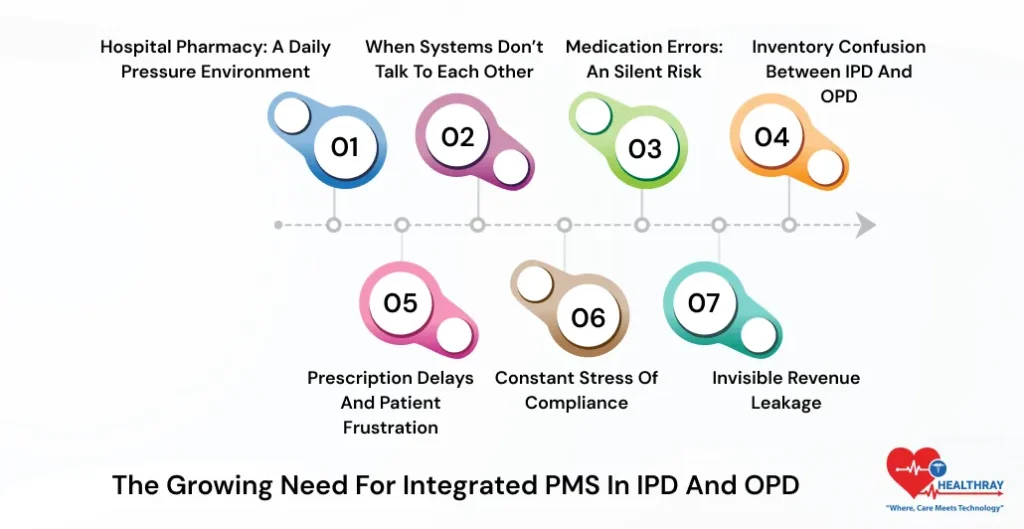
Hospital pharmacies are not just places of medicine dispensing platforms in 2026. Further, they are capable of handling multiple operations in IPD and OPD centers. They face difficulties with both the centers; one is IPD patients, where EHR-aligned, time-sensitive medication administration is essential. On the other hand, OPD patients are hoping for immediate dispensing and accurate billing. Through the traditional system, it becomes a significant hassle for pharmacists to simultaneously handle both types of workflows.
When Systems Don’t Talk to Each Other
In many hospitals, pharmacy software is still dependent on manual workflows and different software systems to run the daily operations. Furthermore, pharmacists view that from one location and make decisions from different places. Simply put, it’s a completely disorganized practice. Moreover, errors silently enter the system because of this lack of integration. This ultimately leads to inadequate dispensing, improper communications and unclear responses. Eventually, with time, these small gaps can ultimately lead to patient wellness complications and operational lapses.
Medication Errors: An Silent Risk
Medication error is a silent risk that impacts patient safety without giving any warning. Studies from the WHO show that one in ten people suffer injuries as a result of medication errors. Furthermore, this further increases the risk in systems when prescriptions are not manually reviewed. Ultimately, the pharmacy department and clinics work standalone and impede the functions.
Inventory Confusion Between IPD and OPD
Inventory confusion between IPD and OPD is common and impedes the operation cycle. Furthermore, the ward displays available medicine but it shows out of stock in opd counter. In the traditional system, stock lacks real-time synchronization. Some locations struggle with overstock, while others experience a shortage of stock. Moreover, this directly results in production loss and workplace distress.
Prescription Delays and Patient Frustration
Prescription delay in the pharmacy is the primary reason contributing to patient impatience. Furthermore, manual evaluation and paper-intensive approvals retard the dispensing workflows. In IPD centers, a small delay can enhance the likelihood of patient plight. On the other hand, a small delay in OPD results in long queues, congestion and unhappy patients.
Constant Stress of Compliance
For hospital pharmacy, compliance is not a one-time task. Instead, it’s daily pressure. Furthermore, standards like NABH, HIPAA still impose valid documentation, audit evidence and access control. In the traditional system, pharmacists follow a manual and fragmented approach, which elevates the probabilities of risks. Ultimately, these gaps are the reason behind compliance uncertainties, consequences and trust loss.
Invisible Revenue Leakage
In hospital pharmacies, revenue loss is highly noticeable. Further, untracked OPD sales or missed IPD medication charges slowly drain the hospital margins. Traditionally, pharmacy billing and hospital systems are not properly linked together. Eventually, finance leakages remain unnoticed. It’s become challenging for management to clearly view the hospital function and take measurable actions to mitigate the revenue leakage problem.
 PRO TIP
How PMS Enhances Inpatient Care
Inpatient Pharmacy: Zero-Error Zone
In patient care, the pharmacy role is not just limited to supply management. Further, pharmacy customer retention software directly links every role with patient safety. In the intensive care unit, oncology, and general wards, even a minor error can have dire repercussions. Moreover, IPD pharmacy requires a strong safety lock system.
PMS as a Digital Safety Net
Pharmacy Management Systems are tightly connected with HIS and PACS/RIS. Further, it brings the inpatient medication in a strong digital safety net. In the radiology department, imaging-linked medicines, such as contrast agents, are automatically mapped with the system. Additionally, it reduces the possibility of incorrect medication and dosage timing, especially during critical case scenarios, where high attention is crucial.
Unit-Dose Dispensing, Less Guesswork
Unit-dose dispensing in PMS integration with HMS is a precise and predictable process. It sets out the exact dose for every customer. Also, it evades the need for manual computation and double-examining of every dosage again and again. This approach improves the dosing proficiency especially in ICUs or lifesaving wards. It minimizes the chances of medicine malpractice and creates an effective and safe environment for patients.
Cost Control Without Compromising Care
Pharmacy Management System governs the cost of the entire system. Without compromising on the quality of care treatment. Through Automated formulary enforcement, pharmacy software suggests approved generic alternatives to pharmacists and doctors. In the traditional system, it was difficult to manage the cost of the entire system manually. It increases the likelihood of errors and ultimately revenue loss. By leveraging PMS, pharmacists can reduce dependency on brand. Hospitals can achieve savings of up to 25-30% on overall drug spending. Overall, it keeps the treatment standard and clinical success rates completely intact.
Faster Workflows, Less Burnout
PMS streamlines the entire operation from batch preparation to floor-wise dispensing. It organizes all the medical preparation steps. Further, it minimizes the last-moment rush. This automation reduces the work pressure on pharmacists by up to 90%. Therefore, they get significant time to concentrate on clinical verification, safety reviews and patient support.
Step towards digital era with our healthcare solution
Revamp your hospital facilities and embrace change for better healthcare management. Ease in managing and organizing large medical datasets leads to effective analysis. Seize the opportunity now!
Streamlining Out-Patient Pharmacy Operations
PMS handle High Volume Efficiently
In Indian hospitals, the OPD department faces the maximum challenges. As 80% of pharmacy volume is managed through the OPD department. Opd department daily deals with more than a thousand prescriptions, And it becomes difficult for pharmacists to provide quick services to every patient. A small delay can ruin th patint satisfaction and ultimately they feel unhappy with hospital services. Therefore, it is equally important for OPD departments to speed up their services and maintain dispensing accuracy. Through PMS, pharmacists can achieve incredible results and can efficiently manage all the day-to-day operations of the pharmacy department.
PMS Brings Order to OPD Chaos
As we know, daily bustle and unpredictable circumstances are common in OPD departments. Further, pharmacy software transforms this chaotic state into a structured flow. Through Token-based queuing, patients get clear visibility on the system. Also, the auto-dispensing process expedites the services of the pharmacy centers. Pharmacy management software removes unnecessary crowding. Waiting gets minimized. Previously, patients waited for 30 mins; now it takes only 5 mins. Overall, it eases the workflows of opd and provides a calm and trouble-free experience to patients.
Self-Service That Patients Actually Like
Integrated self-service kiosk in PMS, provides a remarkable experience to patients. Patients feel everything is in their hands; they don’t need outside support to avail the pharmacy services. Further, patients can instantly check their prescription status. They don’t need to call the pharmacy department to check their status and queue number, unlike in the traditional system. AI chatbots for pharmacies send sms alerts once the medicine is ready for dispatch. Patients get constant updates about their medicine. Overall, pharmacy software minimizes excessive waiting, congestion and patient disappointment.
Digital Engagement Beyond the Counter
The PMS mobile app extends patient engagement beyond the checkout counter. Now, patients can easily view which medicines are in stock and their generic alternatives and dose instructions. Further, Adherence reminders help patients to take medicine on time. This is helpful for chronic patients to regularly follow their healthcare regimen. Overall, this digital support improves treatment consistency and patient confidence.
 NOTE
NOTE
Conclusion
PMS is not just a software tool; it works as a strong bridge between OPD and IPD care. Inpatient care requires precision; outpatient care, on the other hand, requires quick services; Pms maintain balance between the two. In 2026, PMS has the potential to be a revolutionary platform if your hospitals are still having trouble with disjointed systems. Healthray pharmacy software breaks this fragmentation and creates a unified medication journey for IPD and OPD departments.