




Summary
Late lab reports are not just inconvenient. They delay diagnoses, frustrate patients, destroy trust, and decrease clinics, hospital, and independent lab revenues in INDIA and the USA. This effect is not taken seriously by many labs since delays manifest themselves in the form of additional calls, followed by complaints, and finally, loss of referrals. This blog disaggregates the unseen cost of each late lab report and how labs can eliminate the cycle using simple workflow modifications with the help of smarter tools.
Introduction
All clinics and diagnostic centers are faced with delayed lab reports at one time or another. There are instances when the delay occurs due to the piling of samples. It can sometimes occur due to the fact that the staff can skip to manual entries. On other occasions, machines remain idle over extended periods of time since nobody monitors workflow load. With time, such problems escalate to full scale operational slogs impacting patient care and financial performance.
The issue is worsen in most facilities as the smart systems are substituted with outdated tools. A number of labs in INDIA and the USA continue to rely on spreadsheets, unstructured processes, and handwritten information. That is a slowdown in reporting even when the test itself is completed in time. This is where a modern laboratory information management system restores sanity back to the floor. It automates the movement of samples, increases the visibility and minimizes the reporting confusion before it damages your clinic.
And now we shall see how the delays cost your lab money and how frequently and how much more than you think they will.
The Real Reason Delayed Lab Reports Keep Increasing
When you talk to the lab managers, the majority of them report the same. They attempt to be fast in their work, but still reports are sent late. Although this might look like a simple workload problem, the actual issue runs much deeper.
INDIA and USA labs are high-throughput environments with limited staff. Teams juggle multiple tools because data sits in different systems. Consequently, most of them fail to track report turnaround time in real time. Delays grow silently without being visible to anyone.
The effects feel small at first, but as the day moves forward, they compound. Labs in INDIA and the USA handle rising patient loads, while still depending on manual steps that slow every stage of testing. Despite the appearance of smooth movement, micro-delays happen in sample receiving, barcode mismatches, re-entry of data, and repeated verification cycles. These tiny gaps stack up and eventually consume hours. The delay does not happen because staff work less; it happens because the workflow does not help them work smarter.
When Tools Don’t Talk, Departments Slow Down
Whenever labs run multiple systems that fail to talk to each other, information moves slowly across departments. A technician waits for the sample entry. A receptionist waits for report confirmation. A doctor waits for test results before beginning treatment. This one chain slows the entire day.
Meanwhile, accuracy becomes harder to maintain because teams shift between spreadsheets and outdated lab diagnosis management system tools. These systems cannot keep up with today’s volume or real-time update requirements. If these gaps remain untouched, report turnaround time drops, patient frustration rises, and delayed lab reports become unavoidable.
 NOTE
NOTE
Because of this, delays keep repeating themselves unless the workflow becomes structured and automated.
Why Delayed Lab Reports Are Worse More Than Labs Think
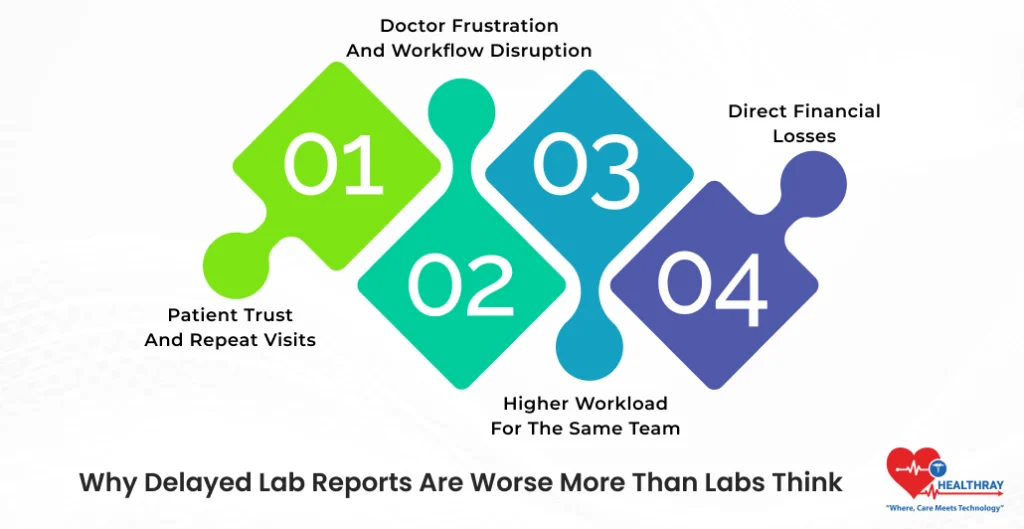
Most of the labs are aware that delays impact the patient experience, but they do not often estimate the full effect. We should disaggregate the hidden losses.
Patient Trust and Repeat Visits
Patients expect reports on time, especially in today’s fast-paced medical environment. Nevertheless, they lose faith when they fail to get them.
Suddenly, they find another lab to provide them with quicker service. Eventually, the clinic that referred the patient also begins to reconsider its partnership.
Essentially, the effect of delayed lab reports is not only immediate patient dissatisfaction but also the reduction of the referrals in the long run.
Doctor Frustration and Workflow Disruption
Physicians rely on quick outcomes in order to make decisions. When reports arrive late, treatment plans stall. Clinic queues slow down. Follow-up appointments stretch out. This puts an unjustified burden on specialists and patients.
The similarity in the complaints of the doctors in INDIA and the USA is that, they are not able to provide the appropriate care when the reports flow in a random manner.
Higher Workload for the Same Team
Any delay leads to additional calls, increased repeat requests, and continuous review of waiting test lists. Due to this fact, technicians find it difficult to cope with their day-to-day jobs. This in turn leads to stress and lack of efficiency.
Direct Financial Losses
The longer a report stays pending, the higher the operational cost becomes. Labs lose money because:
- Staff must revisit old cases
- Machines remain underutilized.
- There is a need to repeat sample collection.
- Referring physicians transfer patients to quicker laboratories.
This is where the majority of the labs fail without knowing that the timely reporting directly affects the revenue.
How Delayed Lab Reports Affect Patient Care
Clinics do not pay much attention to the impact of delayed lab reports on patient care. When results arrive late, treatment timelines stretch unnecessarily. As an example, delayed CBC may delay surgery clearance. Delayed sugar tests may slow down monitoring of diabetes. The delayed biopsy may cause stress for days.
Moreover, emergency cases suffer the most because decisions depend on quick numbers. If the result cycle slows, the entire clinical chain slows with it. This means that doctors will be wasting time, and patients will be left with the burden of uncertainty.
Now it is evident that speed is not just a matter of convenience; it is safety.
Where the Delay Really Happens Inside the Lab
Delays are not usually caused by analyzers despite many lab owners thinking that the cause of the delay is the testing machine. On the contrary, they are products of all that is around them.
1. Ineffective Sample Tracking
The labs that are spreadsheet based have difficulty in monitoring the location of every sample at any particular time. Consequently, samples do not take the required time.
2. Mismatched Data Across Systems
There are various tools that generate disjointed information. Technicians can switch between interfaces and this slows down data management of laboratories and increases errors.
3. Manual Report Entry and Printing
Each minute of typing or reformatting a report contributes to the total time. Reporting therefore is sluggish during high time.
4. No Automation for High-Volume Days
Unpredictable peak demands occur in Labs in INDIA and USA. In the absence of lab automation or systematic automated lab workflows, the team becomes overwhelmed.
As a matter of fact, there are delays that occur due to workflow gaps, rather than absence of skill.
How Modern Tools Reduce Delayed Lab Reports
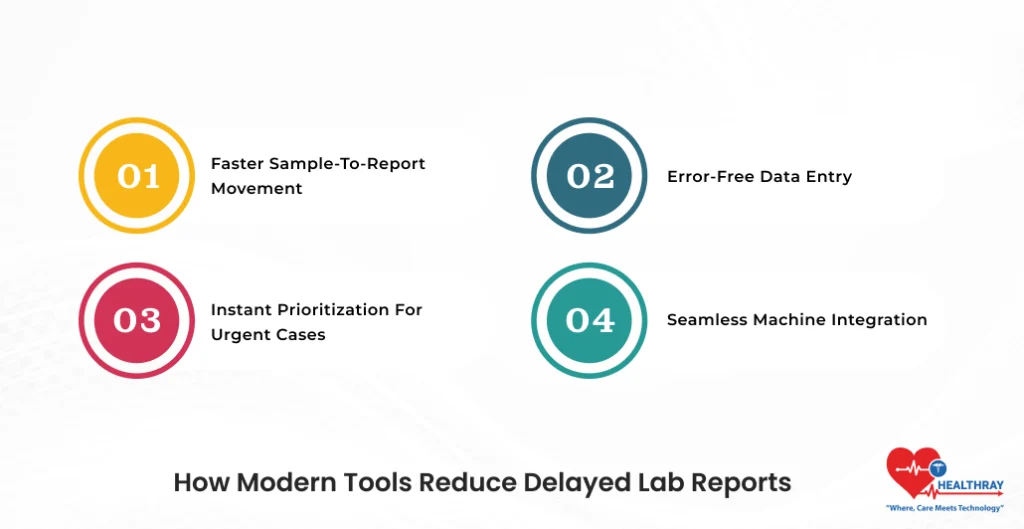
Labs which transform to structured systems immediately cut down chaos. They also gain control over timelines because automation handles the repetitive tasks. Let’s explore how modern lab management software fixes the problem.
1. Faster Sample-to-Report Movement
A new LIMS system will track every sample once they are in the laboratory. Status is automatically updated thus eliminating guesswork and avoiding bottlenecks.
2. Error-Free Data Entry
Reporting becomes easier and quicker with reduced manual processes. In addition to this, this minimizes the forward and backward corrections among employees.
3. Instant Prioritization for Urgent Cases
The system draws attention to urgent samples. Due to this, technicians are more efficient in dealing with deadlines.
4. Seamless Machine Integration
Modern systems sync with analyzers. The data flows automatically, which shortens overall report turnaround time.
The Clinically Accurate Way to Fix Delay Issues Permanently
Labs that desire uniform speed have a straightforward trend.
Step 1: Digitize Every Stage
Digitally recorded labs are seldom lost of samples. Once data is centralized, then the confusion is removed.
Step 2: Remove Manual Workflows
The best teams are slowed down by manual processes. When such steps are eliminated in labs, the speed of reports is immediately increased.
Step 3: Use Tools That Support Growth
Today, Labs in INDIA and the USA are developing rapidly. They require tools that are able to grow with them and not tools that are going to keep them behind.
Step 4: Train Staff for Consistency
The teams perform better in practice when all the members adhere to the same approach. This ensures that there is consistency in speed.
 PRO TIP
Healthray: Bringing Speed and Clarity to Every Report
Healthray streamlines the whole process of lab work such that your staff will not have to worry about getting lab reports late again. It replaces fragmented processes with one connected flow designed for accuracy, speed, and simplicity.
The following are the benefits that labs receive with Healthray:
- Real-time sample tracking
- No manual dependencies, centralized reporting.
- Rapid connection to analyzers.
- Fluent workflow pathology lab software.
- Intelligent scheduling of urgent tests.
- Faster lab data management
- Printing and safe digital delivery.
Healthray supports as well the advanced lab management system software, which enables the labs to monitor the workloads, assign duties and measure peak-hour pressure. Because of this, teams work smoother and complete reports far earlier than before.
All in all, Healthray assists the laboratories in INDIA and the USA to restore order to the day to day business.
Conclusion
Late lab reports are even more expensive than money. They destroy trust, interrupt clinical workflow, and delay decisions that are important. Labs which address this problem at the outset create greater patient loyalty and improved relationships with hospitals and clinics. Their results are also less prone to errors and less work pressure.
When labs adopt smart systems like Healthray, speed becomes predictable. Information remains clean, employees operate with ease and all the reports arrive to the physician on time even on a busy day.
In case you want your lab to eliminate delays forever and provide quality service, it is high time to modernize your workflow with the help of LIMS software. Get a free demo and find out how easily you can change your reporting speed.