






Summary
The reason why operating costs at diagnostic labs do not tend to increase due to a single large decision is uncommon. Rather, they grow slowly by slowly with a daily inefficiency that becomes normal with time. Manually coordinating and checking, slow visibility, and reactionary planning are some of the activities that gradually strain resources. The reason why lab cost reduction strategies are effective is because they find ways of eliminating these hidden leaks as opposed to imposing drastic cuts.
The automation and systematic systems transform how time is spent in labs and not only money. Once the habitual work is transferred to systems, the trained professionals are back on track. Errors reduce. Planning improves. As a result, the cost management will be sustainable and not stressful. Besides, automation promotes expansion without causing an increase in anarchy.
Accountability is also enhanced using digital systems. Every action leaves a trace. Making decisions is based on facts and not assumptions. As time goes by, this clarity enhances confidence in leadership. Expenses cease to be erratic.
The most important thing is that it does not imply that operational costs will be minimized at the expense of the quality. Smart workflows ensure accuracy, pace, and credibility instead. Labs that embrace well organized automation early on achieve stability earlier. Delays by those who delay cost them later in fixing things. This blog discusses the natural appearance of cost discipline when systems facilitate the systems of operation of the diagnostic labs.
Introduction
The modern diagnostic laboratories work under severe pressure. Volumes rise. Expectations increase. Margins tighten. However, most laboratories continue to depend on people to perform their duties, which could be better handled by computers. This leads to the upward creep of costs that is not clearly visible.
The problem can be solved more readily when the labs implement a Laboratory Information Management System that streamlines the daily activities into one process. Teams operate in a single structure, as opposed to using spreadsheets, registers, and disjointed tools. Errors reduce. Rework declines. Time resorts to what is important.
Operational strain is easily experienced as inevitable. Nonetheless, it is due to disjointed operations as opposed to workload. In case systems automatize coordination, labs no longer react and begin to plan. Therefore, lab cost reduction strategies are no longer idealistic but realistic.
Notably, automation does not displace human beings. It supports them. Experienced workers have to spend less time working to repair preventable mistakes. Leaders do not lose their focus in the process of seeking updates. In the long term, the lab changes to no longer focus on firefighting, but instead forward planning. That transformation is everything different.
Why Manual Lab Operations Inflate Costs Over Time
Manual operations hardly go dead simultaneously. They instead cause little inefficiencies that build up without saying. Each time an entry is done twice, when approval becomes delayed, or a manual reconciliation is done wastes time. That period will end up with increased operation costs.
With the increase in labs, coordination is more difficult. Sample volumes rise. Timelines are made tighter in reporting. Paper systems are not coping up. In turn, teams make up by working longer hours or including resources. Expenses increase with no increase in results.
Also, patterns are lost in the manual processes. Executives have a hard time pinpointing sources of money leakages. There is experience based decision making without data. Over time, this lack of operational cost visibility weakens control.
This is ended by automation. Structured systems measure activity in real-time. Bottlenecks become visible. Corrections occur early. This makes the cost control to be proactive and not reactive. Labs are stabilized not through effort, but by design.
When Skilled Lab Staff Spend Time on Preventable Work
Highly trained professionals often spend hours on coordination rather than diagnostics. This disparity increases both expenditure and de-motivation. Staff fix issues that systems could prevent. Errors repeat. Fatigue grows.
In time, laboratories become inefficient not due to the lack of skill in teams, but as a result of inefficiency in the systems. Automation creates equilibrium. Experienced employees are concerned with precision and approval. Systems handle tracking and coordination. The latter division enhances performance and stabilizes expenses.
Learn more: Digital Labs 2026: Zero-Paper Future
Lab Cost Reduction Strategies Begin With Automating Repetitive Work
The majority of lab cost reduction strategies fail since they do not focus on the factors but only on the symptoms. Reduction of costs without working processes leads to resistance and burnout. This is not the case with automation. It removes friction quietly.
Repetitive tasks consume time without adding value. The daily amount of resources used in data entry, status checks, and manual follow-ups is a drain. Lab workflow automation absorbs these tasks into predictable processes. Automatic updates occur automatically. Errors surface early.
As a result, labs regain time. That time shifts toward patient care, quality checks, and improvement initiatives. Costs stabilize naturally. Automation helps to grow without duplication of effort.
Redirecting Workforce Effort From Process Handling to Patient Care
Instances of automation in coordination give the staff back their times. Validation improves. Communication becomes clearer. Importantly, people feel supported rather than replaced.
This re-focus gives credibility both internally and externally. The patients are able to get timely results. Doctors rely on consistency. Automation also increases efficiency and reputation with time.
Diagnostic Lab Management System as the Engine of Workforce Efficiency
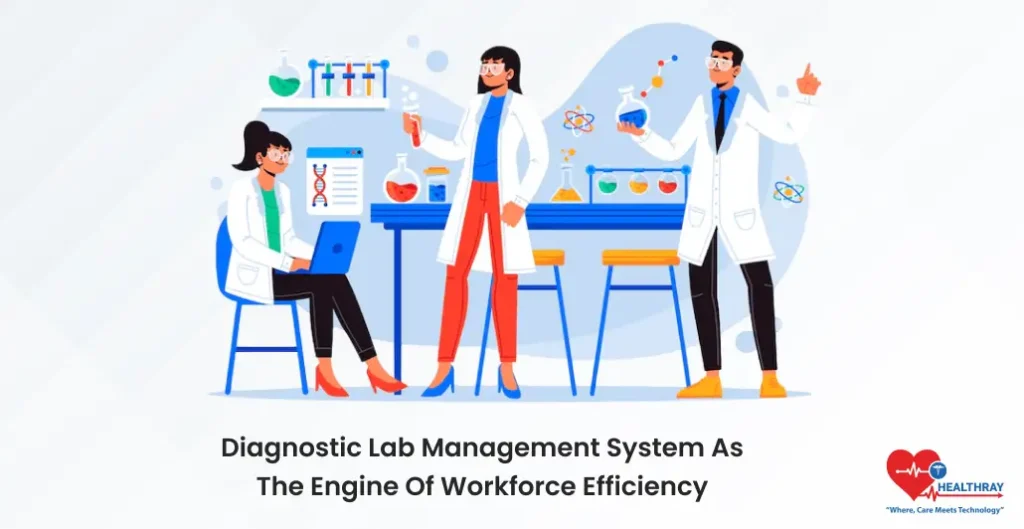
A diagnostic lab management system is not just a way of organizing data. It organises work flows between departments. Tasks follow defined paths. Approvals remain traceable. Confusion reduces.
Teams observe development immediately instead of asking the questions, who did what. Leaders are performance trackers and not micromanagers. As a result, there will be an increase in productivity without the pressure.
Efficiency improves because systems enforce discipline consistently. People no longer rely on memory or follow-ups. Over time, labs operate with rhythm rather than urgency. Such a rhythm control is more expensive than any manual intervention.
Lab Workflow Automation Cuts Hidden Labor Costs
Hidden labor costs often escape attention. Overtime, rework, and delays feel unavoidable. Yet automation exposes their root causes.
With lab workflow automation, processes follow logic instead of habit. There is a smooth movement of samples, validation and reporting all with the help of a patient report delivery system.
 PRO TIP
In the long run, automation transforms the labor hours to productivity gains. Labs have fewer defects and increased value.
Diagnostic Lab Software That Turns Time Savings Into Cost Control
Diagnostic lab software converts the saved time into quantifiable results. Quick processes eliminate backlog. The transparent data enhances planning. Leaders act earlier.
When workflow stabilizes, labs become confident. Expansion feels manageable. Costs remain predictable. Judgment is not taken over by software. It supports it with clarity.
Operational Cost Visibility Improves When Systems Replace Manual Tracking
Patterns are concealed in manual tracking. Systems reveal them. Under automation, the leaders recognize the areas of concentration of resources. Costs align with activity.
Smart decisions are made through better operational cost visibility. Investment is aimed at actual requirements. Waste declines. Labs plan with confidence.
Real Time Lab Operations Monitoring Prevents Workforce Overload
Real time lab operations monitoring highlights pressure points early. At the point when stress is about to accumulate, teams rebalance. Accuracy improves. Burnout reduces.
Equipment Utilization Improves When Workflows Stay Predictable
Much of the laboratory spending is on equipment. Machines stand idle in the downturns of coordination and teams scramble in the upsurge. This disequilibrium enhances wear and reduces a return on investment. Better equipment utilization should start with the clarity of the diagnostic lab workflow instead of new acquisitions.
Machines can work on a regular basis when the flow of samples is controlled by systems. Downtime reduces. Preventive maintenance is easier to schedule. As a result, labs utilize more value out of the available infrastructure rather than spend too soon.
Distribution of workload is also achieved through automation. It is not a matter of habit but capacity that makes the difference in the movement of the samples. The shift ensures the health of equipment and enhances throughput. In the long term, the controlled use directly promotes the lab cost reduction strategies without affecting the service quality.
Test Turnaround Time Shrinks When Cost Control Becomes System-Led
Delay is usually indicative of inefficiency but not volume. Manual handovers, unclear ownership, and repeated validations slow reporting. These time wastages add pressure and non-traceable costs to operations.
Organized systems reduce the test turnaround time by eliminating ambiguity. There is a certain direction in every step. Alerts surface early. Automatic escalations take place.
As turnaround improves, labs reduce repeat inquiries, follow-ups, and rework. Staff focus on validation instead of coordination. Patients get the results in a shorter period of time. Doctors trust consistency. Cost control and efficiency come together.
Step towards digital era with our healthcare solution
Revamp your hospital facilities and embrace change for better healthcare management. Ease in managing and organizing large medical datasets leads to effective analysis. Seize the opportunity now!
Diagnostic Data Compliance Prevents Costly Rework and Penalties
Failure to comply generates costly effects. Lack of record of logs, ambiguous edits, and missing records results in audits, corrections, and reputational risk. The cost of correcting these problems is much higher than averting them.
When the labs align operations to diagnostic data compliance, documentation ceases to exist. Actions are automatically captured in systems. Traceability stays intact.
Compliance no longer becomes an additional burden. Rather, it becomes a normal business process. There is stability in costs due to the absence of surprises. In the long run, compliance discipline secures credibility as well as budget.
Patient Report Delivery System Reduces Follow-Ups and Manual Corrections
Mistakes in reporting waste time and confidence. Manual delivery processes introduce delays, confusion, and rework. Each correction pulls staff away from productive work.
A system of patient report delivery ensures that reports take a predetermined direction. Status updates remain visible. Access controls protect accuracy.
Follow-ups go down as reporting stabilizes. Employees cease to respond to repetitive questions. Patients gain confidence. Timely delivery is important to doctors. The cost control will also be better by saving friction silently.
Diagnostic Lab Workflow Alignment Eliminates Redundant Effort
Disjointed workflows are a waste of labor. There is repetition of steps as systems are not conversant with each other. This redundancy has no significance to cost addition.
Work flows in a logical manner when labs coordinate activities by developing an organized diagnostic lab workflow. Dependencies stay clear. Ownership remains visible.
With increasing alignment, there is less duplication in labs. Teams collaborate smoothly. The cost reduces without reducing the speed or quality. Where memory has failed, systems provide uniformity.
How Diagnostic Labs Can Reduce Operational Expenses
Most labs are afraid that quality is at risk because of cost reduction. As a matter of fact, the actual danger lies in inefficiency. When systems replace guesswork, quality improves.
That is what diagnostic laboratories can do to make their operations cost efficient in the long run. Robotization deals with redundancy. Visibility replaces assumption. Teams work with clarity.
Costs fall because waste disappears. Quality rises because focus returns to diagnostics. The development does not seem chaotic but manageable.
Healthray Built for Sustainable Cost Discipline in Diagnostic Labs
Healthray does not use cost control as a feature list, but rather as an operational result. The platform organizes day-to-day activities in a manner that promotes efficiency instead of imposing it.
The system helps in automation in terms of coordination, reporting and monitoring. The visibility is not discontinuous. Accountability stays clear. When teams are pressured, they cease improvising.
Healthray also enhances real time lab operations monitoring and highlights pressure points early. of labs in order to empower leaders to take action at an early stage. Facts are used in making decisions and not estimating. Expenses are consistent with the increase in the volumes.
 NOTE
NOTE
Conclusion
During cost reduction, it does not have to be aggressive. It needs to be operationally clear. Labs become non-reactive and begin to plan when systems direct day-to-day work.
Lab cost reduction strategies succeed when automation supports people rather than replacing them. Anxiety is substituted with visibility. Firefighting has been supplanted by predictability.
When a diagnostic lab is under your management, it is high time you studied the reality of work flow. Book a free demo of Healthray and experience how organized systems save money and ensure accuracy, speed, and confidence.
Select the tempo of your lab tomorrow and not today.