


Brief Summary
One of the most asked questions from the healthcare organization. And, if you are the one that searches for the answer, your research ends here. We came with a single solution – the hospital management system that provides hospital revenue optimization strategies, which increases income without raising expenses. Check it out for extensive briefing :
Introduction
While one set up the healthcare organization – they have one clear objective that is to earn more revenue. But, it is not that simple as saying. Need modern strategies, hard efforts, and inspect whether the expenses increase or not. Still, confused how to implement strategy to each workflow phase. And, practically it is definitely not possible.
However, if you are picking the right healthcare solution – you won’t face many hardships to achieve your long-term goals. Hospital revenue optimization requires a consistent approach, which is easily given by the hospital management system. It boosts your healthcare practice, improves financial viability, and mitigates operational expenses.
New healthcare technology gives you the intense power to remodel your medical working system, giving them the right direction that assists to increase revenue with less expenses. Furthermore, it provides more personalized service, creates a smart daily routine that augments efficiency, reduces risks, and saves expenses.
Common Challenges Occur In Hospital Revenue Optimization
Doesn’t matter how many physical facilities you have in the healthcare organization, obstacles always occur in the optimizing healthcare process. Moreover, it creates struggles in controlling hefty clinical funds, increases bed-debts, and enhances subtle nuances in managing expenses and applies compliance standards. Here are the common obstacles you found in hospital revenue optimization :
Incorrect and Missing Healthcare Documents
If you are using spreadsheets or making entries of every transaction, it takes an intensive effort and huge time. Moreover, it affects the complete revenue cycle and increases the aggregate expenses. Facing vital hurdles due to insufficient medical records :
- Increases auditing time
- Frequent interactions with doctors
- Creating invoicing errors
- Enhances potential fines
- Intensify risks
Accurate comprehensive details easily administers the clinical process, increases financial performance, and also, augments the efficiency level.
Complex To Apply Coding Rules Manually
Implementing coding regulations while drafting invoices and financial statements is the big challenge, while you do it manually. Moreover, if you are missed it and then, you have to face the adverse consequences like :
- Enhances cash flow issues
- Increases error rates
- Decreases financial stability
- Inefficiency in financial work
- Augments non-compliance errors
Additionally, it does not help you in the advanced analyzes like anticipating outcomes and cannot find the precise reason for rejecting claims.
Delay In Approving Claims
A critical hurdle and negatively affecting the entire financial cycle and enhances burnout of healthcare staff. Moreover, it affects the patient care, decreases the clinical operational service, and can impose heavy financial penalties. Let’s discuss what can we do to optimize insurance claims :
- Analyzing the denial patterns
- Persistently store needed details
- Instantly check the claim documents
- Quick alerts in case of any error
- Regularly reviewing information
When you adopt these strategies, you will strengthen the financial performance of your healthcare and render high-end quality care.
 PRO TIP
Outdated Technology, Decreases Performance
Conventional healthcare technologies, not work anymore in the modern era because the patient demand is advanced and creates inefficiency. Moreover, the HMS systems increase the error chances, enhance denial rates, and augment the rate of repetitive activities.
If persistently you utilize the traditional technology and delayed working tasks, it enhances dissatisfaction score, increasing human resource expenses, and augments revenue leakage. It enhances operational challenges, enhances staff burnout, improves processing of insurance claims, and prevents claim denials.
Lack of Skilled Training
A critical hurdle in the hospitals, where personnel don’t know how to tackle the wide financial funds in the appropriate manner and embed with the protocols. And, if you do not comply with the necessary rules in the standard format, it increases financial penalties along with patient health risks. Let’s understand how to bridge the gap :
- Conducting regular training sessions
- Adopting the smart HMS like system
- Provide financial literacy to staff
- Encourage them to obtain certificate
- Harnessing AI-enabled technologies
Healthcare training must be the effective one, otherwise it adversely impacts on the hospital organization and increases expenses instead of minimizes costs.
Hospital Management System – The Best Practice You Ever Found For Maximizing Revenue Without Raising Expenses
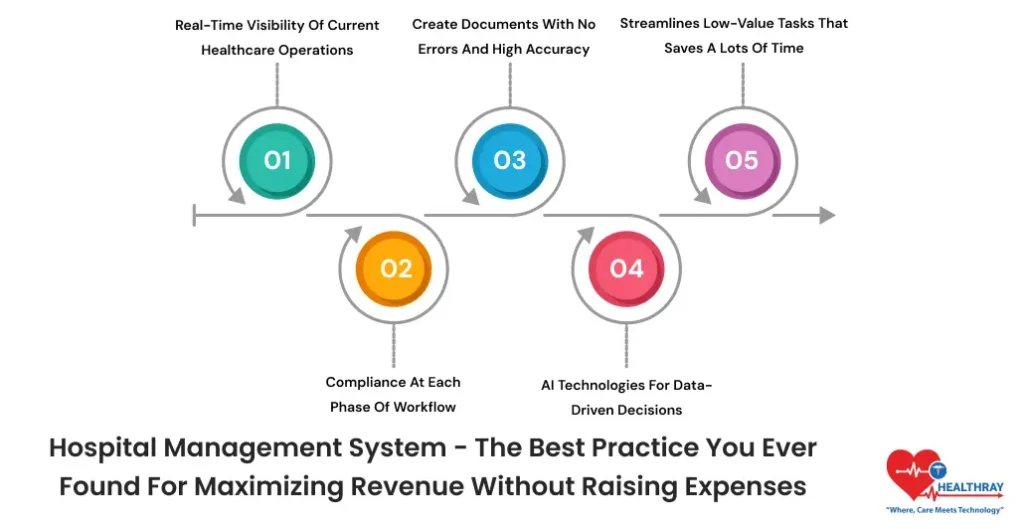
Require the helping hand for optimizing healthcare revenue? Then, the hospital management system is the superb answer for you. Furthermore, researchers say that it actually decreases the operational expenses, enhances efficiency, saves costs, increases performance, and reduces no-shows. Let’s take a look why its it the best practice :
Real-time Visibility of Current Healthcare Operations
- Effective for professionals, patients, and third-party healthcare systems, they can check real-time details from any digital device.
- Assisting to get the asset details, about the patient location, and get stock information in the current time.
- Maintains the workflow practice, resolves the clinical issues instantly, and handles stockout details.
- Decreases the healthcare expenses, enhances clinical staff output level, and also, mitigates expenses.
Compliance At Each Phase of Workflow
When you leverage the smart hospital information management system for hospital revenue optimization, it must adhere with the healthcare protocols. Moreover, it smoothly complies with the necessary legal regulations like General Data Protection Regulations, European Commission, and other protocols without any stress and feeling burdensome.
Therefore, the hospital management system improves operational performance, increases financial sustainability, maximizes efficiency, and saves large costs.
Create Documents With No Errors and High Accuracy
A robust healthcare solution provides extensive capability to draft 1000’s of healthcare documents with not a single mistake, it automatically inspects the huge or smaller mistakes and corrects them swiftly. It’s because of :
- Structured medical information
- Have drop-down options
- Integrate with audit trails
- Protect common data errors
- Increases precision and reduces risks
Rendering smooth coordination across divisions, seamlessly transferring documents, easily reviewed, and complies with necessary rules.
AI Technologies For Data-Driven Decisions
If you want to reinvent the healthcare working system, the AI methodologies, the suitable one for you. Moreover, it incorporates step-wise workflows, where the advanced technologies play the critical role in accumulating information, eradicating errors, and using machine learning principles to analyze what the data pattern is.
Furthermore, the deep technologies come to create the neural networks and inspect the predicting and actual errors, and try to minimize it with the varied procedure. Helps to predict outcomes and easily make data-driven decisions.
 NOTE
NOTE
Streamlines Low-Value Tasks That Saves A Lots of Time
In the daily routine of healthcare facilities, there are a massive number of activities, which are conducted with more precision and less time period. Moreover, it encompasses :
- Administering medical records
- Controlling financial documents
- Tracks healthcare inventory
- Manages healthcare staff
- Create analytical reports
Therefore, it helps clinical staff to take more patient care time, focusing on the strategic analytical part, and examining hospital revenue optimization strategy.
Step towards digital era with our healthcare solution
Revamp your hospital facilities and embrace change for better healthcare management. Ease in managing and organizing large medical datasets leads to effective analysis. Seize the opportunity now!
What Are The Key Indicators For Maximizing Revenue Performance?
Are you confused in measuring healthcare performance? And, it is difficult for you to inspect whether your hospital organization is growing or stagnant. Moreover, Here are the key indicators that helps to know about the status of healthcare industry :
Patient Churn Rate
Check your patient churn rate? If it decreases then, it is good and you should continue to invest in the current technology.
Moreover, if it’s increasing, you will stop using it and move to the other critical strategies. It increases patient acquisition expenses and reduces potential losses.
Net Collection Rate
Inspect how much revenue you collected after settling the bad debts? It has the specific formulae for computing, the HMS platform helps to reckon it. Moreover, it is a critical indicator because it points out cash flow and efficiency. Its computed with :
- First, get the sum of charges
- Cut down contractual rates
- Calculate total payments
At last, divide total payments by the remaining amount (sum of charges – contractual rates). It its below 95%, requiring severe attention. And, if it is higher than 95%, indicates the good performance of the organization.
Patient Satisfaction Score
For meticulously checking the healthcare revenue performance, it is better to examine how many patients are retained annually and most important, take automatic feedback, whether they are happy with the clinical service. If you have a high patient satisfaction score, then it indicates :
- Quality care services
- Reduces errors
- Faster claims
Therefore, hospital queue management systems improve healthcare outcomes, increase healthcare reputation, and enhance work efficiency.
Claim Denial Rate
A high or low denial rate tells you a lot about hospital financial performance. Directly proportional to the hospital revenue. Furthermore, If the claim rate is a bit higher, then it indicates a vast effect like decreasing cash flow, affecting the financial stability, and decreasing efficiency.
If the denial rate is less than 5%, then it shows the great hospital performance and it is higher than 10%, indicating the heavy revenue loss. In between, you can adopt new strategies and improve clinical results.
Why Are Most Healthcare Adopting The Smart Healthcare Strategies?
Smart hospital strategies shift from traditional approaches to a modern system, where it streamlines for you to concentrate more on the patient-centered care and helps to administer clinical services effectively.
Furthermore, it has an intelligent infrastructure that seamlessly captures varied sets of clinical data, easily examines and predicts information, and effortlessly communicates across the healthcare divisions.
It increases patient convenience, improves clinical service quality, administers healthcare crises, improves experience, and maximizes healthcare efficiency.
Conclusion
Do you want to increase your healthcare revenue without increasing costs? Then, the hospital management system is the one for you and perfectly applies hospital revenue optimization strategies. Furthermore, it is the superior clinical practice because it shows real-time visibility of clinical operations, easy compliance at each phase, draft documents with peak accuracy, AI methodologies for impactful decisions, and controls low-value tasks to save more time. The key indicators include patient churn rate, patient satisfaction score, claim denial rate, and net collection rate, which tells you more about the healthcare performance.