


Summary
AI chatbots are extremely valuable applications for medical centers. AI bots are constructed with the goal to make discourse between patients and healthcare providers more accessible, immediate, and available 24/7. Chatbots are extremely utile in critical circumstances. They can scrutinize the basic symptom profile of patients and instruct them whether they need an urgent doctor consultation or not. This reduces the number of unplanned hospital visits and ensures doctors concentrate on more serious cases. In this blog I will delve into how AI chatbots in hospital systems can strengthen patient collaboration. Also, I will discuss how AI virtual assistants work alongside medical professionals in prescribing a personalized regimen to patients. Keep reading!!
Introduction
Fast, unambiguous, and trustworthy patient communication is paramount in the modern digital medical care landscape. Patients would have to call several times to get their questions answered in a traditional system. They have to visit hospitals for appointment booking, investigating report status, confirming doctor accessibility, and engaging in billing-related questions. This leads to physical exertion and staff responsibilities also get stepped up. However, AI chatbots in hospital systems can seamlessly overcome these complexities by taking over all the monotonous tasks of human employees, from organizing appointments to final discharge.
AI chatbots conveniently interface with hospital management system software and deliver real-time, normal responses to patients’ queries. With HMS, the patient can simply chat and book the appointment, receive reminders and check the status of their test reports. Overall, AI chatbots have been considered an intrinsic part of a healthcare management system and make patient conversing more informed, faster and efficacious.
AI Chatbots in Hospital Systems: Why do Healthcare AI Chatbots Fail in Real-World HMS Deployments Despite Initial Success?
In real-world patient management system deployments, AI chatbot failure is a common concern, particularly when every practice appears to be flawless in the pilot trial stage.
1. Integration Issues with Legacy Systems
Problem: Traditional HMS are incapable of incorporating AI conversational assistants. Further, this typically breaks down the data silos and workflow in the medical practices.
Solution: Hospitals should begin with API-based integration and then embark on a phased implementation process and initially concentrate primarily on fundamental components (like appointments and billing).
2. Real-World Data Complexity & Accuracy Drift
Problem: AI Chatbots in hospital systems seem accurate in a pilot but provide wrong and biased responses in real data fluctuation.
Solution: Hospitals should regularly reprogram the model, use diverse data sets and also add human-in-the-loop verification.
3. Infrastructure Limitations
Problem: Insufficient internet connections, electrical power shutdowns, and low server storage space negatively affect the functionality of AI conversational agents.
Solution: Healthcare organizations should apply cloud-based scalable systems and offline recovery options and invest in high-quality IT systems and infrastructure.
AI Chatbots in Hospital Systems: Strategies to Integrate Chatbots with Legacy Hospital Systems
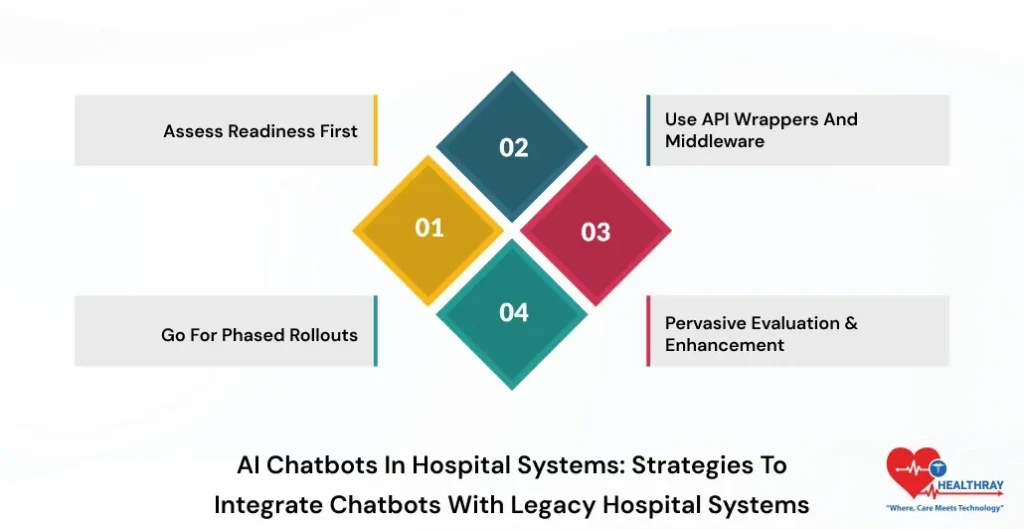
1. Assess Readiness First
Before embarking on AI bot integration, hospitals should prioritize focusing on current readiness. Further, they should evaluate infrastructure, staff skills and compliance requirements. They should audit existing EHR to understand compatibility gaps more accurately.
2. Use API Wrappers and Middleware
Directly redesigning the existing system could be impulsive. Further, hospitals should focus on the “build around, not through” approach. Hospitals should use tools such as FHIR/HL7 APIs, REST wrappers and middleware. These tools allow asynchronous data exchange that opens avenues for real-time upgrades without breaking the foundational structure of the system.
3. Go for Phased Rollouts
Integrating the full system entirely is not a prudent approach. Firstly, hospitals should ideally start operations with small pilots such as appointment reservation and patient standard queries. When the system becomes stable, then gradually clinics can incorporate advanced modules such as billing and medication management. This reduces the potential risks posed and interruptions in operations thoroughly.
4. Pervasive Evaluation & Enhancement
After integration, the hospital should systematically check on the AI robotics performance. They should offer suggestions for enhancements whenever necessary. Further, they should acquire feedback from every team participant. This approach will help you understand the bot’s performance more thoroughly. And ensure that the protocols are satisfactory and effective.
Solutions to Prevent AI Hallucinations in Healthcare Chatbots
1. Use Retrieval-Augmented Generation (RAG)
AI bots should not only base themselves simply on the training knowledge. Further, AI chatbots in hospital systems should be capable of using the RAG approach to fetch data in real time from trusted resources such as medical databases, EHRs and verified records. This will make the response more trustworthy and factual in nature. This approach naturally reduces the negative implications of hallucinatory states.
2. Human-in-the-Loop Oversight
In healthcare, 100% automation is not safe. That’s the reason human intervention is absolutely mandatory as well. Further, hospitals should escalate in-depth searches, such as symptoms, diagnosis and medicines to doctors or highly knowledgeable medical experts. Use confident scoring to point out low-confidence responses. for a normal review.
3. Strong Guardrails and Prompt Design
It is highly imperative for the medical sector to provide concise directives to chatbots. Further, hospitals can use negative prompts and low temperature settings to educate chatbots for predictable and factual responses.
 PRO TIP
How do AI Chatbots in Hospital Systems Communicate with EHR Based Systems?
1. Basic Integration Concept
AI conversational assistants intuitively synchronize with EHR (Electronic Health Record) databases. This allows users to validate patient information conveniently. Through this integration, automated chatbots can give individualized and dependable responses that are consistent. For example, AI provided relevant information related to patient history, reports and medications. This makes the practices faster, and doctors can easily browse the material that typically requires a long time with a hand-held system.
2. Use of APIs and FHIR Standards
For integration, hospitals should adhere to secure APIs or standards like HL7 FHIR . Further, the API serves as a gateway to facilitate a secure conversation between the simulated chatbot and the digital health record (EHR) system. FHIR (Fast Healthcare Interoperability Resources) assembles the data into relatively small, feasible resource sets. Read our blog healthcare data security india to know more about it.
3. Logging and Record Updates
Chatbots update all the interactions in the ehr system proactively. This helps doctors to access complete patient communication histories. Moreover, it helps in more accurate screening and ongoing continuity of medical treatment.
Security Best Practices for Chatbot-EHR Data Exchange
1. End-to-End Encryption Everywhere
The data transmission should be fully protected by encryption in chatbots and EHR data exchange. Further, hospitals should use TLS 1.3 for data transit. Use AES-256 encryption when data is in rest mode. This approach safeguards against the possibility of unlawful disclosure and data lapses.
2. Input Validation and Sanitization
It is highly imperative for hospitals to properly validate and sanitize chatbots’ input messages. If a hospital fails to verify the input validation, this exacerbates the probability of SQL injection and XSS attacks. Further, hospitals should check API payloads against predefined schema and should block suspicious inputs.
3. Rate Limiting and API Protection
To protect the EHR APIs from overload and attacks, hospitals should implement rate limiting. Further, this approach ensures only a limited request is addressed in a given time. This naturally cuts down the likelihood of DDoS breaches. Hospital can capture any inappropriate use instantly.
Step towards digital era with our healthcare solution
Revamp your hospital facilities and embrace change for better healthcare management. Ease in managing and organizing large medical datasets leads to effective analysis. Seize the opportunity now!
What ROI can Hospitals Expect to Receive from AI Chatbots in Patient Communications?
1. Overall ROI Expectation
Hospitals can expect strong ROI from AI chatbots. Further, hospitals can expect recovery of initial investments in 12-18 months. This ROI predominantly stems from cost cutbacks, higher levels of patient contentment and enhanced operational effectiveness.
2. Cost Reduction in Operations
AI bots can accurately deal with 60–80% of routine queries such as appointment registration, FAQs and basic customer service. This significantly minimizes the call center’s cost. Additionally, it reduces the staffing cost up to 30–40%.
3. Data-Driven Insights
Chatbots collect data on patient interaction. Further, this helps hospitals easily analyze demand patterns and patient behavior. By validating these powerful insights from data, hospitals can easily engage in better planning, targeted marketing initiatives, and care delivery. Also, read our blog hospital revenue optimization to know more about it deeply.
How do AI Chatbots Streamline Prescription Refills through HMS Integration?
1. Easy Refill Request Process
It is easy for hospitals to request prescription refills through AI chatbots in hospital systems. Patients just need to submit messages like “refill my headache medicine,” and AI automatically takes care of the corresponding request. It eliminates the need for placing multiple phone calls and visiting hospitals. Additionally, the entire process becomes fast and convenient.
2. Smart Patient Verification
Chatbots verify the patient details, such as login details, OTP and biometric methods, before processing the refill request. Further, it efficiently synchronizes with the HMS/EHR system. And it efficiently validates the patient’s true identity. It lowers the threat of unauthorized intrusion and keeps the entire premises intact and safe.
3. Safety Evaluations and Doctor Authorization
Chatbots ensure a safety check before approving the refill request, such as verifying allergic reactions, current reports and doctor memos. Simple cases are automatically approved. However, before submitting a request, complicated and critical cases are first forwarded to physicians for final confirmation.
 NOTE
NOTE
Conclusion
AI chatbots in hospital systems are assisting healthcare facilities in delivering round-the-clock services. Conversation bots provide personalized responses based on patient history. Also, it automates all the routine work of appointment booking, reminders and FAQs handling. Hospitals should perceive AI chatbots as a support system, not a replacement. AI conversational assistants are a strong business investment if they’re properly implemented.