


Summary
Hospital CRM software is not an option anymore; it is now essential for modern patient relationship management. This blog post explains what hospital CRM software is and how it benefits healthcare facilities in 2026.It outlines key features, highlights benefits, and provides a simple implementation roadmap for beginners. It is relevant and effective across the entire spectrum of healthcare facilities.
Introduction
Recall a situation in which a patient exited from your hospital without receiving any follow-up calls. Consider an example of an overscheduled ward that had a vacant space due to a missed appointment. These cases do not just happen by coincidence-they are symptoms of a basic malfunction of operations.
Hospitals will face rising pressure in 2026 from increasing patient demand and high staff turnover. They will also deal with fragmented systems and growing competition from innovative healthcare providers. The present generation of Hospital Management System has outgrown their functions as mere record keepers of patient information and need advanced relational management functions.
A Hospital CRM System solves this by centralizing data, automating tasks, and delivering personalized care at scale. The global market of healthcare customer relationship management systems, which is projected to reach $17.10 billion in 2024, is projected to reach 43.4 billion in 2034 (Precedence Research, June 2025). This kind of rapid development leads directly to the path, in which the management of healthcare is going to develop. This article explains healthcare CRM, its features, benefits, and how to implement it successfully.
What Is a Hospital CRM System?
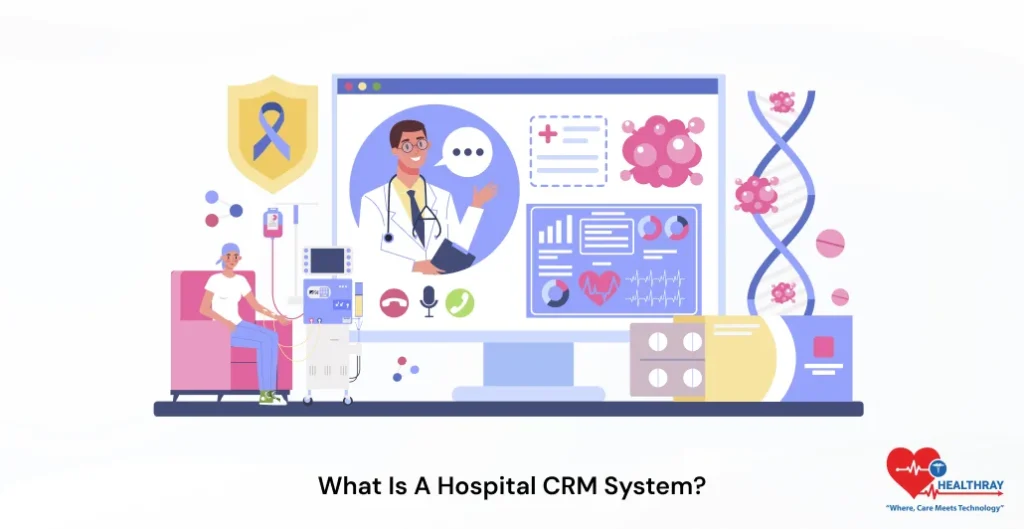
A Hospital CRM system is a Customer Relationship Management solution designed specifically for hospitals. This system is vastly different as compared to the traditional customer relationship management systems which are commonly used in businesses. Healthcare CRM solutions support clinical needs, while traditional CRMs focus on sales and customer management.
It is far beyond a record of information to make contacts.It centralizes patient records, including admissions, treatments, appointments, billing, and feedback in one system. To clear up any question of where all this is driving to, we suggest this all-inclusive review of Hospital CRM as a patient-focused healthcare management tool.
Most healthcare CRM solutions typically operate across three main areas:
- Operational CRM: CRM is used to automate scheduling, appointments and other daily activities.
- Analytical CRM: Analyzing patient data makes it possible to predict potential health conditions and determine quality of care.
- Collaborative CRM: Co-ordination among care providers, departments and patients.
When these three elements work together, they turn a fragmented care experience into a smooth and well-connected patient journey.
 NOTE
NOTE
Key Features Every Hospital CRM System Must Have
CRM systems can vary significantly in their features and effectiveness. Below are the key features that distinguish basic solutions from high-performing ones.
1. Unified Patient Profiles
All patient information should be centralized. This includes medical history, laboratory reports, diagnoses, treatments, and past communications with staff. There should be no information gaps for clinicians working on individual patients.
2. Appointment Scheduling & Automated Reminders
A reliable system should manage the entire appointment process, from booking to follow-ups. The system handles booking confirmations, notifies patients ahead of their visits, and keeps them informed afterward. Hospitals using this approach have seen appointment cancellations drop significantly.
 PRO TIP
3. Link between EHR and HIS System
The CRM system installed at the Hospital should integrate with the EHR system and HIS systems entirely. This reduces data duplication and billing errors. It also provides a 360-degree view of the patient’s condition without switching between different software programs.
4. Predictive Analytics
CRM technologies have the capability to detect risky patients through artificial intelligence before they become ill. According to IBM Watson Health, these technologies can reduce risk detection by 30% and hospital readmissions by 20–30%.
5. Multi-Channel Communication
Today’s patients use multiple channels to communicate, including SMS, email, phone calls, and patient portals. A good system brings all these channels together, ensuring every patient stays connected through their preferred method.
6. HIPAA and GDPR Compliance
Patient information and transactions are highly sensitive. An effective system must secure both using encryption, role-based access, audit logs, and HIPAA/GDPR compliance. A CSSD Module can also be used by hospitals that handle sterilisation processes to facilitate the workflow and enhance its efficiency.
7. Patient Satisfaction Tracking
Patient satisfaction scores in hospitals have increased by at least 55% with CRM-based feedback collection and NPS monitoring systems. These tools help improve overall patient experience. Real-time patient satisfaction data helps hospitals take early corrective action and prevent future problems.
Step towards digital era with our healthcare solution
Revamp your hospital facilities and embrace change for better healthcare management. Ease in managing and organizing large medical datasets leads to effective analysis. Seize the opportunity now!
Real-World Benefits of Implementing a Patient Relationship Management System
The results of a well-implemented system are both clear and impactful. Hospitals around the world have experienced the following benefits:
- 41% growth in retention of patients: According to Forrester Research, in March 2026, providers with CRM-driven engagement programs indicated this.
- Reduced no-shows: Multi-channel based automated appointment reminders reduce the issue of no-shows.
- More efficient care coordination: CRM systems can be used to streamline decision making, minimizing delays in care delivery processes and maximizing the accuracy of care delivery..
- Less administrative load: There will be no excessive time wastage on the part of the administrators filling paper work as most of the tasks will be automated.
- Improved marketing ROI: It is possible to segment patients into various groups, and tailor-craft campaigns to chronic conditions, preventive care and other services.
- Connections with more powerful referral networks: On CRM platforms, referrals between doctors are recorded, ensuring that patients are directed to the appropriate specialists.
An important case study that is worth mentioning here: The Cleveland Clinic implemented a healthcare CRM system. This resulted in better operational efficiency, higher patient satisfaction scores, and decreased patient no-shows. This shows that investing in the right system can be highly cost-effective.
How to Successfully Implement a Hospital CRM System
Selecting the right tool is only part of the process. The following five steps roadmap is pragmatic to the effective implementation:
Step 1-Define Your Goals : Do you want to decrease no-show rates, increase rates of post-discharge follow-up, or simplify the process of communication with billing? Clear objectives will guide which CRM capabilities your organisation should prioritise.
Step 2-Map Your Existing Workflows : Audit the flow of information through your hospital before going live To understand how information moves through your hospital, audit the current workflows. Determine manual processes, bottlenecks, and redundancies, which should be removed by CRM. In case you are also upgrading your existing HMS concurrently, using a systematic HMS Migration Checklist will assist you to prevent the expensive inconveniences when transferring to a new system.
Step 3-Choose the Right Platform : Evaluate CRM opportunities according to the ease of use, the opportunity to integrate with EHR, readiness to comply, scalability, and the quality of the vendor support. Hospitals often use Salesforce Health Cloud, Microsoft Dynamics 365 Healthcare, BIG Contacts, and EngageBay. Hospitals can adapt each of these platforms to match their size and specific needs.
Step 4-Train Your Staff Thoroughly : Technology can only work when people utilize it properly. Invest in effective onboarding, documentation, and training. Make CRM an enterprisewide endeavor, not just at the front office or administration team.
Step 5-Measure, Test, and Optimise : Monitor KPIs, including the appointment adherence rates, patient satisfaction rates, and staff response time after go-live. Regular evaluations highlight improvements and, in addition, help maximize investment value.
How a Hospital CRM Builds Stronger Patient Relationships
It’s no longer about whether you should invest in such a system. What matters now is how quickly you take action, especially as the market continues to expand rapidly.
- Consistent communication builds trust : Patients feel better when they receive regular reminders, updates and follow-ups as they will have the feeling that the hospital is actually concerned about their health.
- Personalised care increases loyalty : By remembering the history, tastes and preferences of a patient, you can provide a more personal experience which is highly valued by a patient and also remembered.
- Faster response improves confidence : Rapid answers to questions or booking requests are reliable. Patients are more assured to select a hospital that acts promptly.
- Staying connected builds long-term relationships : Health tips, check-up reminders or just following up with someone after a check-up helps to maintain the relationship and transforms a single visit into long-term relationships.
Conclusion
Healthcare has always been about relationships-between doctors and patients, between departments, and between hospitals and the communities they serve. These connections form the foundation of effective care. The difference is that managing these relationships has become more complex. Hospitals now need to manage these interactions at a much larger scale in an increasingly technology-focused environment. It’s the foundation that allows meaningful patient relationships to grow and scale effectively. It turns reactive communication into proactive, coordinated care while converting unstructured data into useful insights. Additionally, it supports smooth transactions and ensures every patient feels valued, even during busy times.
Hospitals should invest in these systems now to improve operations and patient transactions. Strong growth is expected in this industry over the coming years. A key factor is how quickly your organisation begins implementation. The right Hospital CRM System can enhance care delivery across healthcare facilities of any size. It also builds patient trust and supports sustainable growth in a competitive environment.