

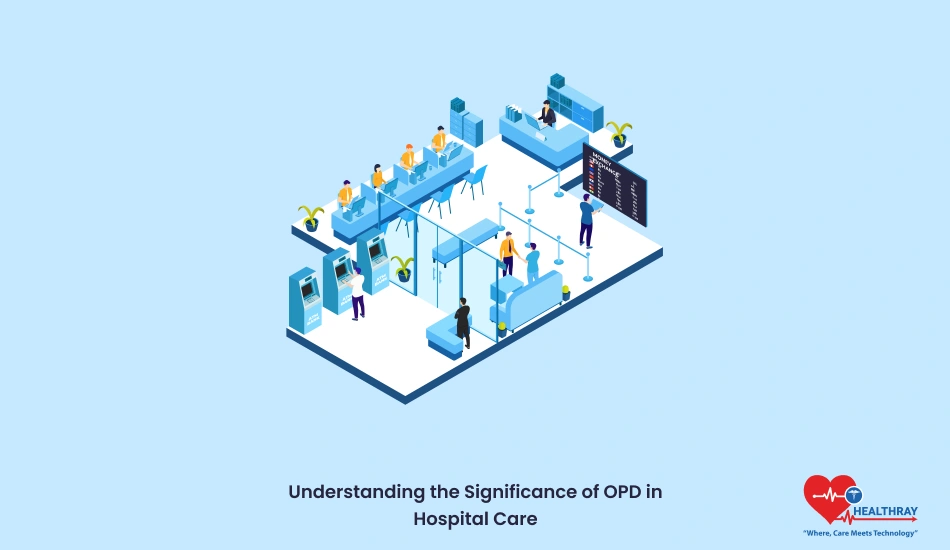

OPD forms, the initial point for healthcare journeys. It is a center of consultations, investigations, and non-admission minor treatment. Hospitals in the digital age have been using hospital management software to simplify these processes and enhance patient care. The OPD is the first experience of a healthcare system by many people in the hospital.
Why is the OPD so important? Doctors provide medical advice to patients without admitting them, which saves time and money. In the meantime, medical workers rely on the OPD of the hospitals to control the number of patients and to make the most of resources. In the field of the administrators, it assists in the efficient healthcare administration and its seamless operation. This is also the learning ground of the medical students.
In addition, both the doctors and patients can be notified and scheduled fast and in real-time through automation. Hospitals use integrated platforms to replace manual systems, improving the overall healthcare system. Consequently, OPDs have become more effective and easy to use by the patients.
What is OPD in Hospital?
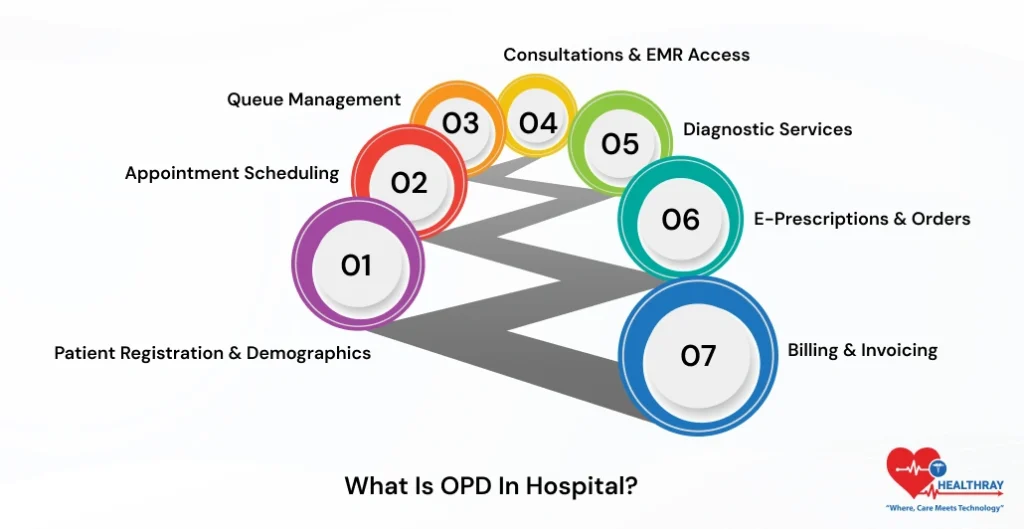
To begin with, it is important to know what is OPD in hospital and how it works in contemporary healthcare systems. The outpatient department is also one of the most significant divisions of a hospital as it provides treatment without an overnight stay.
Historically, OPDs used to deal with consultations, follow-ups, and diagnostic services. But this has changed with the emergence of hospital software that the OPDs are operating in a more organized and efficient way. Such systems minimize waiting times and enhance patient satisfaction.
In modern times, an OPD department in a hospital consists of registration, scheduling, queue management and medical records in a single system. Such arrangement makes service delivery quicker and coordination of care better. Consequently, hospitals would be able to provide high-quality OPD services within the hospital environment.
Core Features of an OPD:
An organized OPD within a hospital entails a blend of clinical support and computerized effectiveness. Also, these attributes assist the patients and health care providers.
- Patient Registration & Demographics: Hospitals provide a unique ID to each patient, thus making the process of record management highly efficient.
- Appointment Scheduling: This reduces waiting time, thus enhancing efficiency in workflow management.
- Queue Management: This is done through digital token systems, which regulate the flow of patients and prevent overcrowding.
- Consultations & EMR Access: Doctors can access instant information regarding patients during consultations.
- Diagnostic Services: This improves the efficiency of diagnosis through integrated diagnostic services, which can be used for wound care or biopsy treatments in the OPD.
- E-Prescriptions & Orders: This allows physicians to write digital prescriptions and test orders.
- Billing & Invoicing: This improves efficiency in billing through automation.
These are usually driven by a sophisticated OPD Software that improves on the performance.
Why Does the OPD Matter?
ODP in hospitals links patients and healthcare providers. It guarantees fast consultation and minimization of unnecessary visits. Meanwhile, hospitals employ systematic work processes with the aid of a patient management system to enhance efficiency.
Moreover, OPDs are important in preventive healthcare as they provide screenings and early diagnosis. This will enhance results and minimize the costs in the long term. Moreover, it enhances the healthcare administration by structuring patient data and processes.
Key Functions of OPD
The OPD management software is a multifaceted part of the hospital care, and a center of various stakeholders. The roles of OPD in hospitals are observed to be different according to the view of healthcare professionals, administrators, medical students, and patients. The OPD fulfills the requirements of every group in the OPD department in hospital in the following way:
| STAKEHOLDER | FUNCTION AREA | DESCRIPTION |
|---|---|---|
| Healthcare Professionals and Administrators | Streamlining Patient Flow | Works effectively with large numbers of patients in an OPD at a hospital so that non-critical cases do not clog up the inpatient services. |
| Efficient Resource Management | Helps effectively distribute the hospital resources such as beds, staff, equipment with a centralized outpatient departmental care. | |
| Improved Patient Outcomes | Allows the frequent check-up, early detection via diagnostic services, and early treatment to improve health outcomes. | |
| Data Collection | Produces insights into patient demographics, trends in health, and the use of resources which aids in the improvement of how healthcare is administered and decision-making. | |
| Medical Students | Learning Ground | Gives practical exposure to patient care by observing and engaging in consultation sessions in the OPD services in hospital. |
| Understanding Workflow | Assists students in understanding the interactions between departments and the care transfers between the OPD in hospital and inpatient. | |
| Skill Development | Gains clinical and practical skills including skills in communicating with patients and performing the simple clinical procedures at the outpatient department. | |
| Patients | Accessible Healthcare | Makes consultations easily accessible without the need of hospitalization via organized OPD services in hospitals. |
| Continuity of Care | Support prevents long-term engagement with healthcare providers, which leads to the improved preventive healthcare results. |
Benefits of OPDs
This is because the OPD in hospital falls under the care of the hospital where there are several benefits that are gained by the healthcare provider, the administrator and the patient. Its structure and intent make healthcare efficient, available and affordable. Now, let us discuss the most important strengths:
Accessibility for Routine and Preventive Care
- To begin with, OPDs receive patients who are non-emergency in an OPD in hospital.
- They provide prompt consultations and this makes the services of healthcare more accessible to the population.
- Additionally, the outpatient department has enhanced clinical efficiency and routine care delivery, which has led to excellent care delivery to patients.
- Moreover, it is relatively cheap to administer in comparison to inpatient departments since it does not entail hospitalization.
- Preventive healthcare services such as health screenings and vaccines are readily available in the OPDs, an aspect that enhances preventive healthcare.
Cost-Effective Healthcare
- A visit to OPD in hospital is typically not as costly as inpatient treatment as it does not incur some extra costs such as room fees and extended hospitalization.
- Moreover, it offers convenience to medical students to get quality training because of its systematic and effective methodology.
- Patients can get the best care services using minimal effort and reduced chances of communicable diseases.
- In the case of chronic patients, frequent visits to the OPDs can save the patient on prolonged medical costs through early detection of problems.
- As the majority of OPD treatments do not presuppose hospital stay, this is yet another aspect where much patients consult their OPD coverage under health insurance to find out whether the cost of consultation and diagnostic services are covered or not.
Early Diagnosis and Intervention
- ODP offers early detection of diseases by efficient diagnostic services provided through diagnostic aids such as labs and imaging services on-site.
- Early intervention improves treatment outcomes and prevents complications that may require hospitalization.
Efficiency in Hospital Operations
- The separate treatment of outpatient cases, OPDs release inpatient resources of patients with critical and emergency cases.
- This systematic pattern enhances operations in the hospitals and the waiting period of the hospitalized patients.
- Also, it enhances the overall operations with the help of Hospital Management System Software.
Enhanced Patient Satisfaction
- OPDs enable healthcare providers to conduct consultations, diagnostics, and minor procedures in one location.
- This integrated approach reduces waiting times and gives patients a clear treatment plan.
- There is follow-up and further care, which will provide further reinforcement and improved health results.
- The design of the OPD is beneficial to individual patients as well as the overall healthcare system since it provides a balance between the care delivery and the use of resources.
Challenges in OPD Management
The OPD is a significant issue but by itself it is a challenge to manage. There are some issues affecting the operations of the OPD department within hospital and quality care being provided to patients. The OPDs are facing some typical difficulties; they include:
High Patient Inflow
Issue: OPDs frequently receive high inflows of patients with the result of overcrowding and lengthy queues.
Impact: Patients are likely to be unhappy and the medical staff are placed with an unnecessary burden of dealing with huge caseloads.
Solution: OPD management software using appointment systems and triage protocols is likely to help plan the patients regarding their urgency.
Limited Resources
Issue: The lack of enough staff, inadequate diagnostic services, and space can obstruct the effectiveness of OPD.
Impact: This can cause delays in diagnosis, consultancy haste and overwork staffing.
Solution: Workflow optimization can be achieved through regular resource evaluation and technological investments, including digital health tools.
Scheduling Inefficiencies
Issue: Walk-in patients, missed appointments, and interdepartmental coordination may affect the daily schedules.
Impact: These inefficiencies cause wastage of time and wastage of resources.
Solution: The modern hospital software can be used to simplify the process by adopting digital scheduling with reminders and real-time messages.
Communication Gaps
Issue: Healthcare providers, staff and patients are likely to have misunderstandings regarding the treatment plans or the follow-ups due to miscommunication.
Impact: This impacts patient outcomes and introduces inefficiencies on care provision.
Solution: Misunderstanding should be reduced by training personnel to communicate well and to use centralized patient records.
Balancing Urgent and Non-Urgent Cases
Issue: OPDs may encounter a blend of emergencies and routine cases and this can cause congestion in the system.
Impact: In case urgent cases are not attended to, it could be because the department is dealing with non-critical patients.
Solution: A triage system can be used to separate patients according to their severity with special consideration to critical cases.
Integration with Technology
Issue: The problem is that numerous OPDs have a hard time adopting and effectively utilizing modern technologies, such as telemedicine and electronic health records.
Impact: This will restrict their capability of giving quicker and more efficient care.
Solution: This can be solved by providing training and a gradual process in combining user-friendly systems with integration of AI.
Effective OPD management software requires healthcare providers to address these challenges with creative and well-planned solutions. By doing so, they can overcome these barriers, ensure smooth operations, and improve patient care.
Innovations in OPD Care
There have been major changes in the OPD due to technological changes and new methods of healthcare delivery. Healthcare system innovations have improved care delivery to patients, reduced wastage, and improved the patient/provider experience. The following are some of the main innovations that will form the future of the OPDs:
Telemedicine Integration
Telemedicine Integration
What It Is: The integration of telemedicine into the healthcare system.
Impact: Patients will have an opportunity to meet with doctors without having to visit the hospital physically and thus wait time will be minimized and convenience will be enhanced.
Example: Remote follow-ups of chronic diseases such as diabetes or hypertension can now be done remotely.
AI-Powered Patient Management
What It Is: Artificial intelligence (AI) applications are being applied in appointment scheduling, patient triage, and record-keeping.
Impact: AI will allow distinguishing the urgent cases sooner, simplify the process, and make sure that the resources are used efficiently.
Examples: Chatbots may assist patients with pre-check-up examinations, which will save physicians time.
Digital Health Records
What It Is: Electronic health records (EHR) transitioning.
Impact: EHRs guarantee interdepartmental communication, minimize errors, and provide patient history accessibly.
Examples: Lab results can be seen immediately by the doctors making them make quicker decisions.
Advanced Diagnostic Tools
What It Is: Portable and high-tech types of diagnostic devices utilized at the OPD.
Impact: The quality of care is enhanced by quicker and more precise diagnostic services.
Examples: The use of point-of-care ultrasound devices enables physicians to carry out imaging examinations within the consultation space.
Appointment Management Systems
What It Is: Web-based appointment booking and management systems.
Impact: These systems will decrease overcrowding and waiting time through optimization of schedules.
Examples: Reminders and the ability to reschedule are available via apps, providing the patients with the opportunity not to waste any slots.
Remote Monitoring Devices
What It Is: Wearable and mobile applications to monitor health indicators of patients such as blood pressure, glucose levels and heart rate.
Impact: These applications enable physicians to track patients between visits, which is an opportunity to provide proactive care.
Examples: A heart patient has a smartwatch to transmit real-time information to his or her doctor.
Enhanced Patient Education
What It Is: Online resources and kiosks, which offer health education in the OPD waiting rows.
Impact: Educated patients have better healthcare choices and adherence to treatment plans, which favor preventive healthcare.
Examples: Interactive screens have the ability to describe procedures, medications, or lifestyle changes.
These new technologies are transforming the way OPDs work and making them patient friendly and efficient. Moreover, with the constant development of new technologies, the possibilities of OPD care improvement are enormous.
How Patients Can Maximize OPD Visits
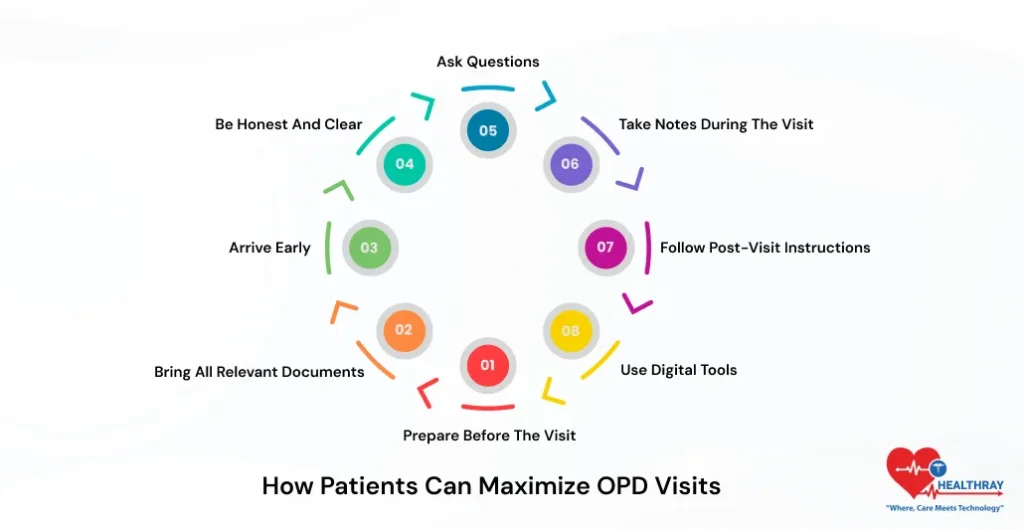
The OPD in hospital visit is the initial step of the resolution of the health concern to most patients. When used to its fullest advantage, this interaction will guarantee the highest quality of results and least of hassle. The following are practical recommendations to assist the patient to maximize on the OPD visit:
1. Prepare Before the Visit
What to Do: Jot down your symptoms, medical history and medications you are taking. Record any questions or issues that you would like to address.
Why It Helps: Preparedness will save time and help you not to forget some crucial things in the outpatient department during the consultation.
2. Bring All Relevant Documents
What to Do: Bring past medical records, lab reports, prescriptions, and any imaging findings that you may have.
Why It Helps: The more your doctor knows about you, the more effective the diagnosis and prescriptions they make based on the diagnostic services.
3. Arrive Early
What to Do: Make sure you arrive in hospital at the OPD at least 15 minutes before your appointment.
Why It Helps: This will allow you time to get whatever paperwork is needed done and save you the stress that comes with haste.
4. Be Honest and Clear
What to Do: Be descriptive of your symptoms, their duration and the way they affect your day to day life. Do not hold back information on the grounds of embarrassment.
Why It Helps: Communication with your doctor facilitates open interaction, which gives him or her all the details to give effective care.
5. Ask Questions
What to Do: When you do not comprehend your diagnosis, treatment courses, and medications, demand clarification.
Why It Helps: Educated patients will be more inclined to adhere to treatments and control their conditions, which serves preventive healthcare.
6. Take Notes During the Visit
What to Do: Write down main details such as your diagnosis, prescribed drugs and your course of action.
Why It Helps: This will aid in remembering orders and giving correct information to family members or other medical professionals.
7. Follow Post-Visit Instructions
What to Do: Take your medications, change of lifestyle and adhere to follow-up appointments.
Why It Helps: Compliance will allow a superior recovery and will minimize the risk of complications.
8. Use Digital Tools
What to Do: Take advantage of apps or hospital portals by using them to make appointments, to receive reports, or to contact your doctor.
Why It Helps: It is easy to manage your healthcare and be more organized thanks to digital tools such as OPD Software.
Patients can make their hospital visits productive and result in improved health outcomes by being active and ready.
Conclusion
All in all the OPD in hospitals is an important interface between patients and health care providers offering easy, affordable and efficient services to patients. To patients, it has been a diagnosis and treatment gateway whereas to the healthcare professionals, it has been a care facilitator, resource optimization and patient interaction. In the case of medical students, it presents a good practical experience in the field of clinical practice.
Although issues like high patient traffic, operational inefficiencies, and development of solutions to integrated patient management systems are threatening the functionality of OPDs, the efforts in telemedicine, AI integration solutions to patient management systems are changing the way OPDs operate. The innovations are helping hospitals to optimize their workflow, decrease the waiting time, and enhance the overall patient outcomes.
With the further development of healthcare, it is necessary to implement the appropriate digital solutions. Hospitals can now streamline OPD processes, automate operations and provide better patient care using a Healthray modern hospital management software, now free to start and feel smarter and more efficient OPD system.