


Managing patient records is indeed the crux of a well-functioning hospital’s operations. Accurate, accessible, and secure medical records are the requirements of every healthcare professional, IT manager, or software operator, and doctor to provide a quality service to the patient as well understanding making decisions. However, traditional methods of recording, storing, and retrieval often slow down, cause mistakes, and leads to inefficient practice.
This is where Medical Records Department (MRD) management software comes in. The design for the manipulation of the patient data by hospitals-this software gives guarantees on easy access to the patient’s record at the same time compliance to safe storage and healthcare regulations. From the minimization of manual workload to patient outcome improvements, the impact thereof is indeed very great.
This article will examine how hospital management software can bring about fundamental changes in hospital workflows: making collaboration among healthcare teams much more seamless and addressing the challenges that modern-day recordkeeping poses. On the other hand, whether a doctor focused on patient care or an IT manager looking to secure the data, everyone will find something here.
Features Of Mrd Business Management Software
Aside from its special features, MRD management software was specially designed also to address the peculiarities of hospitals and healthcare institutions. The following are the most important features of MRD management software:
Centralized Patient Record Storage
The storage of patient data is done into one secure and centralized system. It removes the hassles of dealing with bundled scattered files-in central storing, healthcare providers can quickly get credible information whenever needed.
Secure Access Controls
Confidentiality is paramount in healthcare. MRD software encapsulates strong access controls, thereby allowing only those permitted to view or edit sensitive records. Role-based permissions and audit trails keep the data secure and also track access history.
Seamless Integration with Current Systems
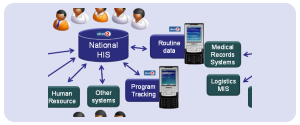
Modern hospitals rely on various technologies such as electronic health records (EHR) and hospital management systems (HMS). MRD management software integrates perfectly into these systems and reduces redundancies while improving workflow efficiency.
Compliance with Healthcare Regulations
Compliance with regulations like HIPAA or GDPR is incredibly intimidating for institutions. Built-in safeguards like encryption, automatic backups, and documentation for audits support that hospitals are compliant with MRD software.
Spooling Advanced Retrieval and Search Options
Time is everything in healthcare. MRD systems have superior search functions that allow patients’ specific records to be retrieved with keywords, dates, and others in a matter of seconds.
Automated Workflows and Notifications
Automating tasks such as record updates and follow-up alerts reduces the manual workload in repetitive tasks. Notifications ensure that important updates and actions are not missed.
These features work together to address the operational pain points of the healthcare provider and his IT manager. They ensure the right information is available to the right person at the right time, without compromising security or breaking compliance.
Advantages for Healthcare Professionals and IT Managers
Implementing MRD management software is not limited to maintaining organized records. Along with streamlining patient record management, it brings tangible benefits to various stakeholders in the healthcare ecosystem. The following discusses the differences it makes to practitioners, IT managers, hospital software operators, and doctors:
Enhanced Patient Care
Easy and fast access to accurate and complete patient records allows doctors and healthcare teams to make well-informed decisions. MRD software reduces the time they will spend searching for files so that diagnosis and treatment may take place more quickly.
Improved Workflow Efficiency
For hospital software operators and IT managers, MRD software automates mundane tasks like indexing and categorizing and archiving records. All these streamline administrative workflows, create fewer human errors, and release resources for more critical tasks.
Strengthened Data Security
Hospitals possess such sensitive information regarding patients, which leads to high priority for the strictest security measures. MRD software applies multifactor authentications along with access controls and encrypts the entries to protect from breaches or unauthorized access-the patient’s privacy is therefore protected from any external oversight as well as any potential legal exposure.
Simplified Regulatory Compliance
Although the regulation for healthcare facilities is labyrinthine, MRD software is much easier when it comes to compliance. Features include an accompanying audit log, security backups, and standards on which records are kept and shared that comply legally, such as HIPAA or GDPR.
Cost Savings in the Long Run
Though the capital expenditure in Medical Management Software MRD may seem enormous, the savings come in the long run. It reduces costs associated with paper usage, cuts down on the requirements for storage area, and overhead management costs, thus providing economical solutions to hospitals.
Reduced Risk of Data Loss
On the other hand, those digital records are free from all those against losing misplaced, theft, and damage due to natural calamities. Added security comes in the form of regular backups and fail-safe recovery options in MRD software.
Improved Inter-Team Collaboration
Information reaches users without barriers, from nurses to specialists who can all get together to reach optimum results. Coordination works well and avoids chain gaps, which ultimately improve patient outcomes.
Every one of the above features will contribute to a healthcare system that is more efficient, more secure, and more focused on the patient. Whether you are a doctor, IT manager, or software operator, MRD management software makes a significant difference.
Implementation Strategies for MRD Management Software
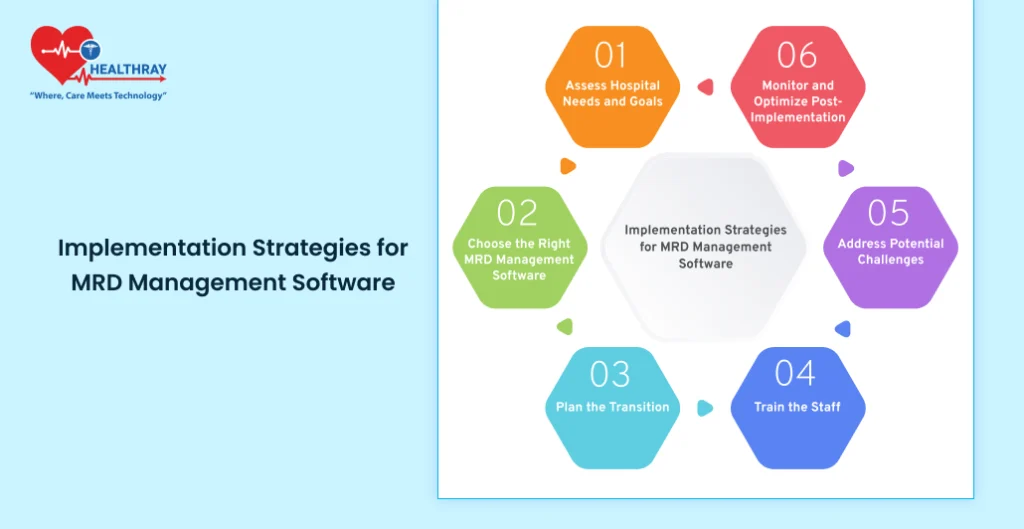
Healthray Implementation Strategies For Mrd Management Software. Adoption of MRD management software within hospitals facilitates a significant shift from the traditional modes of operation. Successful implementation, however, cannot be taken for granted; it requires quite a bit of careful planning and execution. Smooth transition is possible with the following steps:
Assess Needs and Goals of the Hospital
To begin with, assess the record management problems currently existent at your hospital. Find the specific pains: perhaps too little data is retrieved, compliance risks exist, or security breaches occur. In having those defined goals, you’ll be able to select a solution that really fits your facility.
Some Questions to Address:
- What system features are the most important to our operations?
- How many will need to access the system?
- What current systems must be integrated with?
Choose the Software of Choice for MRD Management
Not every MRD solution suits every environment. Find software that is appropriate for the size, complexity, and processes of your hospital. Look for scalability of the systems as well as their ease of use and their capacity to support and service customers.
Considerations Mentioned Above:
- Integration capability with existing EHR or HMS systems.
- Security features such as encryption and role-based access.
- Vendor reputation and support offerings.
Transition Plan
In ill-managed transitions, switching from either a manual or outdated system to MRD software can be an operational meltdown. A comprehensive rollout plan that will minimize operational downtime and facilitate a seamless transition should be stipulated.
Steps to Include:
- Develop an implementation time line.
- Inform all stakeholders of the changes.
- Create a backup of all current records prior to migration.
Train the Staff
Otherwise, without use by its eventual end users, even the most sophisticated of applications can go to waste. Bring your doctors, nurses, IT managers, and administrative staff through thorough training so they can feel at ease with the system.
Best Possible Training Techniques:
- Hands-on Workshops and Webinars.
- Manuals and quick reference guides for users.
- Encourage feedback to address early concerns.
Handle Anticipated Problems
Challenges may come in the face of implementation, such as resistance to the change or technical impediments. Anticipate these challenges and prepare contingencies.
Some Common Challenges and Their Solutions:
- Resistance to Change: Share the benefits and offer continuous support.
- Technical Glitches: Testing the software in a well-controlled environment to ensure that full-scale adoption is undertaken only after successful testing.
- Budget Constraints: Opt for phased implementation to spread costs.
Watch Over the System Post-Implementation and Tweaking
When the system goes live, the performance should be monitored, and user feedback should be accumulated. In this way, new functionalities could be added, while also abiding by the expected regulatory compliance.
Case Studies: Successful Implementation of MRD Management Software
Real-world examples accentuate the transformative properties of MRD management software. Here are a few instances where healthcare facilities achieved wonderful improvements after adopting this technology:
Streamlining Records at a Mid-Sized Hospital
For a mid-sized hospital, patient record retrieval was delayed and was still reliant on a paper-based system. The administrative staff found it very challenging to locate files during an emergency.
Solution: The hospital implemented MRD management software with centralized digital storage and searching capabilities. The software was integrated with their existing EHR system.
Results:
- Reduced retrieval time: Patient records were accessible in seconds.
- Increased efficiency: The administrative workload was cut by 40% for staff.
- Improved patient care: Doctors had real-time access to full patient histories.
Ensuring Compliance at a Multi-Specialty Clinic
During an audit, a multi-specialty clinic was flagged for non-compliance with data protection regulations. They needed a solution to safeguard all patient data and generate audit-ready reports.
Solution: The clinic implemented MRD software that featured encryption, role-based access control, and automatic compliance reporting.
Results:
- Achieved regulatory compliance: The clinic passed all subsequent audits without problems.
- Data security was enhanced: Attempted unauthorized access was blocked altogether.
- Reporting was automated: Compliance reporting was generated automatically, saving hours of manual work.
Cost Cutting in a Large Healthcare Network
This large healthcare network was managing medical records spread over its several locations. With an explosion of physical storage costs and inherent inefficiencies in record transfers, it decided to wake up and smell the coffee.
Solution: It adopted a cloud-based MRD system with secure access to records for all facilities.
Results:
- Cost savings: Network savings amounted to 25% per annum of storage and administrative costs.
- Better collaboration: Teams across locations could access and share records instantly.
- Green operations: The leap to a digital system has drastically cut down paper consumption.
Conclusion
The deployment of MRD management software is a watershed moment for healthcare facilities that desire the modern nexus in operations, patient care, and the assurance of data security. This software automates workflow processes in storing records and also provides a compliance framework to streamline the operation of medical practitioner and IT manager.
Quick access to correct information about patients obviously translates into better judgments and better results for healthcare professionals. Also, that advanced security and hassle-free connectivity between systems will reduce the strain on IT managers and users of such systems. Health institutions that are associated with such systems consistently show considerable time-saving, low costs, and high staff satisfaction levels. If your hospital or clinic has not yet been freed from the devil of record management inefficiency, now is the time to embrace the HMS Software. It really is more than a tool; it is a way of transforming the operations and delivery of care in your organization.