


Quick Summary
For the improvement of patient care, regulation compliance, administrative facilitation, and overall operational efficiencies hospitals require hospital management software for improved resources utilization and sustainable growth.
Introduction
Completely equipped networks of computers are used for data handling in our vigorously invested modern world. Providing patient-focused healthy dynamic care has become a major concern for commerce segments of healthcare providers even though it is a major chunk of our society.
Since this is a multispecialty hospital, many patients move to and fro in and out every day, making it hard to keep their data secure. An intelligent way to resolve issues of this kind was the development of hospital management systems to deal with clinical, financial, and hospital administration concerns.
Not so much less regarding the difficulties faced in automating and executing clinic administrative processes, however, also a competent clinic administration system is required to manage everyday activities that are worked in and around the lab and clinic.
So before putting these hospital management systems into use for your labs or your hospitals, know these reasons to go for the trial.
Overview of hospital management software
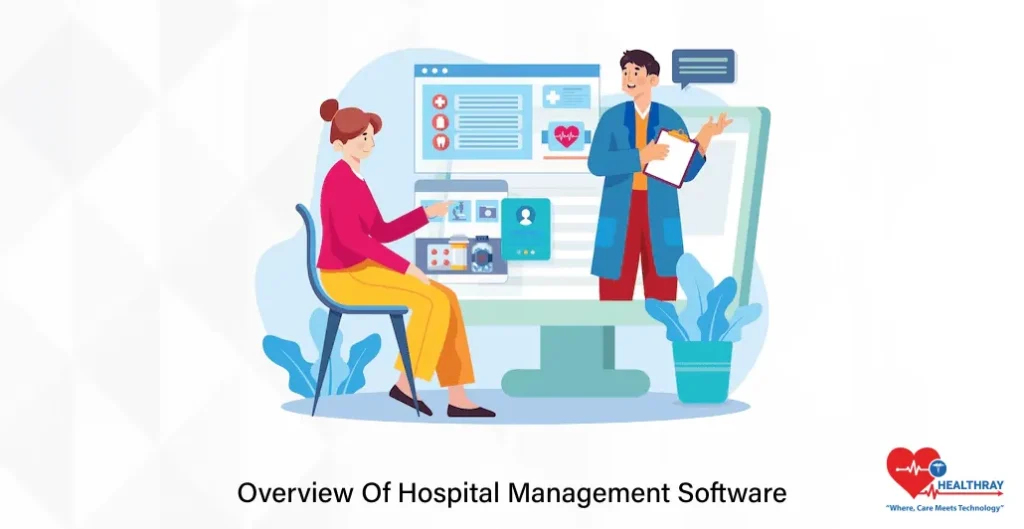
Hospital management software (HMS) is an entire software solution implemented in healthcare institutions for the automation and simplification of several administrative, clinical, and operational activities.
Effective patient management is enabled by HMS, which serves as a centralized platform for managing patient data (demographics, medical histories, and treatment records). The appointment scheduling function allows its personnel to issue reminders, monitor doctor calendars, and make appointments.
Aside from these, hospital management software performs billing, invoicing, insurance claims filling, and payment tracking to ensure that hospital supply inventories (medical supplies, prescriptions, and equipment for their availability and stock out prevention) are well managed. This guarantees the immediate and appropriate compensation for services rendered. The program also allows electronic health record (EHR) maintenance and interfacing with diagnostic and lab equipment, coupled with extensive reporting and analytics insight into how clinical test results, financial performance, patient demographics, and hospital operations interact.
In short, the hospital information management system facilitates the main objectives of promoting operational efficiency, higher standard of care, ensuring regulatory compliance, and maximizing resource utilization in the healthcare establishment through automation and data compilation.
6 Key Reasons Why Your Hospital Is In Need of Hospital Administration Software
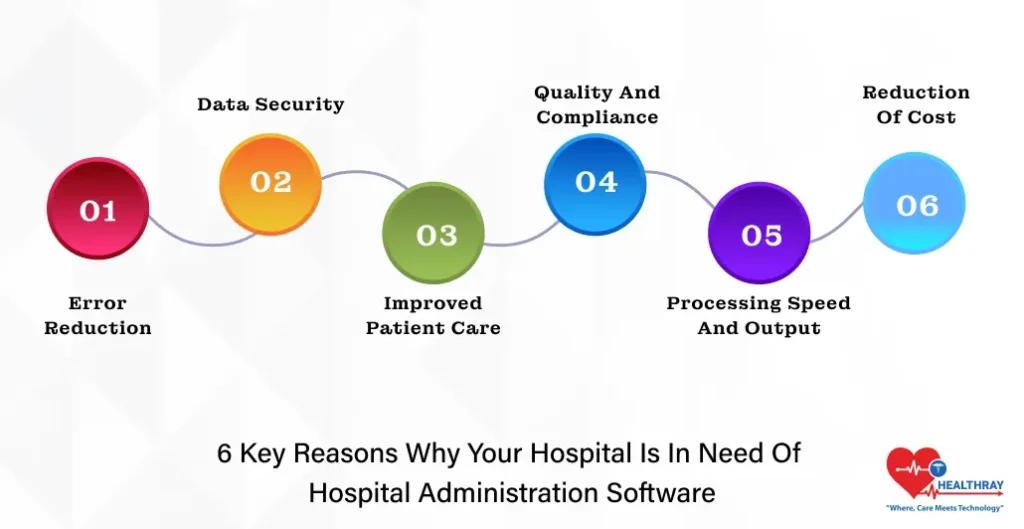
Error reduction
One of the most important reasons that makes hospital management software an indispensable tool in contemporary healthcare institutions is the extent to which it mitigates the risk of errors. Above all, automated processes and the certification of accuracy in patient record files, prescriptions, and billing cut down on errors.
Hospital operations like inventory management and appointment scheduling are streamlined and thus lessened administrative workload, making the institution more operationally efficient. Third is the treasure of patient information that allows for informed decision-making that leads to timely, tailor-made results, which ultimately influence the health status of a patient in a positive manner.
Further promoted, teamwork, faster response times, and better overall care coordination through appropriate communication of departments, staff, and patients. Furthermore, with active monitoring of resource use, the hospitals are able to optimize staff use, eliminate wastage, and put good value for money.
Finally, integrated information management systems would ensure compliance with health care laws, thereby minimizing potential for fines and lawsuits, while guaranteeing data security and patient confidentiality.
Given this rapid positive change, hospital management software is a must in modern healthcare institutions if they are to deliver efficient and wholesome care.
Data Security
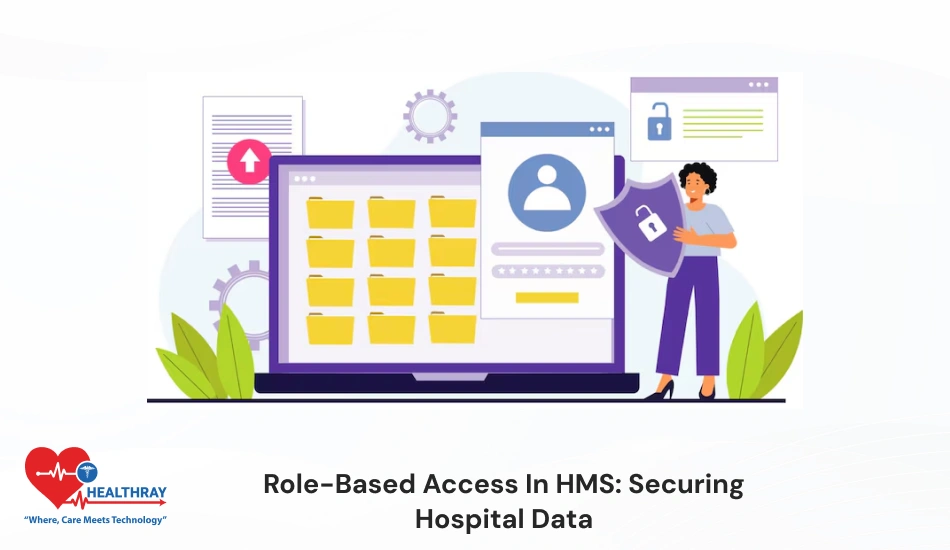
The protection of information from unauthorized access is one of the foremost demands in healthcare, and this is where hospital management software comes into play. The application of stringent security measures like encryption, authentication techniques, and access control against breaches or inappropriate access of confidential patient data is assured by these systems.
The hospital management system, by providing a central data store with secure data transmission methods, assures that financial information, medical history, and personal medical records of patients are safe from cyberattacks.
These protections for data security are further enforced with periodic software updates in compliance with industry standards such as HIPAA (Health Insurance Portability and Accountability Act). Thus, the hospital management software would not only offer an operational effectiveness benefit, but it also assures patients that their private health information is in place with the utmost security.
Improved Patient Care
The hospital administration software greatly enhances patient care by offering clinicians access to integrated health information systems with optimal clinical workflows. Healthcare professionals may plan visits, monitor histories, and acquire current therapeutic data far more efficiently with this application, allowing for more informed decision-making and personalized treatment modalities.
Furthermore, automated updates and alerts almost eliminate medical errors and increase patient safety by triggering interventions. It further simplifies participation and coordination of care between healthcare professionals and organizations. Hospital management software empowers healthcare providers to provide more effective treatment, have better patient outcomes, and additionally improve the ordinary patient experience.
Quality and Compliance
Hospital management software is essential for healthcare delivery organizations transitioning toward improved patient care standards and streamlining their operations. Through efficient patient tracking and reduction of medication errors, treatment quality is transformed; such a change ultimately assures better patient outcomes.
More than that, the software in concern becomes part of the compliance-with-change health legislation requirements to help hospitals avoid fines and legal complications. An efficient asset management system means maximized workforce, equipment, and place utilization which leads to cost efficiency. It is made possible by features like scheduling and inventory control.
Communication is also improved among medical professionals, further advancing understanding satisfaction and safety. Plus, no one has to worry about secret patient data breaches or illegal access with secure protective measures.
After that and last, having speedy access to real-time health information management and analytics enables administrators to make the best-informed choices that enhance operational viability. Any hospital’s framework must contain the hospital management software to provide high-quality care and ensure compliance while maximizing all hospital operations.
Processing Speed and Output:
Come to think of it: there are many benefits that the use of hospital management software could bring about in one’s hospital. First, it accelerates all the administrative tasks like patient registration, billing, appointment scheduling, and so forth, which noticeably improves the speed and output of processing. This automation will, in turn, deliver services faster, which eventually upgrades patient outcomes.
Second, there will be increased overall efficiency since the machinery is digitizing that will free up precious resources to focus more on patient care. Third, it saves time while simplifying the assessment of mistakes that enhance better patient management on admission and throughout discharge.
In addition, it also helps hospitals remain compliant with regulations since its features designed for compliance with health regulations such as HIPAA guarantee patient information security and lessen legal threats. It supports data-driven decision-making that optimizes the operations of the hospital and understanding of care through real-time analytics and reporting tools.
Last but not the least, it supports integration and flexibility, and that adapts seamlessly to changing healthcare standards yet remains interoperable with legacy systems like EHRs for optimal performance throughout the healthcare delivery continuum.
Reduction of Cost
The essential foundation on which the professional educational hospitals build and stand is hospital management software (HMS). Manifolds yield unlimited benefits that directly affect the operational efficiency of modern healthcare establishments and patient care.
In the first place, however, HMS assures cost-saving facilitation such that through automation of administrative chores, process cuts in paperwork, and eventual centralization of resource deployment, notable long-term savings are realized.
Besides improving productivity by enhancing such steps as appointment scheduling, billing, and inventory management, it frees staff to spend more time delivering quality care and better patients’ outcomes.
HMS also features compliance with regulatory requirements, by which guideline-integration elements smoothen the way for healthcare rules and minimum standards, minimizing chances of incurring penalties and litigation.
Also, it delivers valuable data-driven insights through thorough reports and analytics, making it possible for chairpersons to make informed choices and identify areas for development. It has all that is required to allow flexibility and adaptability to suit future growth while also integrating seamlessly with others in the healthcare ecosystem.
Thus, investing in an HMS platform is critical for hospitals wanting to improve operations, better patient care, and ensure the sustainability of health records in the long term.
Try Healthray’s Hospital Management Software!
Talented people use Healthray’s Hospital Management software for great results. Excellent outcome is what Healthray’s Hospital Management system delivers by providing an all-inclusive solution that guarantees more efficient organization in terms of clinical, administrative, and operational processes while enhancing patient care.
Healthray’s HMS ensures even smoother operations using advanced features like those involved in administering patients, making up appointments, billing, and inventory management. Intelligent reporting and analytics are incorporated into our platform while synergizing the administration of electronic health records with laboratory and diagnostic apparatus.
Trust in Healthray for regulatory compliance, optimum resource use, and overall better performance of any hospital, as Highbury Hospital Management software has always done. Try it out today to enjoy the greatest level of excellence and efficiency in managing health.
Conclusion
Regardless of how big or small a hospital is, it should identify its goals and start working towards greater efficiency. It is important to understand that the eventual reputation of your hospital will largely depend on the quality of services you provide. For the success of services you provide, try to have everything come together. Then, take into account: you need an HMIS that takes care of all your hospital’s needs.
Now that you know about all those outstanding hospital management services that can be offered through a complete HMS implementation, feel free! Educate yourself, consult with a trusted HMS provider, and prepare to future-proof your hospital!