



Summary
The cost of HMS nowadays depends on features and customization, not a determined standard price. Implementation, standardized instruction, and regular upkeep are also part of the plan. If hospitals implement the HMS in the right way, this will reduce manual work and improve billing practices. Hospitals can discover significant ROI in just 6-12 months. In this blog I will explore the HMS pricing guide and how it can be your viable investment if implemented in the proper way. Keep reading!!
Introduction
In 2026, HMS transcends from just purchasing to adopting a holistic methodology. Implementation, training, and maintenance all together are also a part of the pricing plan and contribute to the overall expenses. Many hospitals just validate the initial cost estimation and make long-term strategic choices. However, the hidden costs eventually outweigh the advantages. At present, hospital management software is not strictly a general-purpose application. It’s the fundamental foundation that makes the practices tangible. However, when pricing is not transparent, then eventually planning appears vulnerable. This further retards the ROI.
Hms pricing generally depends on modules. Basic modules like patient registration, OPD management and billing are completely affordable, but when hospitals add advanced modules such as EHR, inventory, lab integration, radiology, and analytics, the HMS pricing climbs dramatically. Beyond that, if hospitals add interoperability and integration features, then the entire system becomes cost-intensive.
Before making a viable investment, hospitals should be confident whether they are going for the cheap or smart solution. Hospitals that are grounded on strategic investment will ultimately continue to thrive. Continue reading for in-depth information about the HMS pricing guide!!
Factors Affecting Annual AMC Rates For HMS
1. Hospital Size and User Load
The main factor behind AMC cost is hospital size. Further, small clinics pay around $350–$1,200 yearly. On the other hand, large hospitals (200+ beds) pay around $6,000–$24,000. The costs are prohibitively expensive for large-scale hospitals due to the high number of users and intricate configurations.
2. Customization Level
The AMC cost of standard HMS interoperability software is low and typically ranges between $1,200 and $2,500. However, if the HMS system is highly customized and includes RBAC, AI integrations, and other features, then the total price climbs to $3,500–$12,000.
 NOTE
NOTE
3. Vendor Expertise and Support Quality
Reputed vendors charge an annual maintenance cost up to 12–18% with better support and NABH conformity assurance. However, basic vendors cost around 8–10%. Further, basic vendors can offer limited service standard and quality.
4. Hardware and Infrastructure Dependency
On-premise HMS requires servers and infrastructure storage. This will add an additional expenditure to the total budget. Further costs may reach up to $2,500–$6,000 annually for large hospitals.
5. Service Scope and Contract Terms
Basic AMC covers only updates; however, comprehensive AMC (training, backups, and audits) can double the expenditure. Hospitals that purchase a long-term contract (3 years) can save up to 15-20%.
HMS Pricing Guide: One-time vs. Annual Maintenance Costs for On-Premise HMS
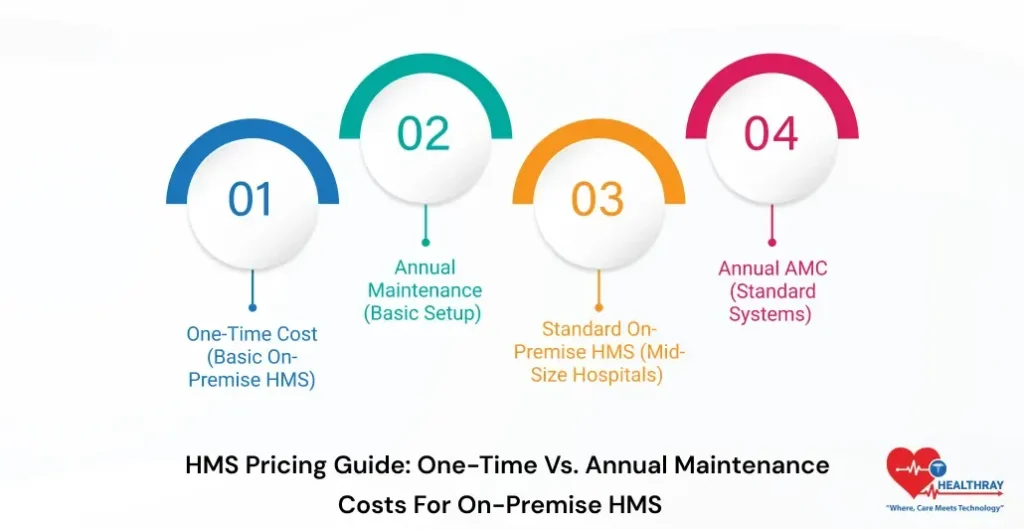
1. One-Time Cost (Basic On-Premise HMS)
The first-time purchase price of a standard, basic on-premise health management system (5–10 users) is between $3,500 and $9,500. Further, it encompasses licensing, development and fundamental components such as patient handling and standardized billing.
2. Annual Maintenance (Basic Setup)
The annual maintenance cost of yearly maintenance is $350–$950, which is 20-50% of the total license. Additionally, it covers regular updates, service support, and security solutions.
3. Standard On-Premise HMS (Mid-Size Hospitals)
The starting price ranges for mid-size medical sectors are $18,000–$48,000. Additionally, the price also includes a comprehensive EMR, billing, and inventory modules as well.
4. Annual AMC (Standard Systems)
Standard HMS fee for annual maintenance services is $1,800–$4,800. It is highly crucial for bug corrections, scalability requirements, and NABH-compliant backup systems.
HMS Pricing Guide: Custom HMS Development cost vs. Cloud Subscriptions
1. Custom HMS Development Cost (Basic Setup)
Basic custom HMS (5–10 users) costs hospitals around $3,500–$9,500. Further, it’s a one-time payment. It includes basic modules that are standard, such as OPD and billing. Annual maintenance will cost hospitals around $350–$950.
2. Standard Custom HMS (Mid-Level Hospitals)
A fully functional HMS (EMR, inventory, lab, and billing) will cost hospitals around $18,000–$48,000. It takes around 6-12 months for complete development. Further, yearly maintenance is around $1,800–$4,800.
3. Enterprise Custom HMS (Large Hospitals)
Enterprise-level HMS cost is around $60,000–$240,000+. Further, its pricing also depends on features and modules. It comprises AI integration and automation features as well. Development of the project will take up to 12-14 months. Additionally, yearly maintenance is also high.
4. Cloud HMS Subscription Cost
Cloud HMS’s starting cost is not that expensive. Typically, it will cost hospitals around $600–$60,000 annually. However, pricing is completely based on features and modules as well. The Initialization charges of cloud HMS span from $0 to $2,500. It is a beneficial strategy for small clinics. Small clinics can embark on their automation journey even with an economical financial plan.
5. Hybrid Model & ROI
Hybrid model (custom + cloud) cost starts from $12,000–$95,000 for 5 years. Further, the cloud provides fast ROI and custom HMS boosts 20-50% efficiency in 1-2 years. It is a viable solution for hospitals in the long term. Check out the blog predictive analytics in HMS to know about how automation can simplify the hospital’s operations.
Step towards digital era with our healthcare solution
Revamp your hospital facilities and embrace change for better healthcare management. Ease in managing and organizing large medical datasets leads to effective analysis. Seize the opportunity now!
Best Ways to Negotiate Lower AMC Rates with HMS Vendors
1. Start Researching the Market
Before initiating the negotiation, first collect quotes from 3-5 vendors. Further, if any vendor is giving you AMC 20-30% cheaper. For example, if vendor A is giving you maintenance services at $4,000 and vendor B is providing you the same maintenance at $2,000 , then you will have a compelling point for a negotiated deal.
 PRO TIP
2. Offer Long-Term Deal
If hospitals commit to 2–3 years of contract and future upgrades, then the vendor will provide them up to a 10–15% discount. Further, if hospitals pay annual prepayment, then you will get an extra 8-10% discount.
3. Demand Cost Breakdown
Ask for an in-depth AMC description. Further, hospitals should negotiate wages and support standard fees if they seem excessively unreasonable. Furthermore, you can negotiate costs by eliminating non-important services (extra training).
4. Define SLA Scope
Hospitals should always incorporate vital services such as routine updates, bug solutions, and a 4-hour response time. Moreover, if hospitals keep hardware support independently, they can reduce AMC costs significantly.
5. Elaborate Hospital Size
Small clinics can limit their users and reduce the AMC changes by up to 10-15%. Moreover, large hospitals deal with high volumes and can seek better negotiated rates.
Best Practices to Reduce HMS Annual Maintenance Expenses
1. Focus on Preventive Maintenance
Regular maintenance is a simple and successful way to cut down the cost. Further, hospitals should review their audits, upgrades, and servers every 3 months. This approach helps hospitals to fix small problems at the initial stage. Additionally, it alleviates the downsides of big repairs and interruptions in service.
2. Smart Monitoring (CMMS Integration)
Use automated monitoring tools and alerts along with HMS to track modules such as billing and EMR conveniently. Moreover, this helps hospitals avoid unnecessary maintenance and hospitals can take action only when it’s necessary. This approach can mitigate the high expenses of maintenance up to 20%.
3. Train In-House IT Team
It is highly imperative for hospitals to provide training to internal IT teams on basic troubleshooting, backups and user management. Hospitals no longer need to call vendors for every small problem. Moreover, clinics can easily minimize external support costs by 25-30%.
4. Vendor Consolidation Strategy
Many hospitals rely on different vendors. This is not a wise practice. Instead of relying on multiple vendors, hospitals should purchase multiple services (such as HMS, hardware, and pharmacy systems) from single vendors.
How Do On-Premise HMS Maintenance Costs Vary By Hospital Size?
1. Small Clinics (5–10 Beds)
On-premise HMS maintenance is highly low for small clinics. Further, an initial upfront fee can go up to $3,500–$9,500. Annual maintenance fee is only $350–$950. This is sufficient for basic software updates and bug resolutions.
2. Medium Hospitals (50–100 Beds)
The initial start-up cost for mid-size healthcare facilities is $18,000–$48,000. However, annual maintenance can reach $1,800–$4,800. This cost is for security upgrades, EMR updates and compliance and standards maintenance.
3. Large Hospitals (100+ Beds)
The initial setup expenses of large medical facilities are $60,000–$240,000+. However, annual maintenance is highly expensive and reaches up to $6,000–$24,000. Additionally, it covers multi-location assistance, analytical tools and 24/7 surveillance. To learn more about it, check out the blog “Smart hospitals using HMS.”
Conclusion
It is highly imperative for clinics to balance upfront cost, scalability and ROI while determining an HMS pricing model. Every hospital’s size and need vary. Therefore, hospitals should blindly pick any pricing model. Before making a long-term commitment, first understand your practice’s needs. Smart planning can help you make your HMS a revenue booster!!!.