


Summary
HMS traces, analyzes, and facilitates the hospital’s billing and revenue cycle management. In simple words, HMS software breaks down all the multifaceted stages of monetary and financial transactions of every specialized division. This rules out holdups and malfunctions in the standardized system. In this blog, I will lay out how hospitals can organize all OPD, IPD, lab, pharmacy and insurance claims functions on a single unified centralized platform with the backing of HMS. Also, I will demonstrate how real-time billing and unambiguous standardized reports enable medical facilities to make tangible strategic choices that lead to overall financial progress. Keep Reading!!
Introduction
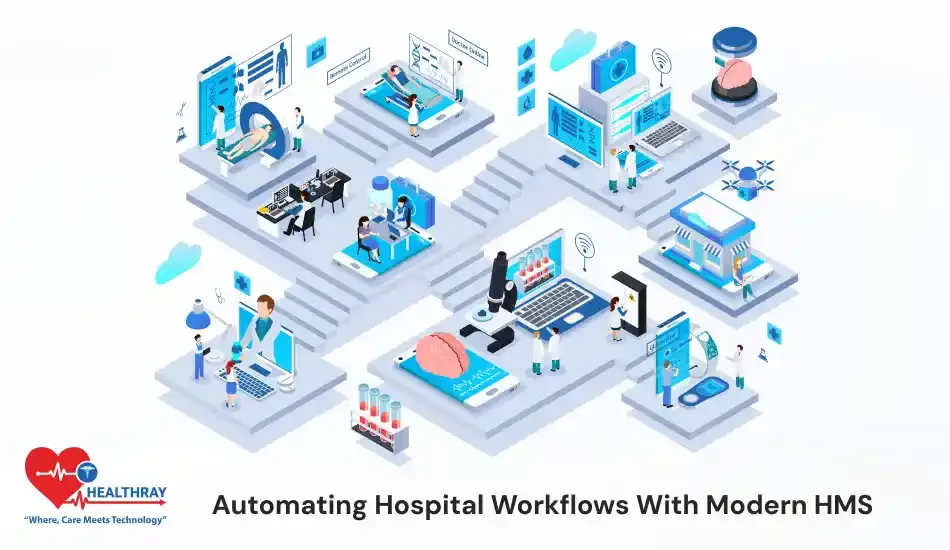
Hospital management system is no longer just a tool for keeping track of patient documents. It has become a fundamental framework for handling standardized billing and revenue cycle administration. Healthcare industry daily comes across hundreds and thousands of transactions that include OPD billing, IPD charges, lab tests, pharmacy sales, insurance claims, and refunds. If hospitals administer all these billing procedures manually or in different systems, then complications, interruptions, and revenue leakage are absolutely certain.
That’s the reason hospitals should embrace hospital management software for centrally managing all their financial support services. A smart HMS system consolidates all the financial tasks ranging from patient enrollment to final payment processing into a unified system. Revenue cycle management’s main goal is to maintain smooth cash flow and ensure maximum revenue in the system. HMS automates this process and makes it convenient for the finance department. In 2026, only placing an emphasis on high-quality medical care is not good enough; financial productivity is equally paramount. Overall, HMS not only boosts revenue development but also empowers hospitals to provide quality care, which is highly critical for long-term viability.
How does HMS Reduce Billing Errors in Hospitals?
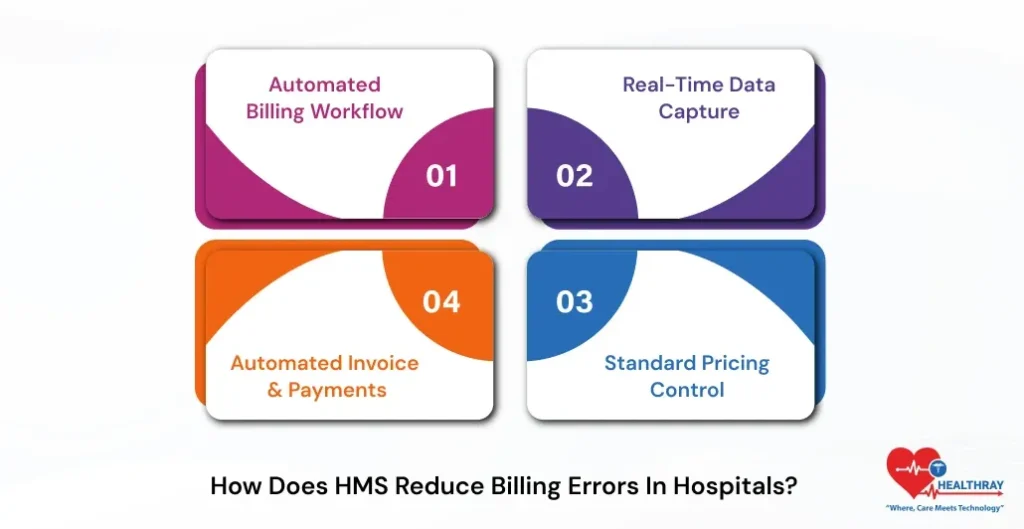
1. Automated Billing Workflow
HMS fully automates the billing process. Further, this minimizes the workload of manual data entry and paperwork. Hospitals can avoid human errors such as wrong calculations, missed entries and duplicate billing. Automation makes the entire workflow efficient, dependable, and consistent.
2. Real-Time Data Capture
HMS automatically gathers information originating from patient registration, OPD, IPD, lab and pharmacy modules. Whatever the services the patient is using are, they are directly reflected in billing. Further, it alleviates the potential risks of copy-paste glitches, missing charges and duplicate entries.
3. Standard Pricing Control
HMS follows predefined charge masters, fixed-rate packages and approved discounts. Further, this helps hospitals maintain consistent pricing for patients and avoid unauthorized changes. Consequently, billing remains transparent and unbiased and mitigates the incidence of disagreements.
4. Automated Invoice & Payments
Hospital data management software automatically generates invoices and performs real-time payment tracking. Further, it evades the need for manual calculation and creates fewer billing mistakes in the practices. Beyond that, patients get clear and itemized bills, which naturally boost their trust.
HMS Features for Insurance Verification to Cut Billing Mistakes
1. Real-Time Eligibility Check
HMS performs real-time eligibility verification where the system proactively connects with the insurance company and TPA. Further, HMS software validates active coverage, policy status and benefit limits at the time of patient initial enrollment.
2. Automated Policy Verification
System automatically examines and validates the patient insurance policy details. Further, policy number, validity and plan type. Further, this minimizes the need for manual checking. Also, it reduces billing errors caused by wrong and incomplete insurance data.
3. Benefit of Mapping & Cost Clarity
HMS clearly maps deductibles, co-pay and coverage limits. Further, it helps determine the amount that hospitals need to collect from patients and insurance coverage. It fixes the usual concern of under-billing and over-billing.
4. Pre-Authorization Tracking
HMS tracks the pre-authorization process and links the required approval with specific treatments. If any services are ongoing without approval, then HMS automatically sends alerts. This approach reduces the consequences of claim cancellations and unbilled procedures.
Strategies to Improve Patient Collections Rates
1. Clear Upfront Cost Communication
It is important for hospitals to clearly reveal estimated costs and their share to patients at the time of visits. When patients have clear visibility on billing. This reduces confusion and irrelevant arguments at the time of billing. Furthermore, this naturally increases the patient’s willingness to pay.
2. Initiate Insurance Verification Prior to Time
Hospitals should verify insurance coverage, deductibles and co-pay before patient visits. Patients can determine the exact amount through this. This avoids later disputes and delays in the process. Further, this enhances the collection rate.
3. Multiple Payment Options
The healthcare management platform provides an easy payment method to patients, such as online portal, UPI, cards, and auto-debit options. When payment is convenient, then patients feel comfortable in the process of settlement. Additionally, this inherently improves collection rate.
4. Flexible Payment Plans
HMS supports EMI and installment-based payment plans for large bills. This minimizes financial pressure for patients and they can gradually pay the payments. Further, this reduces defaults and bad debts.
Benefits of Automated Coding in HMS for Claim Denials
1. Accurate Code Suggestion
HMS includes automated coding tools that scan clinical notes and services and suggest correct ICD-10, CPT and HCPCS codes. It reduces manual guesswork. Additionally, it reduces the risks of claim denial ascribed to wrong and incomplete coding.
2. Real-Time Validation Checks
HMS validates code in real time and instantly flags under-coding, over-coding and missing modifiers. Further, HMS fixes the error before the claim submission. This approach assists hospitals in avoiding claim refusals.
3. AI-Based Denial Prediction
Advanced HMS (health management system) tools analyze past denial data and identify high-risk claims. Further, the system suggests staff better codes that improve the first-pass approval rate and reduce rejection rates.
4. Better Revenue Cycle Performance
Automated coding in HMS enables hospitals to maintain a strong revenue cycle in the system. A better revenue cycle management helps hospitals:
- Reduce claim denials
- Reduce the number of write-offs
- Improve financial performance for the long term.
 PRO TIP
How does HMS Integration with EHR Improve Billing Accuracy?
1. Single Source of Data
Health management systems and EHR integration create a unified system where all the patients’ billing and clinical information are stored in the same place. Further, this reduces the risks of data mismatch and duplication and renders the billing process remarkably precise and dependable.
2. Automatic Charge Capture
When a doctor updates the consultation, procedure and medication in the EHR, it automatically reflects in the HMS billing system. Further, this minimizes the requirement of manual entries and avoids missing and duplicate charges in the system.
3. Reduced Unbilled Services
Sometimes, manual systems fail to enter service bills for a few essential documents. However, HMS-EHR integration ensures every document should be included in service billings. This significantly reduces revenue leakage. Also, read our blog, hospital management software companies, to discover the best platform in 2026.
How does AI in HMS-EHR further Cut Claim Denials?
1. Smart Denial Prediction
An AI-powered HMS-EHR system accurately examines past claims and denial patterns. Further, this helps hospitals determine the high-risk medical claims. AI sends alerts to hospitals before the submission of claims. It enables staff to rectify the corrections as early as possible. Thus, helping hospitals prevents denials at the right time.
2. Pre-Submission Claim Scrubbing
AI automatically checks the claims before the submission process. Further, AI accurately detects coding errors, missing authorizations and incomplete data. This pre-scrubbing” process ensures clean claims and reduces denials caused by technical mistakes.
Long-term Revenue Trends after 5 years of HMS-EHR Adoption
1. Initial Dip in Revenue (Year 1–2)
During the starting phase of HMS-EHR adoption, hospitals mostly face challenges with revenue dips and stagnation. The reason behind this is system implementation cost, staff training and workflow changes that temporarily slow down the operation.
2. Stabilization Phase (Year 3)
The system is automatically configured in its third year, and employees are at ease with its adoption. In this stage, the billing process becomes smooth, and errors are fewer, and the revenue cycle gradually becomes stable.
3. Strong ROI After 5 Years
After 5 years of HMS implementation, hospitals accomplish a higher net revenue, lower costs and better financial stability. Further, HMS-EHR integration is a viable long-term investment that fosters sustainable development.
What are the Long-Term Financial Benefits of Adopting HMS for Revenue Cycle Management?
1. Faster & Accurate Billing
HMS makes the billing process fast and accurate in the long term. Further, it reduces manual errors and all services are captured properly. This makes the claims accurate and expedites the bill settlement.
2. Lower Administrative Costs
Automation minimizes the manual workload. Hospitals depend less on paperwork. This reduces the repetitive tasks that lower the operational cost and elevate the efficiency.
3. Better Revenue Visibility
HMS analytics tools provide explicit insights to management such as revenue trends, denial patterns and payment status. Further, HMS software helps hospitals make better decisions and they can control revenue leakage to a great extent.
 NOTE
NOTE
Conclusion
HMS becomes a necessity for modern hospitals. Hospital automation software streamlines billing and the revenue cycle; this raises efficacy in the practices and makes the financial performance strong. HMS automates the entire process of registration, charge capture, coding, claims submission and collections.
Platforms like Healthray convert fragmented workflows into a seamless system. Healthray helps hospitals make the billing process proactive, patient-centric and sustainable to achieve long-term stability in the system.