


Summary
The hospitals in India are becoming more aware of the fact that accreditation is not about passing through an examination. It portrays the stability of the everyday functioning of care, documentation, and safety standards. At the epicenter of this change is NABH digital compliance. Hospitals that rely on manual records often struggle to maintain continuity, especially as patient volumes grow and regulatory scrutiny increases.
There is more to convenience than digital systems. These facilitate order, responsibility and transparency in day-to-day operations of a hospital. Consequently, compliance ceases to be an additional burden and becomes a regular job. When documentation, audits, and quality indicators live inside connected systems, hospitals remain prepared rather than reactive.
This blog describes the practical support of NABH requirements by digital systems. It focuses on operations, not theory, and shows how hospitals can sustain compliance without exhausting their teams.
Introduction
The hospitals fail NABH assessments since they do not have intentions. The failure is due to the fact that systems do not always support intent. Employees are knowledgeable of procedures. Leaders know the standards. But as records become spread out over files and registers and disassociated tools, compliance becomes weakened in the long run.
To fill this gap, NABH digital compliance creates discipline in the daily operations. It makes sure that documentation, approvals, and quality checks take place naturally during the delivery of care as opposed to after the care delivery. As a result, hospitals cease to prepare against audits and begin to act in a compliant way at all times.
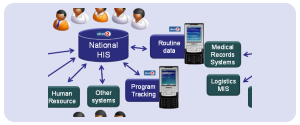
A well-organized Hospital Information Management System is a primary figure in this change. It links departments, standardization of records and automatic maintenance of audit trails. The work progresses so that a hospital can have an overview of compliance during work as opposed to pursuing evidence during inspections.
Essentially, electronic systems assist hospitals to cease compliance based on efforts and adopt system-based reliability.
Why NABH Digital Compliance Fails Without System Support
Many hospitals attempt to meet NABH accreditation requirements using fragmented processes. There are spreadsheets as well as paper files. Verbal approvals replace logged actions. In the long run, such shortcuts compromise consistency.
The Nabh digital compliance would only fail when accountability is based on memory as opposed to structure. As an illustration, incident reporting can take place informally. Departmental consent documentation can be different. Audit logs may remain incomplete. Although each lapse seems small, patterns emerge during assessments.
In addition, the pressure to comply grows with the size of the hospitals. What works on smaller scales disintegrates on higher levels. The growing services, staff turnover and life long care cycles cannot be managed manually. Consequently, the hospitals undergo stress throughout audits rather than confidence.
Digital systems resolve this by enforcing process discipline. Tasks follow defined paths. Actions leave timestamps. Ownership remains visible. As a result, NABH compliance is no longer a situational phenomenon but a repeatable one.
Digital Documentation for Hospitals as the Core of NABH Readiness
Digital documentation for hospitals is the base of NABH preparedness. Documentation does not exist merely to satisfy inspectors. It safeguards clinical judgment, contributes to continuity and demonstrates accountability.
This is an aspect whereby when hospitals use paper or hybrid records, there are gaps. Files go missing. Versions conflict. Updates happen late. These contradictions undermine information confidence. Such gaps are compliance risks during assessments.
Digital systems centralize documentation. Each entry is in structured formats. Edits remain traceable. Access stays controlled. Consequently, the records are accurate and not subjective. Evidence is also reliable, which enhances compliance.
How Clinical Data Standardization Reduces NABH Risk
Standardization of clinical data is one that will ensure that information appears similar irrespective of the department or shift. When doctors, nurses, and administrators record data differently, audits reveal inconsistency. The digital systems remove this variation.
Standardized templates guide entries. Mandatory fields prevent omissions. Alerts surface incomplete records early. Therefore, hospitals can minimize NABH risk without having to add to their administrative workload. Systems form behavior, therefore, creating better compliance.
NABH Compliance Software and the Hospital Quality Management System
The Quality objectives of NABH compliance software match the day-to-day operations. Hospitals integrate quality into work processes instead of making it a quarterly review. This consensus makes the hospital quality management system stronger.
Quality indicators monitor the performance. Deviations surface early. Corrective actions remain documented. Teams react in a relaxed manner rather than being pressured. Consequently, the quality management is no longer reactive but proactive.
Moreover, compliance software ensures that policies translate into practice. SOPs remain accessible. Updates reach teams instantly. A single source of truth replaces fragmented communication. Consequently, NABH digital compliance becomes measurable rather than assumed.
Turning NABH Policies into Measurable Daily Actions
Policies alone do not satisfy NABH. Execution matters. Technological systems translate policies into action. For example, infection control protocols trigger checklists. Follow-ups result after incident reporting. Quality dashboards show trends.
This exposure transforms conduct. The teams embrace expectations. Leaders will keep track of the progress objectively. With compliance, there are few cases of non-conformance since systems dictate course.
Patient Safety Standards NABH Emphasizes and the Role of Digital Systems
The standards of patient safety that NABH focuses on rely on prompt information and integrated care. Errors occur when data hides, delays, or duplicates. Digital systems reduce these risks.
Electronic alerts flag medication conflicts. Clinical histories are still available. Handoffs stay documented. Therefore, patient safety becomes a direct by-product of the digital structure.
Healthcare digital transformation also strengthens transparency. Hospitals detect safety holes at an early stage. Continuous monitoring replaces periodic reviews. Patients are provided with safer care. Staff benefit from clarity. The level of compliance improves due to the fact that safety is visible and quantifiable.
Hospital Software Implementation for NABH Without Operational Disruption
Hospital software implementation often fails when hospitals rush adoption. Resistance rises. Workflows suffer. Compliance goals stall. Effective implementation is an alignment based process and not a speed oriented process.
Hospitals must map workflows first. There should be systems that are supportive of real practice as opposed to idealized forms. Training must emphasize simplicity. When teams understand benefits, adoption improves naturally.
Hospital software implementation stabilizes the NABH compliance, used properly. Systems reduce duplication. Care incorporates documentation. Staff spend less time correcting errors. Obedience fortifies without disturbance.
 PRO TIP
Modular Hospital Information Systems Support Long-Term NABH Digital Compliance
Hospitals hardly remain the same. Departments expand. Services evolve. Patient loads fluctuate. Under these conditions, NABH digital compliance weakens if systems cannot adapt. This is where the modular hospital information systems are essential.
Modular systems enable hospitals to enhance compliance without disrupting the current operations. New modules integrate with current workflows instead of replacing them abruptly. Consequently, hospitals will be stable and more profound in documentation, traceability and accuracy in reporting.
Moreover, modular design supports NABH accreditation requirements across departments. Laboratories, pharmacies, nursing stations, and administration have a common structure but they are functionally flexible. As a result, there will be no more department-level discipline as a source of compliance. Systems are automatic in their enforcing consistency.
Modular hospital information systems curb compliance fatigue over time. Also, teams no longer feel overwhelmed by sudden system changes. On the contrary, compliance increases with operations in a predictable and ordered manner.
Healthcare Digital Transformation Aligns Operations With NABH Expectations
Digital transformation in healthcare is not an end in itself. Undoubtedly, it is there to make clinical intent consistent with operational implementation. NABH digital compliance is able to thrive when transformation is workflow-centric as opposed to interface-centric.
Digital transformation links information through care loops. Treatment plans are associated with admission details. Diagnostics are related to discharge summaries. Quality indicators are the actual performance. Consequently, hospitals can have a continuous compliance picture as opposed to pieces of the puzzle.
Also, accountability is enhanced through digital transformation. Each activity has an online presence. Ownership becomes visible. Deviations surface early. Preventative improvements are made by the hospitals instead of reactive corrections.
Healthcare digital transformation levels the playing field in compliance in the long term since informal coordination is replaced with formal procedures. NABH standards prevent the feeling of being outside. They are instilled in the routine of hospitals.
Hospital Information Management System Software as a Compliance Anchor
NABH digital compliance has its operational anchor, which is the hospital information management system software. It does not merely store data. It dictates the direction of flow of data, persons who can access it and the transformation of data.
In case hospitals do not have integrated systems, their compliance is based on personal discipline. That does not work when pressure comes. Variability is substituted by structure with the help of centralized software. Records have prescribed directions. Edits remain logged. Access stays role-based.
Moreover, the software of the hospital information management system makes the audits easier. Evidence remains available. Reports are generated automatically. There is confidence in the response of teams rather than a sense of urgency. Adherence is enhanced since systems do not require any manual work to store history. Eventually, the compliance changes to permanence.
Clinical Data Standardization Strengthens Patient Safety Standards NABH
Standards of patient safety NABH underline the accuracy, continuity, and accountability. These principles are highly based on standardization of clinical data. There is a risk of safety that goes unnoticed in the absence of standard data.
Digital systems provide uniform formats of clinical entries. The use of treatment notes is based on templates. Formalities Consent forms are standardized. Handover documents remain intact. As a result, clinicians have faith in records without doubting.
Collaboration is also boosted through standardization. Physicians comprehend data quicker. Nurses act with clarity. Administrators monitor quality measures precisely. The quality of patient safety is directly impacted because of trustworthy information.
Notably, standardization besides, minimizes reliance on personal habits. Systems guide behavior. The compliance becomes stronger naturally.
How NABH Compliance Software Simplifies Audit Preparation
New issues are not revealed in the audits. They reveal existing ones. NABH compliance software will make sure that these issues are revealed at an early stage and not when they are inspected.
Contingency software keeps up logs. It tracks approvals. It records deviations. There is up-to-date documentation. Consequently, audit preparedness turns out to be a part of the day-to-day operations and not an isolated activity.
Further, compliance software leads to less anxiety. Teams eliminate scramble over files. Micromanaging preparation is halted by leaders. Evidence stays accessible. Audits become validations and not challenges. The stability verifies that NABH digital compliance remains consistent between inspection cycles.
The Role of Hospital Software in NABH Accreditation
Hospital software is important in NABH accreditation, not just in passing tests. Software influences the manner in which hospitals run in between audits. It identifies the factors of compliance that make or break.
Additionally, security software in the hospital assists in alignment. Clinical care is consistent with documentation. Operations are associated with quality goals. Patient safety coincides with reporting. It is an alignment that avoids drift.
Moreover, there is visibility provided by software. Leaders see gaps early. Problems are fixed within a short time. Constant enhancement takes the place of intermittent repairs. Developed operations make NABH accreditation a by-product. To the point, people are not substituted by software. It assists them by eliminating uncertainty.
Healthray and Practical NABH Digital Compliance
Healthray takes NABH digital compliance as a reality in its operations, and not as a promise on the checklist. The platform designs hospital operations in such a way that compliance occurs naturally in the course of care delivery.
The systems at Healthray ensure that teams follow some steps. The documentation is in standard forms. Access controls are still upheld. Traceability stays intact. Consequently, compliance is not based on reminders and manual checks.
Besides, Healthray facilitates the implementation of hospital software without interruption. Systems are in agreement with actual hospital practices. Training is usability oriented. Adoption happens steadily.
 NOTE
NOTE
Conclusion
Trust is not developed through compliance. Consistency does. One of the lapses that hospitals can rectify is the one in which the hospital handles finances. They are not able to live in uncertainty. The doctors make adjustments to systems when reliability is constant. When patients are treated according to the expected standards, they are more likely to feel safe.
NABH digital compliance should not hinder the growth, but assist in it. It must eliminate ambiguity, defend accuracy and hold accountability. Compliance is made easy when the systems are compatible with the actual workflows.
In case you run a hospital, clinic, or even a specialty center, it is the opportune moment to consider how digital systems can assist NABH requirements these days. Book a free demo in order to see what Healthray can achieve in assisting hospitals to stay organized in a way that compliance is ensured without putting strain on operations.
Select systems that equip your hospital where it is going and not where it is now. Reputation depends on it.