


Summary
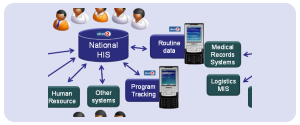
HIMS provides a centralized platform to hospitals where OPD, IPD, pharmacy, lab, billing and even staff management are integrated in single dashboards. HIMS improves the coordination and reduces the gap between the departments. Doctors and nurses work with real-time updates and make treatment decisions faster and more concrete. And the most interesting part, modern HMS doesn’t just store data; it also provides high-impact insight to management to improve their hospital operations. Hospitals that are adopting digitization are not solely elevating their efficiency but also winning their patients’ confidence. In this blog, I will discuss how HIMS improves the complex operation of hospitals and how hospitals can plan their services better and control their cost. Keep reading!!
Introduction
HIMS is not just software; it’s a digital backbone for hospitals. Hospitals that implement timely digital transformation gain an advantage in the competitive healthcare market. In 2026, hospital management information systems use AI and analytics that provide smart insights to hospitals such as patient trends, disease patterns, and resource utilization.
This helps medical services better plan their resources and take control of their costs. Through a hospital information management system, data is instantly updated and expedites the decision-making. HIMS minimizes delays and maximizes the overall patient contentment. Overall, HIMS software makes the daily operation manageable, standardize and maximized in efficiencies.
Why do Some Hospitals Succeed in Digital Transformation Despite Common Pitfalls?
1. Strong Leadership Support
When hospital leaders or top management considers digital transformation seriously, then only real change is attainable. Further, they set a clear vision for modernizing the hospitals. Approving the budget, choosing the right tool and motivating the team are the work of leadership. If leadership is strong, staff can comfortably accept the change.
2. Early Involvement of Doctors and Staff
If hospitals implement the HMS software without involving doctors and nurses, there are high chances that they will not show any interest in using the system functionalities. Further, successful hospitals involve doctors, nurses, and all other team members from the beginning stage. They actively engage medical practitioners in collecting feedback, demos and pilot tests. Early involvement of the team helps hospitals construct an HIMS system that enables them to fulfill their daily responsibilities.
3. Step-by-Step Execution Process (Phased Strategy)
Restructuring the full system at once could be detrimental. Hospitals should refrain from it. Further, successful medical facilities rely on a phased approach to accomplish the hospital software implementation process. For example, first clinics implement changes in registration and gradually move to the lab, then billing and finally complete HIMS. Further, this approach helps medical services identify errors at the initial phase and take immediate action to resolve them. Moreover, staff get immense time to adapt to new features. This minimizes resistance to a great extent.
4. Proper System Integration
Hospitals deal with different departments such as lab, pharmacy, billing, and OPD/IPD. Further, if systems are not connected properly, it raises the chances of data repetition and standard errors. Further, successful hospitals integrate all the workflows of departments in the same place. Saving ample time for hospitals and maintaining a higher level of efficacy.
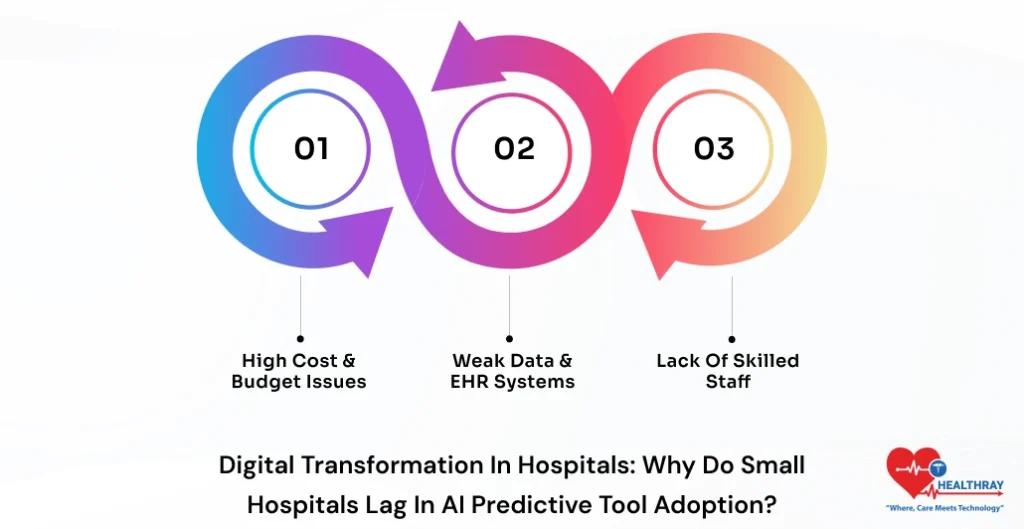
Digital Transformation in Hospitals: Why do Small Hospitals Lag in AI Predictive Tool Adoption?
1. High Cost & Budget Issues
Small hospitals mostly face challenges with tight budgets. Further, software cost, setup, integration and maintenance expenses are high for applying AI tools in conventional procedures. Large hospitals can easily afford it, but for small hospitals, this investment is highly risky.
Mitigation: Small hospitals should rely on cloud-based HIMS. A cloud system typically starts at $100-2,000/month. There are no upfront infrastructure expenses. Small clinics no longer have headaches of financial constraints and purchasing expensive hardware equipment.
2. Weak Data & EHR Systems
AI tools require clean and structured data to work accurately. Further, small hospitals lack strong EHR systems and proper digital records. That’s the reason AI tools won’t work effectively in small clinics.
Mitigation: Firstly, clinics should begin implementing basic EHR and focus on data standardization. Then gradually focus on improving digital records.
3. Lack of Skilled Staff
To implement AI tools in the practice, small clinics need IT experts and data specialists. Further, small clinics often face challenges with staff shortages and lack trained staff to expand and manage AI in the practices.
Mitigation: Provide basic AI training to staff. Take support from third-party vendors or professional consultants. In this case, clinics should choose outsourcing options.
Best Strategies to Involve Clinicians Early in Digital Transformation
1. Co-Design Workshops with Clinicians
Involve doctors and nurses in the planning stage. Further, conduct a workshop with them where they will share their daily workflow and suggest inputs in system design. Thai will assist hospitals to construct software based on real-life needs.
2. Create Digital Champions
Hospitals should involve high-skilled practitioners from every department and create a list of “digital champions.” Further, digital champions can guide other staff members to comfortably use the system. They also assist employees along the way and teach them how to use AI tools to streamline their intricate procedures.
3. Understand Real Pain Points
Hospitals should understand the problems of clinicians before indulging in the implementation process. Whether they find difficulty with paperwork, a slow system or any other major issues. Further, when software resolves their real-life challenges, naturally staff will embrace it.
 PRO TIP
How to Overcome Legacy System Integration Challenges in Hospitals?
1. Use Middleware for Connection
Middleware is a standardized bridge that ties together all the departments under one roof. Further, different systems such as lab, billing, and inventory can properly share the data without changing the system.
2. Adopt API & FHIR Standards
By using the FHIR standard, data movement becomes simple and effortless. Further, through APIs, clinics can easily connect their old system data with modern apps or AI tools without the need for reworking the entire system.
3. Encapsulation (Wrapping Old Systems)
Instead of replacing the old system, hospitals should completely wrap up. Further, they should create a layer on top of legacy systems to convert them into a modern format. This ensures system continuity and upgrades them simultaneously.
4. Use RPA for Temporary Automation
Robotic Process Automation automates all the repetitive tasks of hospital practices. Additionally, clinics can use it as a temporary fix until the upgrade and full integration are finished.
Learn more: Using Digital Systems to Meet NABH Requirements
5. Add Strong Security Layer
In legacy systems, security risks are high. Further, hospitals should use strong security measures such as encryption, role-based access and zero-trust model at the time of integration. This keeps the patient data safe and less prone to cyber attacks. It is easy for clinics to maintain compliance throughout the journey.
Top Mistakes to Avoid in Hospital Digital Transformations
1. Understanding only IT projects
Understanding only how IT functions is one of the biggest mistakes hospitals typically make when implementing hospital automation software. Further, digital transformation in hospitals is people + process + technology. If clinics dont invole doctors ,nurses and other staff members, then it becomes highly challenging to adopt the new system in the practices.
2. Big-Bang Implementation Approach
Launching the entire system at one time is not a smart move. Further, staff gets overwhelmed, which in turn raises the risk of error. This slows down the adoption; ultimately, hospitals lose credibility.
3. Lack of Clear Vision or Planning
Without a proper roadmap, a project becomes directionless. Further, this raises the risks of scope creep (extra features), delays and confusion. It is highly imperative for clinics to focus on proper planning before embarking on this journey. Also read our blog on multi hospital management systems to know more about it.
Step towards digital era with our healthcare solution
Revamp your hospital facilities and embrace change for better healthcare management. Ease in managing and organizing large medical datasets leads to effective analysis. Seize the opportunity now!
Cost Estimation Tips to Avoid Budget Overruns in IT Projects
1. Create Detailed Work Breakdown Structure (WBS)
It is highly crucial for clinics to break the project into small, manageable tasks. Further hospitals should clearly define EHR integration, staff training, data migration, testing, and downtime costs. When all activities are visible, hospitals can easily determine the hidden cost. This makes the estimation realistic.
2. Use Past Data or Benchmarks
Make every effort to maximize the use of any prior project data that clinics may have. For example, determine the previous HMS cost of any hospital or per-bed cost. Further, this benchmark provides you a realistic baseline and saves you from over-optimistic estimation.
3. Add Risk-Based Contingency
Every IT project holds some uncertainty, such as integration issues or customization delays. Instead of blindly adding a fixed percentage, hospitals should identify risky areas and keep a 10–20% contingency for them. Further, this smart planning will help hospitals form unexpected revenue spikes.
4. Bottom-Up Estimation Approach
Ground-level team members (IT team, doctors, and admin staff) can provide you the best estimation, as they actually work on that. Collect inputs from them and calculate task-wise time or effort. Then validate on the management level. Additionally, this approach makes the estimation more accurate and practical.
 NOTE
NOTE
Conclusion
In 2026, adopting HIMS in healthcare has become a necessity. Hospitals without digitalization fall behind in terms of productivity, patient care, and competition. Hospitals that successfully implement new HIMS systems provide better care, fewer errors, and greater patient satisfaction. Cloud-based HIMS platforms like Healthray are highly affordable; even small clinics can embark on digitalization and improve their efficacy.