


Summary
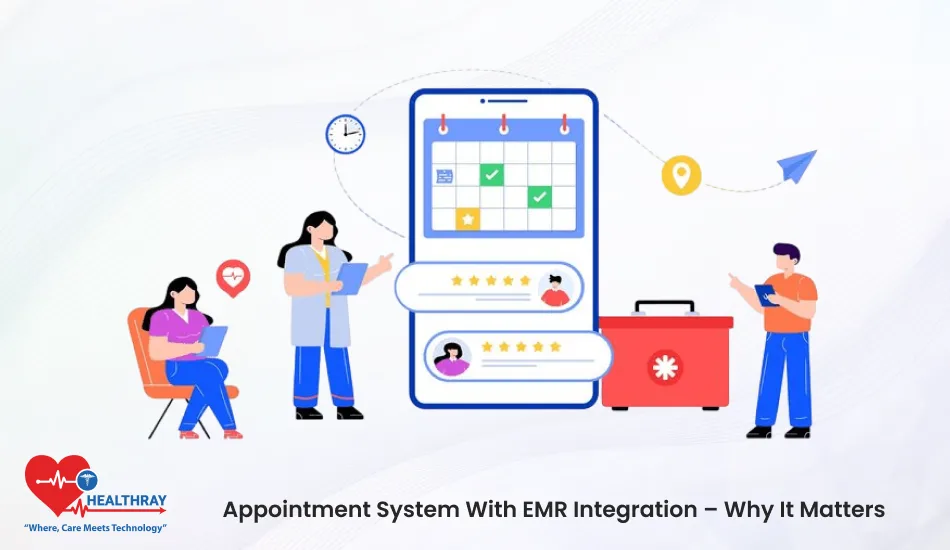
Nowadays, only appointment booking is not sufficient to run the clinics smoothly. It is highly crucial to connect an appointment system with EHR integration. This integration minimizes staff loads, avoids duplicate entries and minimizes the chances of error. Patient information seemingly flows from booking to consultation or follow-ups. In this blog I will discuss how an appointment system with EMR integration offers faster consultations, better clinical decisions, and a smooth patient experience to clinics.
Introduction
In today’s healthcare ecosystem, appointment management is not just limited to booking time slots. For modern hospitals, it’s a smart way to connect the entire patient journey. That’s the reason the appointment system with EMR integration is highly imperative for hospitals.
The patient’s medical records are directly linked to the entire booking when the EMR and doctor appointment system are paired together. It evades the doctor’s need to search files and ask the same details from patients more than once. Past diagnoses, prescriptions, lab reports, and allergy details are accessible to doctors right before the consultation.
It minimizes the manual workload of staff. The EMR automatically reflects the data entered by patients during appointments. It minimizes duplicate entries and reduces human errors. Also, it creates a smooth experience for patients as well. It minimizes waiting time, accelerates consultation, and makes patient care more personalized. Next, I will discuss how appointment system with EMR integration provide real-time, accurate data to doctors that facilitates better clinical decisions. How it extends the appointment process beyond booking and integrates it into connected care. Keep reading!!!!
Why Appointment System With Emr Integration Matters for Clinical Quality
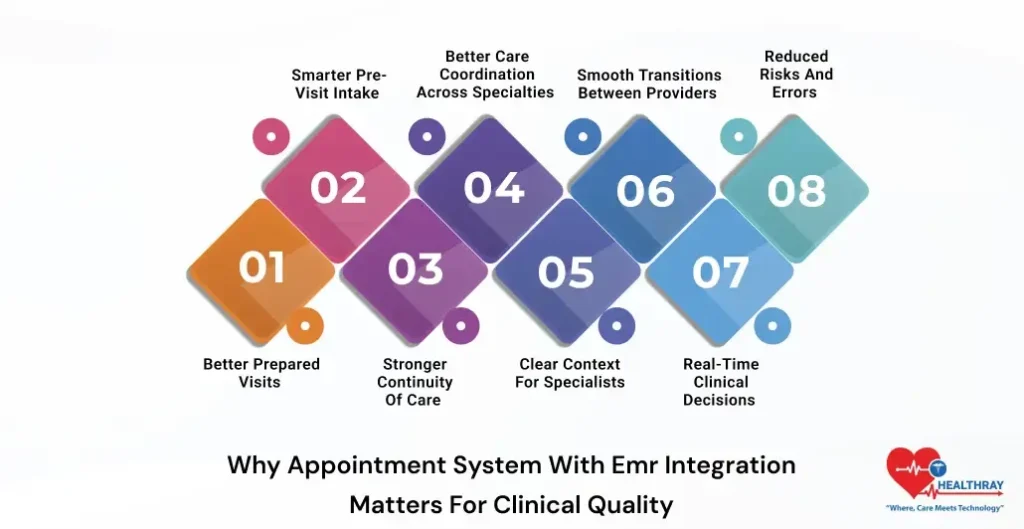
Let’s check out:
Better Prepared Visits
Standalone appointment widgets are incapable of understanding a patient’s clinical story. As the patient books the appointment, EMR presents the relevant clinical context, such as chronic conditions, allergies, recent lab reports, and pending care gaps. Furthermore, it helps doctors to pre-prepare the patient case before the visit. Thus, it makes the consultation more focused and effective.
Smarter Pre-Visit Intake
EMR is connected to pre-visit digital intake forms such as medical history, consent forms, and symptoms to ensure the information is complete and well-structured. Furthermore, Patients no longer have to visit the clinics and repeatedly give staff members the same information, avoiding the need for recitation. Moreover, doctors get accurate data directly in the EMR. Overall, this point of care improves decision-making.
Stronger Continuity of Care
When appointment details and clinical notes update in the same real-time records, continuity of care naturally becomes better. Whether it involves multiple providers, everyone will receive the same information. Furthermore, this makes the diagnosis more accurate and evades the chances of missed appointments. Also, patients can conveniently follow the care plans throughout treatment. Overall, a clinic appointment management solution is not just a scheduling tool; rather, it is a strong foundation for improving quality clinical care.
Better Care Coordination Across Specialties
In multi-specialty clinics, care quality becomes stronger if data flow among different providers flows smoothly. Further, EMR-integrated scheduling makes team-based care safer and more efficient, where every provider works on the same page.
Clear Context for Specialists
Shared EMR data gives specialists a clear picture of why a patient was referred, what medication is being used, and whether or not tests have been completed. Furthermore, this minimizes the guesswork and provides personalized and quality care to patients.
Smooth Transitions Between Providers
When clinics combine primary care and specialist EMRs, it makes the diagnosis tracking better. Also, management clearly follows the treatment plans. More importantly, it makes the care transitions smooth, without any information loss.
Real-Time Clinical Decisions
Through HL7/FHIR interfaces, updated lab results or imaging reports are available in real time. Furthermore, doctors can take concrete decisions on every scheduled visit.
Reduced Risks and Errors
Strong integrated workflows reduce duplicate tests, conflicting treatments, or adverse events especially for chronic and high-risk patients. Furthermore, it fosters patient safety and overall care quality.
 PRO TIP
Why Appointment System With EMR Integration Matters for Patient Experience
Let’s check out:
Self-Service Convenience and Digital Engagement
These days, patients expect healthcare to be the same as other digital services. Further, doctor appointment systems for hospitals provide this convenience without data fragmentation. Patients can easily search their providers and check real-time availability and can conveniently book, cancel, or reschedule appointments 24/7.
One Unified Patient Portal
Integrated patient portals allow patients to access visit summaries, lab results, prescriptions, and their appointment history in the single dashboard. With clinic appointment software, patients no longer need to call staff members multiple times for booking slots. Overall, this makes the experience simple and transparent.
Continuous Digital Engagement
When Digital forms, automated reminders, or post-visit surveys are efficiently embedded and connected with EMR, then patient engagement is not just limited to only appointments. This creates a continuous loop before, during, and after the visit.
Higher Satisfaction and Loyalty
The amalgamation of convenience and transparency improves patient satisfaction escpecially among young and tech-savvy patients. Additionally, this conduces better trust, stronger loyalty, and long-term patient relationships.
Informed Patients, Better Follow-Through
When patients feel they are getting the right information and being valued. Therefore, the likelihood of them attending appointments and adhering to care plans is very high. Best Doctor Appointment Systems supports clear and reliable communication.
Clear and Consistent Reminders
Accurate appointment reminders include the visit type, location, and preparation instructions, which are clearly mentioned; this minimizes confusion. Further, this minimizes last-minute cancellations, and patients feel much more comfortable.
Secure, Ongoing Communication
When clinics connect EMR with secure messaging, it allows patients to ask questions between visits, clarify medication, and provide an easy option for sharing health updates. Patients believe they are in constant communication with clinics.
Smooth Check-In Experience
Integrated workflows reduce the check-in time of repetitive form filling and accelerate the verification process. Additionally, patients view this seamless procedure as an indication of the general caliber of the clinic.
Stronger Relationships and Outcomes
Good communication based on integrated data boosts patient adherence. Further, it improves clinical outcomes and makes the provider–patient relationships more coherent.
 NOTE
NOTE
Why Appointment System With EMR Integration Matters for Strategy and Growth
Let’s check out:
Breaking Data Silos
Without integration, show rates, wait times, and resource utilization are scattered in different systems. Further, this makes it challenging for doctors to decide on meaningful conclusions. EMR-linked appointment data break these silos and unlock powerful analytics.
Real-Time Performance Visibility
With Integrated dashboards, administrators can concisely analyze key metrics like no-show rates, average wait times, provider utilization, and referral completion. Further, clinics can easily monitor all the data at a single place without any manual reports.
Deeper Operational Insights
When you combine EMR clinical data with scheduling data, then staff members get deeper insights, such as which chronic condition reflects more no-shows and which clinics need more extended OPD hours and more.
Step towards digital era with our healthcare solution
Revamp your hospital facilities and embrace change for better healthcare management. Ease in managing and organizing large medical datasets leads to effective analysis. Seize the opportunity now!
Smarter Investment Decisions
Clinics can use integrated analytics to make decisions that are directly related to revenue and outcomes, such as where to add telehealth slots, where to improve opd hours, and where to add new providers.
AI-Powered Optimization
Modern AI and real-time analytics engines are embedded in EMR-linked scheduling data. This system can easily predict no-shows and automatically optimize slot allocation. Thus, it promotes long-term growth strategies.
Moving Toward Open Healthcare Systems
Healthcare ecosystems are gradually moving toward open or interoperable architectures, with HL7 or FHIR APIs serving as central standards. Appointment EMR integration perfectly aligns in this direction and makes the system future-ready.
Standardized Data Exchange
HL7 and FHIR provide structured and standardized ways for scheduling and clinical data exchange. EMRs, hospital information systems, telehealth apps, or third-party tools can easily and securely connect without any risks of data leakage.
Flexible, Vendor-Neutral Ecosystems
Nowadays, vendor ecosystems are evolving rapidly and can easily plug appointment modules, telemedicine platforms, and patient apps with FHIR APIs into the EMR system. Furthermore, this prevents vendor lock-in and clinics get flexibility as per the clinics’ future necessities.
Ready for Scale and Expansion
This future-proofing is particularly crucial for organizations looking to integrate with national health exchanges, expand into new locations, or hire new specialists.
Key Takeaways for Clinics and Hospitals
Let’s step in:
A Strategic Infrastructure, Not Just Scheduling
An appointment system with EMR integration is not limited to scheduling flexibility. Furthermore, it is a strategic infrastructure decision that defines clinic efficiency, clinical quality, and patient loyalty.
Improved Operational Efficiency
Integrated systems reduce no-shows and wait times. Further, automation and real-time synchronization minimize manual workloads and save valuable time for both doctors and staff.
Better Care Quality and Safety
Every appointment is solidified with complete and up-to-date patient data. Furthermore, multi-provider workflows collaborate effectively, significantly reducing errors, delays, and missed follow-ups.
Enhanced Patient Experience and Growth
EMR integration improves patient experience and enables data-driven growth through analytics. Furthermore, interoperability makes the clinic’s operations versatile and secure for the future.
Conclusion
An appointment system with EMR integration is now more than just a convenience in the healthcare industry; it is a need. It helps clinics in delivering better planning, smoother operations, and higher care quality.
We no longer cling to the question. “Do clinics need to incorporate appointment systems?” “Does your appointment system seamlessly integrate with EMR to support present and future needs?” is the true question at hand. Healthcare providers can make their clinics and hospitals future-proof by implementing this step now.