






Summary
The selection of medical software is not supposed to be gambling, but this is the feeling a lot of doctors have. One wrong choice can slow down your clinic, frustrate staff, and make patient care harder than it should be. This Comparison Healthray vs Docpulse is created to eliminate this uncertainty.
Both Healthray and Docpulse claim to simplify operations. However, they serve very different types of practices. There are physicians who require quickness and convenience. Others require organization, reporting and long term development assistance. This guide explains what each system actually delivers in daily practice, so you can choose with confidence instead of hope.
Introduction
Healthcare in 2026 feels very different from just a few years ago. Patient volumes are higher. There are more stringent compliance requirements. The demands on digital records are on the increase. Because of that, software decisions now affect both patient care and business stability. That is precisely why the Comparison Healthray vs Docpulse is relevant nowadays.
Numerous physicians initiate research when they have read an overview of a hospital management system or have seen demos. Although demos demonstrate features, they do not demonstrate friction. Real problems appear during busy OPD hours, billing deadlines, or audit reviews. Doctors then realize that not all digital healthcare platforms age well with growth.
Nowadays in 2026, selecting software is no longer an IT decision. It is a long term operational strategy.
How Doctors and Hospitals Should Evaluate an EMR in 2026

Why “Good Enough Software” Is No Longer Enough
Previously, clinics had simple systems due to workloads remaining manageable. This assumption is no longer true. Physicians have to deal with increased paperwork, insurance work and follow-ups. When software only “sort of” works, it creates daily stress.
The contemporary EMR/EHR software should alleviate brain burden. Eventually, it is supposed to reduce the time taken to document, enhance accuracy, and eliminate duplication. When it fails to do that, doctors compensate manually. In the long run, this will result in fatigue and errors.
Therefore, choosing software that only fits today often creates problems tomorrow.
What Actually Impacts Patient Workflow Efficiency
The efficiency of patient workflow relies on effective coordination. Records have to be related to appointments. The prescriptions also should be directed in billing. The updates of the report should be automatic.When systems break these connections, staff fills gaps manually.
An effective hospital information management system enhances inter-team continuity. It makes sure that information flows in a logical rather than in a redundant manner. This difference cannot be disregarded with the rise in the volume of patients.
Core Differences at Glance
The Healthray vs Docpulse comparison 2026 points to the basic difference in their design philosophy.
Docpulse is an organization that is concerned with simplicity. It will work towards cutting down the hassles of physicians who desire to be operational soon. Healthray concentrates on form. It helps to facilitate departmental and geographical complex operations.
Docpulse works best when workflows remain predictable. Healthray performs better when complexity increases. Neither approach is wrong. However, choosing the wrong one for your growth stage often leads to dissatisfaction.
This difference is easy to understand and it conserves time, money and frustration early.
EMR Experience – What Doctors Feel Day to Day
The long-term adoption is determined by daily experience. This experience of Healthray vs Docpulse EMR is concerned with the actual feelings of doctors when using each of them.
Clinical Documentation, Speed, and Ease of Use
It is light and fast. Physicians tend to change fast. The navigation is also intuitive, and this is useful in peak OPD hours. This convenience is a significant benefit to most clinics.
Moreover, Healthray feels structured. Complex cases, referrals and workflows at the department level are supported by documentation. Despite the steep learning curve, doctors become controllable when they become familiar.
EMR/EHR Software Customization vs Simplicity
Docpulse does not allow customization as it keeps it simple. This is effective in clinics which tend to have standard working flows. Healthray enables more customization across the specialties and departments.
 PRO TIP
Healthray vs Docpulse Pros and Cons in a Real-World Practices
In this section, the pros and cons of Healthray vs Docpulse have been well defined in terms of actual use.
Healthray – Pros
- Designed for hospitals and multi-specialty clinics
- Strong hospital management system capabilities
- Handles OPD, IPD, ICU, pharmacy, and labs
- Advanced reporting and analytics
- Custom workflows across departments
- Works as a scalable EMR for doctors planning growth
Healthray – Cons
- Requires training and onboarding time
- Higher initial investment
- Can feel complex for small clinics
Docpulse – Pros
- Very easy to learn and use
- Fast setup and onboarding
- Affordable for clinics
- Clean interface for doctors
- Ideal for OPD-focused practices
Docpulse – Cons
- Limited scalability
- Basic reporting features
- Not suitable for large hospitals
- Fewer integrations
Hospital Information Management System Capabilities Compared
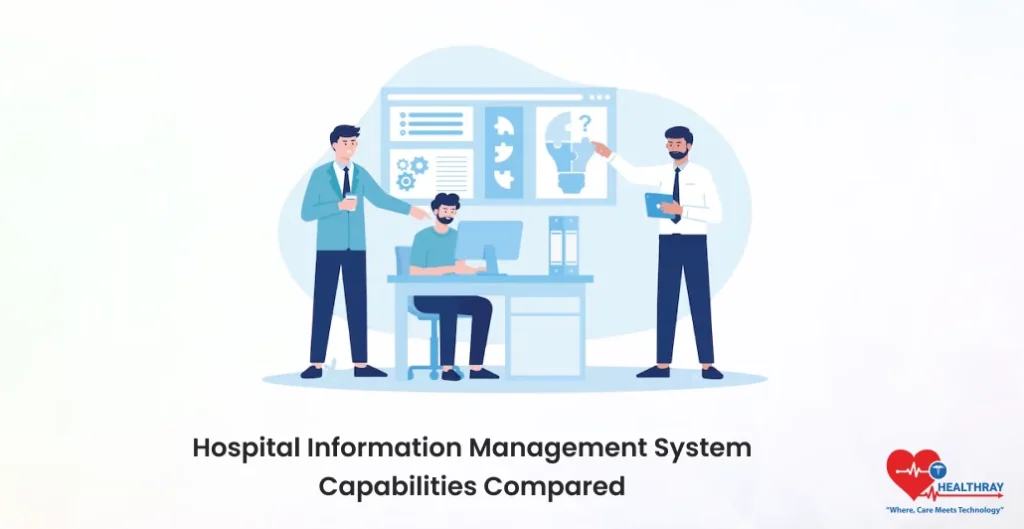
Hospitals require deeper control than clinics. This sub-category dwells on system-level capabilities.
IPD, OPD, Billing, and Department-Level Control
Healthray promotes OPD, IPD, ICU, diagnostics, and pharmacy on a single hospital information management system. The billing also cuts across departments and enhances less reconciliation.
Docpulse is primarily interested in OPD workflows. Although billing suits clinics well, it is usually restrictive to the hospital when the complexity increases.
Reporting, Compliance and Admin Visibility
All in all, Healthray offers administrator dashboards. These dashboards facilitate compliance, planning, and audits. Docpulse reporting is still less complex and clinic-based.
 NOTE
NOTE
Doctor Practice Management Choice
Every software decision eventually becomes a doctor practice management choice, not just a tech choice. Doctors experience the pressure during patient hours, whereas the administrators experience it during audits and reviews. Due to that, you need to select between the Healthray and Docpulse based on understanding what is your practice position today and where it is going.
Moreover, speed is normally favored at clinics. Doctors desire fewer clicks, quick notes and easy billing. Docpulse is suitable in this environment. It helps to facilitate regular operations and minimize day-to-day friction. Employee education also remains affordable, which is important in smaller groups.
Instead, hospitals need coordination. Departments must share data. Administrators should be visible. Healthray helps in the needs by using the structured workflow and centralized control. The system can sustain pressure when it gets complicated though it requires time to set up.
Comparison Healthray vs Docpulse
| FEATURES | HEALTHRAY | DOCPULSE |
| Best Suited For | Hospitals, multi-specialty clinics, growing healthcare groups | Solo doctors, small clinics, OPD-focused practices |
| Core Positioning | Enterprise-grade hospital management system | Simple clinic and doctor practice tool |
| Deployment | Cloud-based | Cloud-based |
| Ease of Use | Moderate learning curve | Very easy and intuitive |
| Initial Setup Time | Longer due to configuration | Quick setup |
| EMR/EHR Software Depth | Advanced and customizable | Basic and standardized |
| Healthray vs Docpulse EMR Experience | Structured, powerful, suited for complex cases | Lightweight, fast, minimal clicks |
| OPD Management | Strong | Strong |
| IPD & ICU Management | Fully supported | Not supported |
| Diagnostic & Lab Integration | Available | Limited |
| Pharmacy Management | Integrated | Basic |
| Billing & Invoicing | Advanced, multi-department billing | Simple clinic billing |
| Insurance & TPA Handling | Supported | Limited |
| Reporting & Analytics | Advanced dashboards and insights | Basic reports |
| Patient Workflow Efficiency | High for medium to large setups | High for small clinics |
| Scalability | High – built for expansion | Limited scalability |
| Multi-Location Support | Yes | Limited |
| Hospital Information Management System | Comprehensive | Not hospital-grade |
| Training Requirement | Required for teams | Minimal |
| Ideal Doctor Practice Management Choice | Doctors planning growth | Doctors prioritizing simplicity |
| Switching EMR Platforms Risk | Lower long-term risk | Higher if growth occurs |
| Scalable EMR for Doctors | Yes | No |
This Healthray vs Docpulse 2026 comparison of clinics and hospitals is a comparison of practical decision points which are being ignored.
The majority of clinics begin with few employees and consistent patient flow. This stage is assisted with the help of Docpulse. Basically, it enables physicians to go into practice fast without significant investment in training. Nevertheless, fast growing clinics tend to reach their limits much earlier than anticipated.
Healthray requires increased effort. Nevertheless, it gears clinics to be extended into diagnostics, into a variety of specialties or even to other branches. This preparation is of use to clinics that intend to expand in a period of two to three years.
In short, Docpulse suits stability. Healthray suits ambition. This difference can be understood to prevent repeat implementation with clinics later incurring expenses.
When Switching EMR Platforms Actually Makes Sense
Doctors hesitate when switching EMR software platforms, and that hesitation feels justified. A change interferes with practices and needs training. Nevertheless, being in the wrong system may end up being expensive in the long run.
Delayed billing, lack of reports and confusion of staff are clear warning signs. When these problems recur, then productivity is affected. Then switching will be a strategic, rather than a risky, move.
It is all about planning. Phased rollout, data cleaning and involvement of the staff minimize disruption. Careful planning of clinics and hospitals normally recovers quicker than anticipated.
Is Healthray a Scalable EMR for Doctors Planning Long-Term Growth?
Many physicians question whether Healthray is really a scalable physician EMR. Practically, it is so, particularly to organizations intending to expand.
Healthray promotes centralized reporting and data on multi-location practices. Specialty hospitals have the advantage of having department-level controls and analytics. In the long run, such structure minimizes manual labor and enhances accountability.
Docpulse is effective in the smaller setting. Nonetheless, it approaches practical limits with the increase of complexity. Scalability is more frequently more convenient than early convenience to doctors who are considering long-term growth.
Patient Workflow Efficiency and Daily Operations
The efficiency of workflow with patients usually defines the satisfaction of the staff. Teams operate with confidence when there is smooth integration of systems, appointments, records and billing. When they fail to, employees pay manually.
Healthray enhances efficiency in the workflow of patients by integrating departments. This limits repetition of work and misunderstanding. Docpulse is efficient in smaller clinics that have regular workflows.
There is no universal approach that is superior. Efficiency requires size and form. Being realistic is the way to avoid idealistic expectations.
Digital Healthcare Platforms and Future Readiness
Modern digital healthcare platforms must support more than documentation. They are required to promote growth, compliance and patient experience.
Healthray is a highly structured and reported company. This facilitates audits, growth and complicated care delivery. Docpulse is usability and speed oriented and is advantageous to clinics with steady work flow.
The future is prepared by vision. Expansion planning practices enjoy more systems. Consistency practices have the benefit of simplicity.
Conclusion
This Comparison Healthray vs Docpulse will depend on intent rather than features.
Docpulse is suitable for physicians seeking convenience, fastness, and no set up. Healthray is suited to organisations that require structure, reporting and scalability. The right decision minimizes the stress levels and secures future development.
There is no universal winner. There is only the right fit for your stage.
To conclude, the Comparison Healthray vs Docpulse shows two strong tools serving different needs. Docpulse delivers simplicity. Healthray delivers control.
If you run a clinic and value speed, Docpulse works well. If you manage a hospital or plan expansion. Schedule a free demo and see how Healthray offers stability.
Choose with honesty about your future. Your workflow depends on it.