


Summary
Hospitals today generate more data than ever – yet most still operate reactively, responding to problems after they’ve already happened. This blog explores how predictive analytics in HMS is changing that. You’ll understand what it actually means for day-to-day hospital operations, the five predictions already reshaping how smart hospitals work, and why most hospitals haven’t made this leap yet despite the technology being available. More importantly, you’ll see what a hospital looks like when it finally stops reacting and starts predicting – and what to look for in an HMS built to get you there.
Introduction
Three days post-discharge, a patient is readmitted. One of the nurses is dragged to a ward that was not expected to require additional hands. The drugstore is out of stock of a drug that has been in high demand over the past two weeks. None of this was unpredictable. The information was just lying there in the Hospital Management Software. There was simply no time in which the hospital could have been able to do something with it.
That is where predictive analytics in HMS comes in. Additionally, it is not merely a feature upgrade, that is, a completely different way of operating a hospital.
The vast volumes of data gathered by most hospitals today are immense. Gathering information and employing it are quite different, though. The reality is that most hospital teams continue to make decisions based on what has already occurred and not what is about to occur. Predictive analytics in HMS alters that equation altogether.
 NOTE
NOTE
The Difference Between A Hospital That Reacts And One That Predicts
Consider two hospitals. The two have an equal number of beds. They both utilize a hospital management system. Both have experienced staff.
One hospital finds out a ward is understaffed when it’s already understaffed. The other receives a flag 48 hours beforehand and balances out the roster prior to the shift beginning. One hospital notices a patient is deteriorating when vitals visibly crash. The other receives an early warning when it is still possible to take some action.
It is not a difference in terms of resources. It’s not about staff quality either. It is about the ability of the hospital management system to come up with patterns before they become problems.
As a result, the reactive hospital continues to operate – but at pressure. All decisions occur in reaction to a wrong that has already occurred. On the other end, the predictive hospital is an intelligence running hospital. It does what the data indicates is next.
This is how smart hospital technology really looks like in practice. Not flashy dashboards. Not expensive hardware. Instead it is a system that reads your own hospital data and advises you what to do with it, before you even have to.
Where Predictive Analytics In HMS Lives Inside
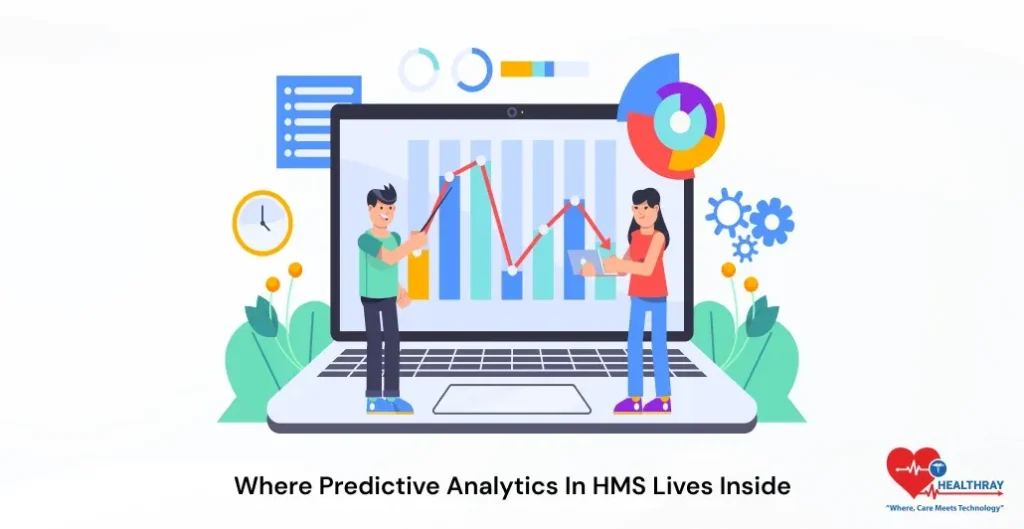
One of the points that should not be disregarded is as follows: predictive analytics does not require new data. Your HMS already possesses all that it requires.
EHR documentation, history of appointments, billing trends, lab findings, pharmacy orders, discharges – it is all in your system. AI in hospital management doesn’t bring external intelligence into your hospital. Rather, it ultimately explains the smart that your hospital already produces on a daily basis.
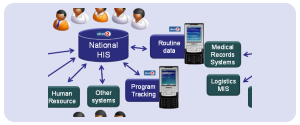
Simple terms of its operation are as follows. The HMS gathers systematic information from all departments. Healthcare machine learning models then discover patterns in that data – patterns that recur, patterns that forecast. As a result, when those patterns appear again, the system raises a flag. Your team gets an alert. Action happens before the outcome becomes unavoidable.
This is also why cloud-based medical practice management software has got a true advantage in this regard. Cloud-based platforms update in real time, sync across departments without delay, and run predictive models on live data – not yesterday’s exports.
 PRO TIP
Your hospital already has the HMS at its heart. Predictive analytics simply activates it.
The Five Predictions That Are Changing How Smart Hospitals Operate
PREDICTION #1: Which Patients Will Be Readmitted Before They Leave
Predictive analytics in HMS can determine a patient with likelihood of returning within 30 days before he or she leaves the door. The model examines a history of diagnosis, social issues, patterns of medication compliance, and discharge. Based on this, care teams can intervene, follow-up call, amended discharge plans, or home care referrals, when the patient is still within the building. Another study by 2025 in the American Journal of Managed Care demonstrated reduced readmission rates from 27.9% to 23.9% in a safety-net hospital where predictive models lowered readmission rates by intervening prior to discharge.
PREDICTION #2: Where Staffing Will Break Down – 48 Hours Before It Happens
The last-week-based scheduling is a guessing game. Hospital management based on AI reads admission predictions, seasonal trends and bed occupancy to forecast two days ahead of staffing pressure. Consequently, managers change rosters even before the gap manifests itself – not in the crisis.
PREDICTION #3: Which Beds Will Be Needed And When
One of the most challenging tasks in any hospital, in terms of stress, is bed management. Predictive modeling in healthcare solves this by forecasting discharge timelines and incoming admission volumes simultaneously. Bed coordinators actually view the picture of tomorrow.
PREDICTION #4: Which Drugs Will Run Short Before The Shortage Hits
Pharmacy inventory forecasting uses prescription trends, seasonal illness data, and supplier lead times to flag shortages before they happen. It is one of the most obvious advantages of predictive analytics in hospital management system no more emergency order, no more substitutions at the worst.
PREDICTION #5: Which Patients Are Deteriorating – Before Vitals Visibly Crash
This is where the capabilities of clinical decision support systems come in. A real-time vitals feed and an electronic health records analytics feed a continuous risk model. Once the pattern of a patient changes to the direction of deterioration, the system notifies the care team – usually 6 to 12 hours prior to a clinical transformation. That window is a life saver.
Learn more: Questions Before Buying HMS Software
Why Most Hospitals Haven’t Made This Leap Yet
Given all of this, why aren’t more hospitals already doing it? The honest answer involves a few real barriers.
Data silos are the most common obstacle. Departments within a hospital such as labs, pharmacy, billing, clinical, etc. are often based on independent systems that do not communicate with each other. Without unified data, predictive models can’t work accurately. This will be among the most significant obstacles of AI analytics implementation in hospitals nowadays.
Legacy HMS platforms weren’t built for this. Many hospitals run systems designed a decade ago. Those systems store data, but they don’t analyze it. Moreover, retrofitting predictive capabilities to a legacy underpinning seldom works well.
Staff trust is a real factor. Clinicians and administrators do not necessarily have faith in algorithmic recommendations, particularly at the beginning stages of adoption. This isn’t irrational. Actually, it is not so much of a training problem as it is a governance issue. The PMC 2024 Delphi study on smart hospital transformation observed that evidence-based frameworks deficiency is a major gap in the implementation of AI in a healthcare setting.
Bias and accountability gaps also slow things down. If a predictive model produces a flawed recommendation, who is responsible? Hospitals need clear governance structures before they can deploy these tools at scale.
All these obstacles are, however, not irreversible. They’re solvable with the right platform and the right implementation approach.
Step towards digital era with our healthcare solution
Revamp your hospital facilities and embrace change for better healthcare management. Ease in managing and organizing large medical datasets leads to effective analysis. Seize the opportunity now!
What a Hospital Looks Like on the Other Side of the Leap
Consider an instance of a morning handover at a hospital with full predictive analytics in HMS. The charge nurse is already aware of the top three patients with the highest risk of readmission today. The bed coordinator has the occupancy planned tomorrow up to 8 AM. The pharmacy flagged a potential shortage five days ago – and the order already went in.
Meanwhile, the staffing manager had changed the schedule of Thursday 2 days earlier, no one had complained. Ward 4 had a patient who was in a bad state, and last night, he intervened, six hours before anything could have raised concern about her. She’s stable now.
This is the hospital operations efficiency when the system is functioning as it should. Not reactive firefighting. Active and evidence-based actions at all levels.
The numbers back this up. Healthcare organizations integrating advanced analytics see an average ROI of 147% within three years. Moreover, McKinsey and Harvard research indicates AI and predictive analytics could save the US healthcare system between $200 billion and $360 billion annually. Health Affairs reported in January 2025 that 65% of US hospitals now use predictive models – with adoption accelerating every year.
In the long run, the hospitals that invest in this now won’t just run better. They will become the model of others.
Conclusion
Is Your HMS Built for This Leap? The next leap isn’t about buying new technology for its own sake. It’s about finally using what your hospital already knows. The patient who came back three days after discharge, the understaffed ward nobody saw coming, the pharmacy shortage that blindsided everyone, none of it was unpreventable. The data was there. The system just wasn’t built to act on it.
If your current system stores data but doesn’t act on it, you’re leaving the most valuable part unused. Here’s what to look for in an HMS built for predictive intelligence:
- Real-time data access across all departments
- Built-in machine learning models – not third-party add-ons
- Interoperability with HL7 and FHIR standards
- Open APIs for integration with existing tools
- Patient record management systems that feed clean, structured data into predictive models
- Transparent model outputs your clinical staff can understand and trust
Start free with Healthray if you want a platform built for exactly this – one that turns your hospital’s own data into decisions your team can act on today.