
Summary
In contemporary hospitals, it would be an understatement to consider RIS as merely an imaging system. The radiology information system is actually the operational backbone that translates raw data into decisions; it transforms silos into bridges and, indeed, makes complex healthcare processes patient-centric. In this blog I’ll underscore the role of RIS in hospitals and how it brings forth remote access, scalability and security in data without adding data-heavy IT burdens so, let’s get started!!!
Introduction
Radiology departments in a hospital conjure images of X-rays, CT scans, or MRIs. But present-day radiology departments do more than just imaging investigations. This is a critical part of clinical decision-making. There is a role for a powerful system, RIS, that operates behind the scenes of silent transformation.
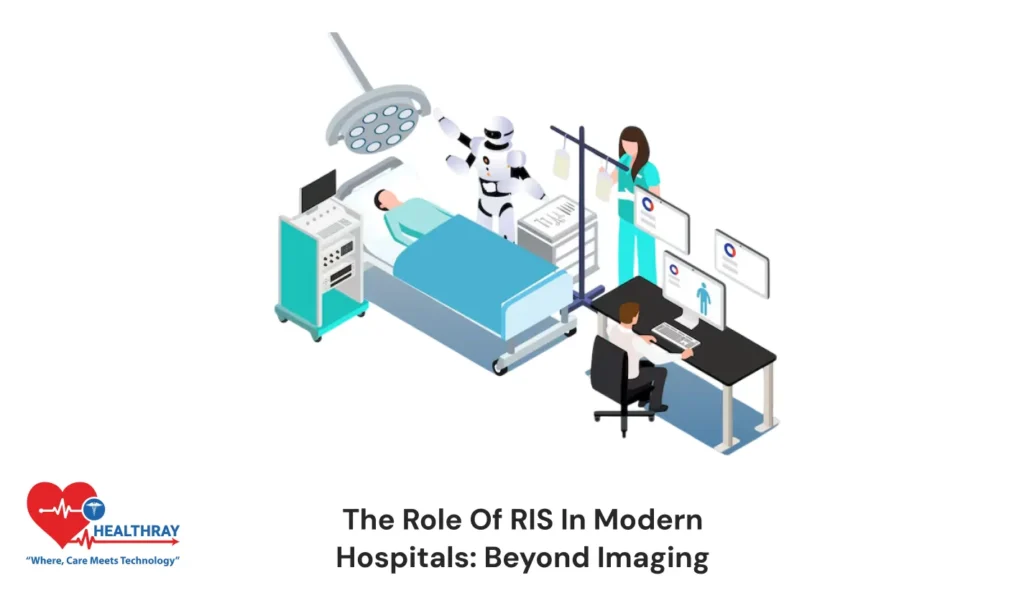
Modern AI-powered radiology software is not just limited to report storage. This streamlines the entire workflow from patient registration to appointment scheduling, modality coordination, reporting, and billing integration. When every step is connected, it naturally reduces the delays and errors, and doctors get powerful insights. RIS impact is not just confined to radiologist workstations.
The real change is visible when departments start coordinating with each other. When radiology, billing, OPD, and clinical teams function in the same rhythm, then hospitals are not like machines; they become well-coordinated systems. The role of RIS in hospitals may not be known to patients. They are unaware of the technology that works behind the screen. But what they believe is more important—less waiting, no confusion, and timely reports. Simply put, a smooth visit is one with fewer questions and more clarity.
Role of RIS in Hospitals: Core Functions
Let’s find out:
The Silent Engine of Radiology Operations
The radiology department works smoothly only when strong system work is behind its back. Furthermore, RIS is a silent engine that keeps the daily operations neat and organized. From patient registration to appointment scheduling and from order entry to report delivery, RIS manages the entire imaging lifecycle in a connected workflow.
From Orders to Reports: Everything in One Flow
Radiology information systems successfully process the imaging orders submitted by referring physicians. Further, all exam statuses, such as scheduled, in progress, and report, are visible in a single dashboard.
Automated Reporting and Secure Information Flow
It automates report generation and secure distribution, thus ensuring the right information reaches the right person at the right time. Clinics no longer need to take headaches of manual follow-ups and scheduling and delays.
Beyond Imaging: Billing, Compliance, and Insights
RIS plays a strong role beyond imaging. Further, it efficiently manages billing workflows and generates compliance reports and provides statistical analysis for single patients or procedure groups. Hospitals get clear visibility on all the medical practices and help them identify areas that still need improvement.
Smarter Scaling Without Extra Burden
In-built automation minimizes errors and accelerates the process. Further, hospitals become capable of handling higher imaging volumes without the need to increase proportional staff. This potency is the real advantage of modern radiology.
Patient Journey Orchestration, Not Just Scheduling
Let’s dive in:
Pre-Visit: Intelligent Order Management
Getting Imaging Right Before the Patient Arrives
The role of radiology information software is not just limited to appointment booking. Its real value becomes evident when patients arrive at hospitals.
Smarter Orders, Smoother Patient Flow
In the pre-visit phase, RIS intelligently validates imaging orders, checks indications, suggests the correct modality, verifies contrast requirements and also ensures protocol appropriateness. Let’s understand more about it:
Built-In Rules That Prevent Mistakes
RIS rules engines are highly smart. Further, it automatically flags duplicate orders, missing lab values, and contraindications like low eGFR for contrast studies. Thus, it reduces last-minute cancellations and re-scans and offers safer imaging practices.
Right Guidance for Referring Doctors
Integration with CPOE (Computerized Physician Order Entry) provides real-time prompts to referring doctors. Further, if an order is incomplete or requires correction, then the system immediately guides, eliminating the need for back-and-forth calls.
Eliminating Back-and-Forth, Orchestrating the Journey
Intelligent guidance eliminates repetitive calls and manual follow-ups. This way RIS manages the journey and also orchestrates it thoughtfully, efficiently, and in a clinically responsible way.
Day of Visit: Queue Management and Throughput
Managing Queues, Not Just Time Slots
The real challenges on the day of the visit are in flow control rather than time slots. Digital radiology workflow software goes beyond static appointments and efficiently manages dynamic queues such as patient condition, modality availability, unexpected delays, and emergency priorities. That’s the reason the radiology manager smoothly balances walk-ins, inpatients, and ED cases without compromising outpatient patient experience.
Real-Time Visibility, Real-Time Control
Managers can see which modality is in use, which is idle, and where the breakdown is with live dashboards from RIS in real time. Further, it also tracks patient wait times and SLA breaches to help radiologists instantly take corrective actions.
Filling Gaps Before They Hurt Efficiency
RIS smartly saves unused slots from wastage. Furthermore, if a patient does not show up, the system sends an automatic offer to waitlisted patients via SMs and the patient app. Overall, it reduces no-show gaps, provides better throughput, and makes patients more satisfied.
Post‑visit: Coordinated Follow‑up and Referrals
Turning Reports into Next Actions
Radiology work is not finished after imaging. In the post-visit phase, RIS automatically triggers follow-up actions such as additional imaging, lab tests, and specialty referrals through intelligent workflows.
From One-Time Reports to Long-Term Care Pathways
This aids in the radiology department’s transition from passive services to an active driver of long-term patient care, where every report guides the next clinical steps.
Smart Reports That Don’t Stop at Findings
Structured report templates help radiologists easily determine the next steps. They are embedded in a clear recommendation report that minimizes ambiguity.
Automated Reminders That Prevent Missed Follow-ups
As “6 months of follow-up CT recommended” phases were detected, the system automatically generates a reminder list. Additionally, it reduces the possibility of missing crucial follow-ups.
Closed-Loop Communication That Builds Trust
RIS ensures closed-loop communication workflows that notify and acknowledge critical results. Further, the referring physician’s acknowledgement brings clarity, creates accountability, and makes patient safety strong.
Role of RIS in Hospitals: Integration with Hospital Systems
Let’s check out:
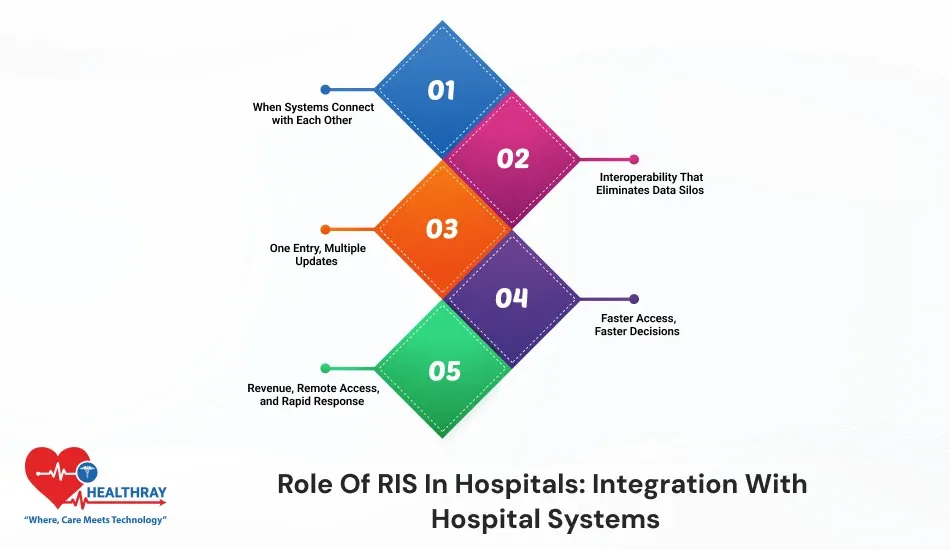
When Systems Connect with Each Other
Hospital workflow breaks when the system becomes a separate entity. Further, the real power of the radiology information system is visible in this point when it seamlessly cooperates with hospitals’ core systems, such as PACS, HIS, and EHR/EMR.
Interoperability That Eliminates Data Silos
Global standards HL7 and FHIR ensure that imaging data smoothly travels across hospitals, without creating any silos. As the study is completed, RIS automatically sends details to PACS and links the images with patient records. Further, this seamless data flow reduces manual handoffs and all departments get the same up-to-date information without delay and confusion.
One Entry, Multiple Updates
The practical benefit of integration is single-entry workflows. Additionally, data is entered once and reflects in every connected system. This minimizes data entry errors and saves staff time on unnecessary repetitive tasks.
Faster Access, Faster Decisions
When departments get real access, it naturally improves diagnosis speed. Further, Doctors, radiologists, and billing teams can view the same information, thus eliminating delays and miscommunication in the system.
Revenue, Remote Access, and Rapid Response
Integrated RIS streamlines automated billing and revenue cycle management. Further, in corporate hospitals this setup supports remote radiologist access and emergency workflows, thereby reducing the turnaround time significantly. This level of connectivity makes the RIS platform an enterprise-wide imaging coordination hub.
 PRO TIP
RIS as a Foundation for AI and Research
Let’s check out:
Where Clinical Context Meets Intelligent Data
AI and research are not just based on algorithms; their real strength lies in clean, contextual, and well-structured data. Further, RIS here plays a crucial role as it tightly unites clinical context, imaging orders, and patient outcomes in a single thread. That’s the reason RIS becomes a reliable foundation to build and validate AI models.
Curated Datasets, Not Raw Images
Through RIS, hospitals and technology vendors assemble high-quality training datasets where labels are strong and metadata are consistent. On the basis of indications, modality types, patient demographics, and outcomes, radiologists can easily define cohorts without taking on the burden of manual chart assessment.
Faster Research, Less Manual Effort
Previously, creating patient groups for research was a slow and error-prone process. RIS simplifies the process by creating structured queries. This saves time, increase accuracy and moves on studies faster.
Privacy-First Data Sharing
It is easy to apply data de-identification pipelines on the RIS layer. Further, it protects the multi-center research and AI collaboration without compromising patient privacy. Hospitals can confidentially exchange datasets while maintaining ethics and compliance.
 NOTE
NOTE
Real-World Evidence and Quality Programs
Let’s dive in:
Turning Daily Imaging into Measurable Quality
Radiology generates data on a daily basis, which serves as the foundation for real-world evidence. Further, RIS-generated data quality programs directly feed accreditation requirements and payer reporting.
Proving Value in a Value-Based Care World
As value-based care models expand, clearly demonstrating imaging appropriateness, report turnaround time, and clinical outcomes is a strong competitive advantage.
Benchmarking That Drives Smarter Investment
RIS metrics assist departments in determining their position relative to their peers. This information is valuable to all executives, whether it relates to recruiting personnel, upgrading equipment, or adopting AI tools.
Conclusion
Modern hospitals gain operational efficiency through RIS. It improves reporting accuracy and brings patient experience to center stage. Seamless integrations and continuous innovations further amplify its impact. Investment in RIS prepares the hospital for future growth. Therefore, RIS is more than just a tool for operational efficiency; it is also a quality-growth enabler.