




Summary
Clinical appointment management has become a critical solution for growing practices. Additionally, clinics are dealing with an increasing number of patients and operational pressure. Clinics find it difficult to manage hectic situations of scheduling, walk-ins, cancellations, and follow-ups. Clinical management solutions seamlessly organize appointment booking, reminders, and queue flow. This minimizes staff pressure and patient flow becomes smooth. In the end, clinical achieves operational efficiency, patient trust, and sustainable growth. In this blog, I will discuss how clinic appointment management solutions emerge as practical support systems and address real pain points, which is highly essential for growth.
Introduction
Have you ever wondered how difficult it is for growing clinics to manage patient appointments smoothly? As patient volume grows, clinics face a high risk of compromising care quality. Manual booking, phone calls, and register-based scheduling create errors, delays, and long waiting times. It is not easy to run the clinics efficiently, especially when time is a critical factor. Just consider the possibility that a minor scheduling error or neglected follow-up could be the cause of both workflow disruption and patient dissatisfaction. Late reminders, double bookings, and unclear doctor availability directly impact patient experience.
That’s the reason clinics need a solution that makes the appointment process fast, accurate, and controlled. Clinic appointment management solution provides a centralized and smart platform where staff can effortlessly supervise bookings, doctor schedules, visit history, and follow-ups easily. Plus, through appointment data, staff can easily analyze patient flow and doctor utilization. Overall, the doctor appointment system can conveniently make the growing practices efficient, minimize risk and delay, optimize workforce efforts and propel clinics in a scalable, compliant, and hassle-free growth direction. Keep reading this blog to know more about the clinic appointment management solution and how it helps growing practices to build a safe and stress-free environment.
Challenges for Expanding Clinics
Let’s check out:
Manual Scheduling Bottlenecks
Dependency on phone calls and spreadsheets creates scheduling double bookings, long wait times, and high no-show rates. Furthermore, it negatively impacts revenue and patient trust.
Growing Coordination Complexities
As clinics scale, it creates coordination complexity among providers, departments, and resources. Plus, fragmented schedules and disconnected systems result in miscommunication; this negatively impacts patient flow. Consequently, it enhances delays, staff effort gets multiplied, and overall operational efficacy loses momentum.
Front Desk Overload
Daily pressure of walk-ins, last-minute cancellations, and room or equipment allocation creates continuous workloads for front desk teams. Furthermore, Manual handling slows down responses, lengthens the queue, and negatively impacts overall service consistency.
Staff Burnout & Operational Stress
Continuous manual coordination, follow-ups, and schedule adjustments fuel staff burnout. Additionally, the team’s focus shifts from patient care to firefighting as productivity steadily declines, increasing the likelihood of mistakes.
Disconnected Systems & Rising Costs
Outdated and disconnected systems disrupt the data flow of the EHR and billing department. Overall, information delay slows the delivery, enhances duplicate efforts, and inflates administrative costs. It becomes extremely challenging for clinics to measure efficiency and scale the system.
The Strategic Role of Clinic Appointment Management Solution
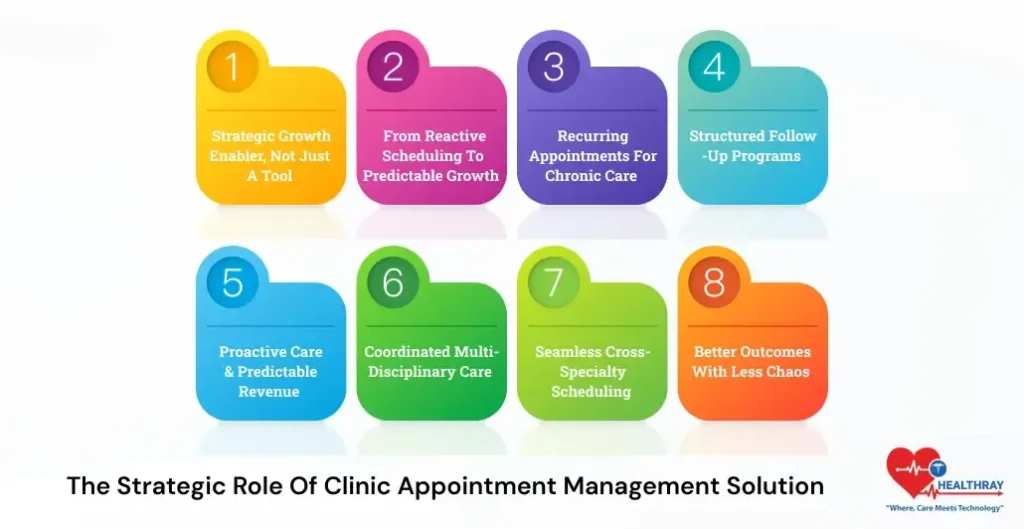
Let’s check out:
Strategic Growth Enabler, Not Just a Tool
For growth management, a doctor appointment system for hospitals is not just an administrative convenience but a strategic growth driver. Further, it helps clinics in handling higher patient volumes, complex service offerings, and multi-location expansion without compromising patient experience or clinician well-being.
From Reactive Scheduling to Predictable Growth
Clinics eliminate chaos by transitioning from manual, reactive scheduling to data-driven appointment management. Further, a clinic appointment management solution improves patient satisfaction and builds predictable revenue streams. Beyond that, it helps clinics achieve long-term, sustainable growth.
Recurring Appointments for Chronic Care
As we know, chronic care requires ongoing management rather than one-time visits. Further, Diabetes, hypertension, heart failure, COPD, and CKD conditions require long-term, structured follow-ups, where consistency governs the outcomes. Let’s find out how a clinic appointment management solution helps doctors manage recurring appointments:
Structured Follow-Up Programs
Doctor appointment booking software for clinics creates recurring appointment templates for clinics on the basis of monthly, quarterly, or condition-specific intervals. For example, the system automatically plans baseline visits, a 1-month review, a 3-month lab follow-up, and ongoing quarterly check-ups for diabetic patients.
Proactive Care & Predictable Revenue
The clinic’s appointment system sends auto-reminders, notifies missed appointments and sends notifications to staff on timely outreach. Further, this improves clinical outcomes, enhances patients’ adherence, and generates steady demand or predictable revenue for clinics.
Coordinated Multi-Disciplinary Care
When growing practices include dietitians, physiotherapists, and allied specialists, then coordination becomes extremely challenging. Further, the unified appointment management system converts the care to the envisaged pathway where every consultation is a connected step not isolated visits.
Seamless Cross-Specialty Scheduling
After a cardiology consultation, a patient can easily arrange a physiotherapy or rehab session in the same workflow. Further, patients get a clear glimpse of next steps. Along with that, it improves patient adherence and care delivery becomes smooth and predictable.
Better Outcomes with Less Chaos
Well-coordinated multidisciplinary appointments minimize manual follow-ups, reduce staff workload and patient get end-to-end guided experience. Overall, clinics achieve better outcomes, higher satisfaction, and operational efficiency.
Implementation Roadmap for Scalable Appointment Management
Let’s check out:
Assessment & System Selection
Firstly, clinics should assess current gaps such as no-show rates, peak-hour chaos, and provider calendars. Furthermore, correlate it with baseline KPIs, like 80%+ utilization. Select the system on the basis of growth trajectory. Use HMS-integrated solutions and standalone tools such as Healthray for clinics and hospitals. Also, read our blog doctor appointment software comparison. Here, I go over the top platform in detail and how healthray can be your ideal long-term fit.
Phase 1 & 2: Setup to Stabilization
Phase 1 (Week 1): Configure slots through guided onboarding, synchronise calendars and instruct front desk teams on digital queues. Start the pilot from a single platform and use dashboards to monitor performance.
Phase 2 (Weeks 2–4): Roll out patient portal, enable automated reminders and activate billing integration, minimizing no-shows up to 20–30%.
Phase 3: Optimization & ROI Unlock
Level 3 (Month 2+): Firstly, analyze data trends, redefine AI for peak hours, and incorporate telehealth services. Moreover, train persistently on chronic care recurring appointment scenarios. A 15–20% increase in revenue is possible with filled slots, and share ROI with stakeholders to foster buy-in.
 PRO TIP
Proven ROI Metrics
Clinics get clear, measurable returns by adopting scalable appointment systems. More importantly, it minimizes average wait times to 45%, reduces no-shows to 30-40% and increases conversion to ~17% growth through automation.
Operational Efficiency & Faster Payback
Clinics achieve 80%+ provider utilization, allowing staff to focus on patient care rather than administrative tasks. Further, most practices recuperate ROI in 3-6 months. Multi-channel platforms like Healthray have a 4.9/5 patient satisfaction rating and offer seamless expansion.
Patient Experience & Future-Ready Growth
Self-service booking improves patient NPS and predicts analytics staffing demand. For example, it handles flu season surges dynamically. In the long term, interoperability makes the system stable and future-ready and strengthens the revenue cycle and data-driven growth.
 NOTE
NOTE
Choosing the Right Clinic Appointment Management Solution for a Growing Clinic
As clinics scale, appointment management is not just limited to scheduling tools. Further, it becomes an operational backbone. It is highly indispensable for clinics to gauge long-term fit and growth readiness along with features.
Key Evaluation Criteria
- Workflow Fit: The system should naturally align with current and future workflows–scheduling, triage, billing–without any additional manual steps.
- Integration Depth: The system should perfectly integrate EHR, billing, telehealth and communication tools so that data remain unfragmented and evade the need for workarounds.
- Scalability: Clinic appointment management solutions easily support multiple locations, doctors and specialties, eliminating the need for changing system requirements periodically.
- Ease of use: The application should include user-friendly and intuitive features for front desk staff, clinicians and patients.
- Automation Capabilities: The System should include reminders, waitlists, recurring appointments and rule-based scheduling automation. This helps clinics relieve manual load.
- Security & Compliance: Ensure strong access controls, encryption and audit trails that comply with healthcare compliance standards.
Future-Proof Strategies for Growing Clinics
Let’s check out:
AI-Driven & Predictive Scheduling
In the upcoming years, AI will perform predictive slotting based on patient risk, visit patterns, and demand in addition to scheduling appointments. Further, voice-based booking will make the accessibility significantly more comfortable, especially for senior or chronic patients.
Hybrid Care Models at Scale
Hybrid in-person and teleconsultation models provide deeper flexibility to clinics. Further, platforms like Healthray smoothly handle 70% of the virtual visit load, without any operational strain.
Security, Compliance & Smart Integrations
Future-ready clinics will emphasize more on HIPAA-equivalent compliance, role-based access, and strong encryption. Furthermore, pair core scheduling with selective marketplaces such as Healthray so that scalability remains viable without system overhaul.
Waitlists & “ASAP” Slots: Recover Missed Revenue.
Smart waitlists help clinics effectively recover revenue loss from cancellations. When patients cancel the appointment, the system instantly notifies registered patients on waitlists. This refills the slot instantly. Let’s check how a clinic appointment management solution minimizes revenue loss:
Better Utilisation in High-Demand Areas
This strategy works very well in urban clinics that have a high demand for early appointments. Further, the system helps patients get early slots; this makes the clinicians’ daily schedule stable, even if modifications are made at the last moment.
Consistent Volumes, Predictable Growth
Clinic appointment management solution eases the fluctuation of waitlists and ASAP slots, ensuring maximum utilization of doctors’ timing. Further, this helps clinics maintain consistent patient volumes, enhances operational efficiency, and makes ensemble growth predictable.
Conclusion
Clinic appointment management solution has become a practical necessity for growing practices, whether it’s a small clinic or a multi-doctor setup. Now clinics are no longer dependent on calls, registers, or spreadsheets. This system automatically detects the conflicts and converts the daily operation to a smooth routine. Overall, it helps clinics achieve better time utilization, happy patients, and controlled growth– without compromising care quality.