

In This Blog
All the information you need for choosing the best doctor appointment system before making a commitment to the platform:
- Which are the five systems that rule the 2026 healthcare scheduling market, and what layer does each system truly occupy?
- Why will evaluating scheduling platforms purely based on features mislead you?
- How much more expensive is it to run a unified OS compared to a modular stack of tools?
- Which system is suitable for your clinic based on its size, operations, and growth stage?
- What compliance requirements should your scheduling software meet?
The 2026 Healthcare Scheduling Reality: Why Systems Decide Revenue
For those who were looking to find the top doctor appointment system just for the features list, then you are in for a surprise. The discussion in 2026 has changed its focus completely. No more should we consider a doctor appointment system as an administrative tool used at the backend but rather as a source of revenue generation upfront.
The figures speak for themselves regarding this transition. The global healthcare scheduling software market is valued at $496 million and is growing at a rate of 11% to 12%. Clinics are currently judged on conversion efficiency – the rate at which booked appointments turn into completed visits – along with no-show automation. Meanwhile, a government-based report on the occurrence and economic impact of no-shows showed that clinics had an average rate of 18.8%, with each missed appointment incurring a direct cost of $196 per patient.
The 2026 strategic insight: Clinics that see scheduling as a standalone tactic are leaving money on the table. The clinics that incorporate scheduling into one seamless digital process are beating their competition when it comes to all relevant KPIs. “Clinics aren’t losing patients due to lack of demand; they are losing them by having disconnected scheduling processes.”
 NOTE
NOTE
The Healthcare Software Stack: Understanding Value Layers
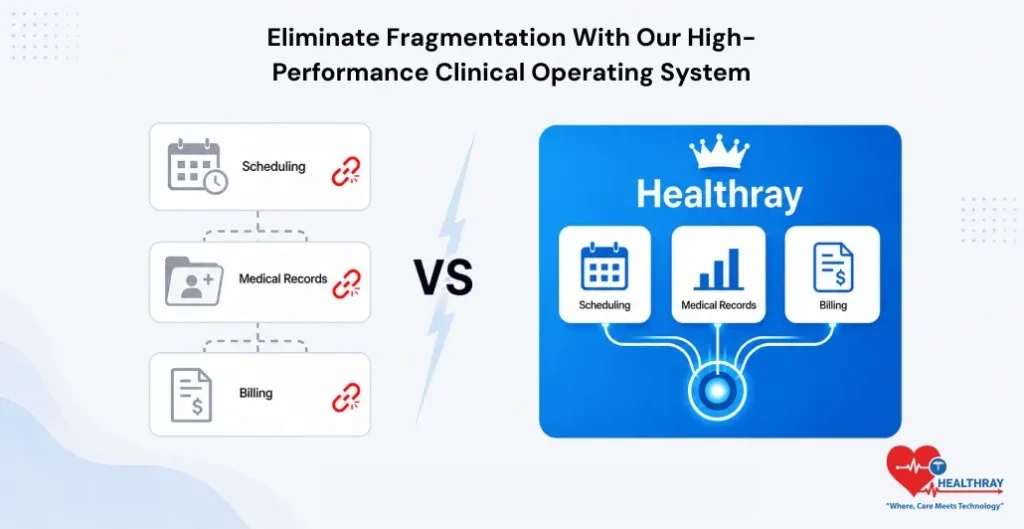
The biggest error that clinics commit when trying to figure out which scheduling solution works best for their needs is viewing different products as if they operate at the same level of the technology stack. This is a mistake. Healthcare software exists within a layered ecosystem, and understanding where each system fits is critical to choosing the right platform for your clinic.
Here’s the rationale behind that: a solution that is designed to only support patient acquisition cannot possibly help in improving billing efficiencies at the same time. A bridge to integrate legacy EHRs cannot become a full-fledged practice management operating system. The approach of examining systems based on their stack placement is how the market for 2026 works.
How Doctor Appointment Systems Are Positioned In The 2026 Market Stack
Before analyzing the tools, it is important to remember that the appointment booking system for doctors functions at a different level within the healthcare technology stack. The tool plays a unique role in the patient experience, supported by the doctor appointment calendar system that manages daily scheduling visibility.
| SYSTEM | MARKET LAYER | ROLE VS. FULL OS | REAL-WORLD IMPACT PATTERN |
| Healthray | Full Clinic OS | The Standardized Benchmark | Saving 40% in administrative tasks due to complete integration |
| Zocdoc | Acquisition Layer | Partial – Discovery Layer only | Expensive per lead acquisition; requires an external OS |
| Phreesia | Intake Layer | Partial – Intake Functionality | Lives on top of existing EHR systems |
| Tebra | Practice OS | Growth Integration Model | Ideal for stand-alone and solo practices |
| Nexhealth | Sync Layer | Partial – Legacy Bridge | API sync for aging EHR environments |
The price difference: Despite being initially more costly than modular systems, unified clinic management systems cut overall costs by 25 to 40 percent due to factors such as system integration, employee training, and third-party tools.
Healthray: The Unified Clinic Operating System Benchmark
Healthray is ranked at the top among the best doctor appointment systems simply because it belongs to the most consolidated layers among what the clinics can get today. Instead of addressing one aspect of the appointment scheduling system, Healthray eliminates the need for all of the different tools, combining them into one solid solution.
The ROI is self-explanatory: clinics utilizing this cohesive framework claim a 30%-40% efficiency boost by avoiding the tedious process of manually reconciling the information in their scheduling, medical records, and billing departments because there is no interoperability between the three systems. This inefficiency is precisely where profit bleeds out.
Market Position: Instead of having scattered and disconnected tools, Healthray provides clinics with a system of record, eliminating the information vacuum that is costing clinics money every day.
Strategic Verdict: Healthray falls into the highest ROI category for clinics looking to achieve complete digital transformation. It is the yardstick by which all other systems are measured.
 PRO TIP
Analysis Of Specialized Market Layers And Partial Solutions
Zocdoc – The Patient Acquisition Engine
Zocdoc is the main player when it comes to search-based patient discovery. If your practice requires fresh patients that need to locate your services via the Internet, Zocdoc acts like a formidable marketplace. But remember, Zocdoc is an acquisition layer alone, which means it will help with discovery and scheduling, but it will do nothing beyond that point. The cost-per-lead model becomes expensive and forces you to build a full operating system after scheduling.
Phreesia – Enterprise Intake Infrastructure
Phreesia handles about one out of every seven physician appointments in America, and this statistic is testament to how reliable this product is when it comes to being a part of the intake process software sector. It focuses on online patient intake, eligibility checking, and even payments from the patient at the time of their visit. The software sits on top of an existing EHR in large health networks.
Tebra – Independent Practice Growth Platform
Tebra, formed through the integration of Kareo and PatientPop, is designed for independent and solo practitioners who need an all-in-one digital growth solution without enterprise-level pricing. The platform integrates practice management, electronic health records (EHR), digital presence, and patient engagement – including medical scheduling tools – into a single solution tailored for the SMB healthcare sector. As a result, Tebra is among the most practical options for small clinics transitioning from paper-based processes.
NexHealth – The Legacy EHR Bridge
NexHealth provides an innovative solution to a particular problem: how to make aging legacy EHRs behave as if they were modern-day platforms. This is achieved through API integration that allows for instant scheduling, appointment reminders, and online patient intake forms even if the EHR itself is decades old. Therefore, for large healthcare organizations that cannot afford to change their entire technology stack, NexHealth is usually the most practical choice.
Market Direction In Consolidated And Modular Healthcare Systems
It is apparent where the 2026 market stands. It will no longer be an operational matter but a regulatory one when a wrong choice of structure is made at this stage. According to the CMS Promoting Interoperability Program, eligible hospitals and clinics must submit proof through data on the meaningful use of the certified electronic health record technology, and this has direct implications for the quality score of Medicare.
Unified OS Model: One system does all the scheduling, EMR, billing, and communications. You have just one data layer, one vendor, one phone number, with automated appointment reminders for doctors built into the workflow to reduce missed visits. It’s simple from an operational standpoint, which is its main strength. Growing clinics always choose this route because of the very low cost of ownership and easy staffing.
Modular Stack Model: Several specialized components combined into one solution. Provides maximum flexibility for corporate-level organizations where legacy applications have very high switching costs. But the danger is that every integration point can fail, and licensing and maintenance costs often exceed expectations.
Most independent and emerging medical facilities need optimal doctor scheduling software for today’s needs. For them, a single OS delivers better ROI. Layered systems work only in specific cases. However, NexHealth and Phreesia fit large hospital chains better.
Best Doctor Appointment System by Use Case Explained Clearly
The best solution does not have the most bells and whistles. The best solution fits your practice as it is today. Therefore, this is how the landscape looks.
Best Overall Solution – Healthray: Integrates scheduling, EMR, billing, and patient communication in one suite. Clinics see a reduction of 40% in administrative burden. Best fit: practices scaling rapidly that require just one vendor, one contract, one platform.
Best Patient Acquisition – Zocdoc: Leading solution for search-driven patient acquisition. Use as a front door but not your back office. Requires another operating system to manage all post-scheduling activities.
Best Enterprise Intake – Phreesia: Handles 1 out of 7 medical encounters in the United States. Provides an additional intake system on top of your current EHR technology. Therefore, best for major healthcare organizations requiring improved intake without upgrading everything.
Best for Independent Clinics – Tebra: Designed for individual doctors and small partnerships. Integrates EHR, claims processing, practice management, and website functionality all in one economical solution. Meanwhile, best for transitioning from paper or obsolete technology.
Best Legacy EHR Bridge – NexHealth: Helps legacy EHR systems work like newer systems by syncing via APIs – but without having to replace the system outright. Good Fit For: Networks that are too big to afford to switch to a new EHR altogether.
The Bottom Line: Each system wins in its lane. Match the tool to the actual problem you are solving – not the one that looks most convincing in a sales demo.
Learn more: Managing Chronic Disease Burden with Recurring Doctor Appointment Scheduling helps clinics automate repeat visits, improve continuity of care, and reduce missed follow-ups for long-term treatment patients.
Final Thoughts: Why Smarter Doctor Appointment Systems Cannot Wait
Poor scheduling is more than an inefficiency; it is a clear leakage point in patient care continuum and income.
The latest doctor appointment software ensures that there are no missed appointments, cuts down no-shows, and ensures patients remain on track regarding their treatment without the need for remembering or manually organizing.
For clinics handling large volumes of patients or those providing chronic treatments, there can be no going back to old ways, as good scheduling forms the basis of successful treatment and sustained patients’ loyalty.
Upgrade to the best doctor appointment system today – because delays in care always start with delays in scheduling.