



Summary
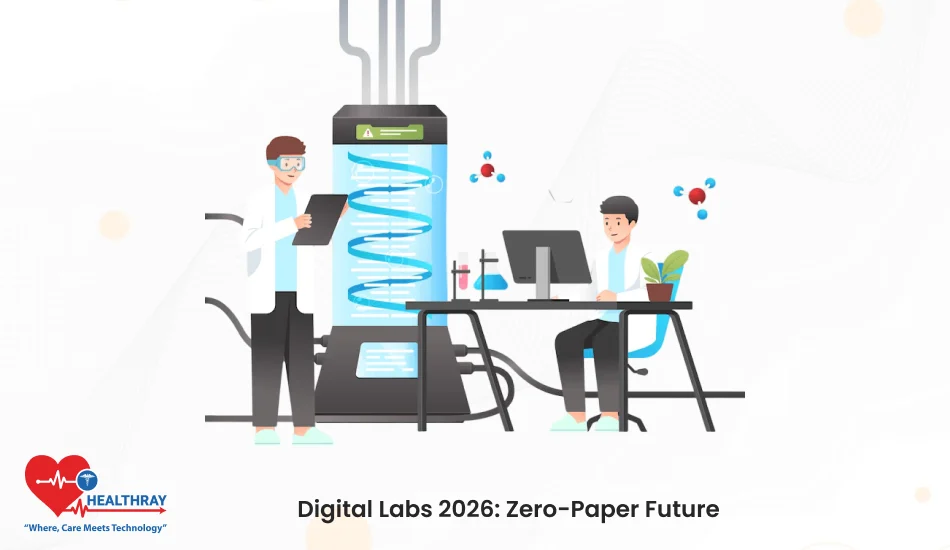
Across INDIA and the USA, diagnostic laboratories are under constant pressure to deliver faster results while maintaining accuracy, compliance, and transparency. Even though a high number of laboratories continue to use registers, paper records and disjointed digital devices, the system is not able to keep up with the speed of contemporary diagnostics. This is where digital labs 2026 comes into play as a useful roadmap and not a far-off concept.
A computer lab does not depersonalize the process. Rather it eliminates friction in day to day activities. When laboratories abandon paper and rely on well-organized digital systems, the flow of information will not be interrupted. Consequently, employees start working in unison, the turnaround is enhanced, and the mistakes are reduced automatically.
More to the point, digital transformation assists the laboratories to scale without anarchy. The number of patients has been on the increase particularly in high throughput settings both in INDIA and the USA. Growth brings confusion in the absence of a systematic system. Growth is manageable with the appropriate foundation. On this blog, the author writes how the future of labs is a zero-paper place, why paper-based operations will have a hard time staying afloat after 2026, and how the new systems allow stability, speed, and confidence.
Introduction
When laboratories talk of going paperless, most of them visualize an expensive renovation or an abrupt halt in routine operation. Nevertheless, a more basic realization tends to initiate the shift towards digital labs 2026. Paper slows everything down. It slows down decision making, conceals mistakes and restricts visibility of departments.
In INDIA, the diagnostic centers are faced with a high number of patients, and they are staffed with low personnel. Laboratories in the USA have high documentation requirements and compliance requirements. Regardless of such differences, both settings have a similar problem, which is scattered information and manual coordination.
This is the reason why a lot of laboratories are currently depending on laboratory information management systems to create sanity in daily activities. Paper is bound to be eliminated once samples, reports and workflows are bound in a single platform. Teams do not pursue information anymore but take action on it.
To find out the reason why such a shift is important, we will have to take a closer look at what paper-based labs are going through today and why the zero-paper future has become inevitable.
Why Paper-Based Labs Are Reaching Their Limits
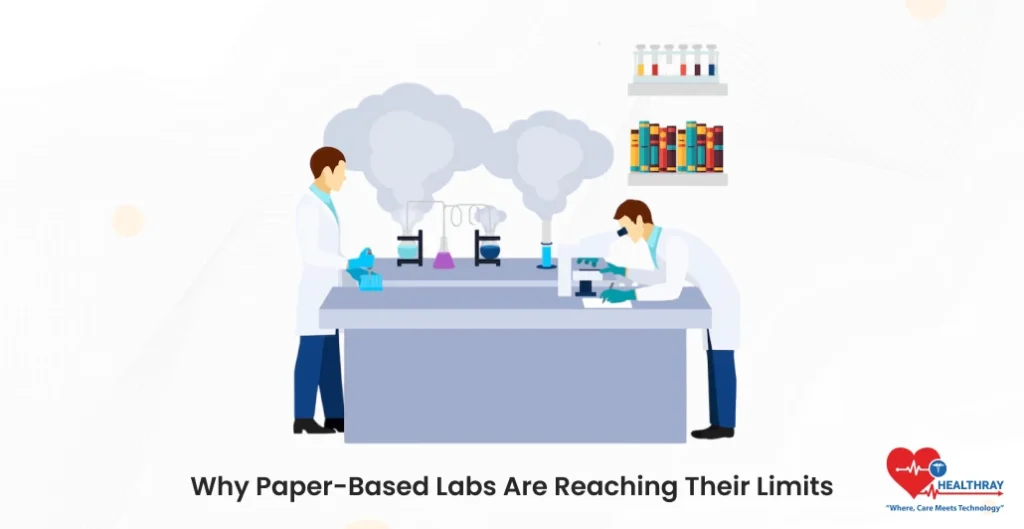
Paper workflows worked when labs handled fewer samples and simpler processes. Today, labs operate across multiple departments, instruments, and locations. Every handoff poses a threat when done manually.
Paper creates delays at each stage. Samples are awaited by manual logging. Reports are physically transferred between desks. Mistakes remain unnoticed until a person notices. This minor inefficiency over time adds up to lost time.
Labs in INDIA are experiencing this pressure in the form of increased demand for diagnosis. In the USA, there are loopholes that are revealed in compliance audits due to manual documentation. Paper, in both instances, helps no control, but rather undermines it.
As a result, teams do not work in laboratories due to lack of skills, but the workflow is not organized. Digital labs 2026 can mitigate this challenge by substituting manual coordination with predictable and traceable processes.
Diagnostic Lab Digitization Is No Longer Optional
The greater the diagnostic volumes, the less innovative the diagnostic lab digitization is and the more survival. The labs, which still use printed forms, handwritten logs, or a collection of spreadsheets, cannot be consistent. Each manual process is risky.
Digitization replaces guesswork with clarity. Every sample will have a digital record of collection up to report delivery. Doctors trust results more because systems record every verification step in the lab management system software. This makes the patients feel confident as no one can ascertain delays as a mystery.
INDIA Diagnostic centers within this country are known to handle hundreds of samples per day. The labs in the USA deal with complicated compliance reporting. Digitization in both instances makes sure that growth does not water down quality. Labs do not need to add personnel to deal with paperwork but allow systems to deal with coordination.
Digital Labs 2026: A Shift Toward Structured Operations
The concept of digital labs 2026 is not about speed as such, but about structure. All activities within the lab have a specified workflow. Digital identities are given to samples. Tests pass through apparent phases. Reporting is done after confirmation.
This structure alters team working. Employees do not enquire about the status of samples anymore. Verbal updates are not relied on by the supervisors. Rather, the system is real-time reflective of reality.
This structure is needed as the labs expand. In its absence, volume brings about confusion. Through it, complexity remains manageable. The said difference is the reason why digital labs perform better than paper-based labs.
The issue of growth poses different challenges in the labs in different regions. INDIA experiences increased demand at a low infrastructure. The USA is experiencing greater regulatory control. But they both need scalability.
Digital labs 2026 help to scale processes through standardization. New technicians follow guided workflows. New branches are copies of successful setups. Even the growth in volume does not affect quality.
Scalability is no longer based on personal experience. Systems carry institutional knowledge forward.
Role of LIMS Software in the Zero-Paper Transition
At the core of every digital lab sits dependable LIMS software. This software integrates individuals, processes and tools into one line of operation.
Staff do not have to fill in registers; they enter data only once. Information flows automatically within departments. Results are fed directly via instruments. The process of validation is the same.
Because of this, labs minimize the errors in re-entry and help to save time every day. In addition, the cloud-based lab management software establishes accountability. Each activity has a mark, and this enables laboratories to realize bottlenecks at an early stage.
Labs that implement LIMS in both INDIA and USA experience a reduction in last-minute escalations and coordination.
Lab Data Management The Future of Digital Labs in 2026
The information on spreadsheets is confusing. Lab data management consolidates information in a single credible source.
Maintaining centralized data enhances better reporting and trend analysis. Supervisors detect common problems at a quicker rate. Compliance becomes easier to maintain.
More to the point, teams no longer waste time on information search. Decisions become faster and more confident.
Paperless Lab Workflow and Digital Lab Operations in Daily Practice
A lab workflow without paper does not imply the lack of supervision. Rather, it automates the process of following up.
Tasks move automatically from one stage to the next. Alerts notify teams when action is required. Dependencies are evident without meetings.
This means that the labs cease responding to delays and begin to avoid them. Efficiency improves without adding pressure on staff.
 PRO TIP
Visibility is one of the biggest benefits of digital lab operations. Workloads, progress, and delays can be viewed immediately by supervisors.
This exposure allows proactive decisions. Teams reassign tasks prior to the expansion of backlogs. Managers change priorities without stopping work processes.
This flexibility in INDIA assists labs to deal with unexpected inflow of patients. It helps to prepare audits in real-time in the USA.
Labs operate as ecosystems. The processing units, reporting teams and collection centers need to remain in sync.
The work of digital labs facilitates teamwork. Everyone sees the same data. Miscommunication declines. Follow-ups reduce.
This alignment enhances turnaround and satisfaction among staff at the same time.
Lab Automation and Automated Lab Workflows Remove Hidden Delays
Manual coordination consumes time and energy. Lab automation eliminates administrative monotony in day to day activities.
Automation takes care of sample tracking, notifications, and assignment of tasks. Staff focus on testing rather than chasing paperwork.
As time goes by, laboratories also make fewer mistakes and handoffs become easier. Automation does not add work because it brings about uniformity.
Labs are the greatest victims of hidden delays. Samples wait silently. Reports stall unnoticed. Calls pile up.
With automated lab workflows, these blind spots disappear. Tasks move automatically once prerequisites complete. Alerts notify teams before delays escalate. Supervisors do not fight but intervene at an early stage.
In addition, automation enhances responsibility. Each step carries ownership. When it slows the system identifies the reason and location. That visibility is time saving and it lessens internal friction.
Learn more: True Cost of Delayed Lab Reports and Fixes
Consistency is an attribute of accuracy. Lab automation ensures that consistency stays intact even during peak loads.
Automated checks minimise human error. The validation processes are consistent. Repetitive tasks complete without fatigue.
This has led to technicians being concerned with administration, but not interpretation. Physicians get results they believe in. Patients experience fewer repeat tests.
The automation develops trust in the whole diagnostic chain.
Digitization of Pathology Lab Workflow Gains Accuracy
Pathology laboratories are very coordination-intensive. Slides move across teams. Reports require validation.
A digital pathology workflow laboratory process makes all samples traceable. There is automatic updating of each stage. As a result, errors decline and turnaround improves.
The doctors get prompt reports and patients spend less time in the waiting queue.
 NOTE
NOTE
Paperless Lab Workflow Strengthens Compliance
Compliance requires documentation. Paper complicates it.
A digital laboratory process captures all activities automatically. Audit trails stay complete. History of versions is still available. Regulatory checks become smoother.
This reduces accreditation reviews in the USA. In INDIA, it trains laboratories to meet the growth requirements on compliance. Paperless systems facilitate expansion without taking more risk.
Future of Paperless Laboratories Is Already Taking Shape
The paperless laboratory is not coming at any point in the future in 2026. It unfolds gradually as labs replace one manual step at a time.
Early-started labs have an advantage. They do not scramble but adapt amicably. Their teams are accommodating of systems as opposed to being resistant.
Paperless does not imply impersonal. Quite to the contrary, it liberates staff to concentrate on quality and care.
Healthray + the Digital Labs 2026 Vision
Healthray is a provider of structured, scalable solutions to labs that are heading toward a digital lab in 2026. Its LIMS system streamlines workflows, data, and automation without overloading teams.
Healthray is concerned with lab behavior in the real world. Systems are flexible to operations and do not impose strict templates on the labs. This approach helps labs transition smoothly without disruption.
Healthray helps the laboratories to operate in a single center or in a network of locations.
Conclusion
Paper does not collapse in one day. Instead, it fades quietly through delays, missed handovers, and growing confusion that teams slowly learn to tolerate. Over time, this tolerance becomes the biggest risk. By 2026, labs that continue to rely on paper struggle to keep pace with expectations in both INDIA and the USA. Meanwhile, digital labs move faster, respond with clarity, and operate with far greater confidence.
Digital labs 2026 stand for transparency, coordination, and control across every stage of testing. They protect teams from overload. They prevent patient frustration before it begins. More importantly, they allow lab leaders to see problems early rather than react late. When information flows without friction, accuracy improves and trust follows naturally.
The zero-paper future does not demand perfection from day one. It asks for intention, structure, and the willingness to remove silent bottlenecks. Labs that start this transition early gain room to grow, adapt, and scale without pressure. They prepare their teams for the future instead of forcing them to catch up.
If you think that this is the right moment to rethink how your lab works. Take the first step toward a controlled, compliant, and paperless operation. Schedule a free demo and explore how Healthray can help you build a future-ready lab before delays decide the cost for you.