

Summary
INDIA and the USA clinics reconsider the way they handle patient records, physician workflows and daily processes. Even though there are numerous clinics with paper files or fragmented digital tools, the increasing number of patients reveals loopholes that drag down the care. These gaps become apparent when they are present in every instance; missing notes, late updates, vague medical history, time wasted during manual medical charting, etc. it becomes obvious that the clinic requires a more powerful and integrated system. A good clinic EMR system can address these gaps by providing structure, accuracy, and clarity to each department. This blog walks you through the real signs you need a clinic EMR system that your clinic may be ready for EMR adoption and why you should switch to it sooner before it becomes a matter of loss, delay, and inefficiency.
Introduction
Enter a contemporary clinic and you will find something interesting. The waiting room might seem serene but in the background the physicians juggle paperwork, patient history, laboratory reports, charts, and follow-ups- all simultaneously. The load gets heavier when the files of patients are scattered on desks, cabinets, emails, and WhatsApp messages. At this point, the majority of clinics understand that their operations have ceased to be proportional to the number of patients.
In this change, a significant number of healthcare staffs begin considering a single alternative that they once overlooked: a specific EMR Software that can restore sanity to clinical activities. Clinics begin noticing that their growth outpaces what paper files can manage. As operations expand, scattered tools slowly damage interdepartmental communication. Eventually, doctors feel the burden of rising patient expectations across INDIA and the USA.
A clinic EMR system in this setting does not just store data but it restores sanity. It enhances the coordination between front desk, nursing and doctors. And above all, it minimizes the minor errors that happen day by day and gradually become bigger operational losses. The need is often realized by the clinics not as they desire new technology, but as they realize that their existing procedures are no longer in favor of their day.
Sign 1: Paperwork Slows You Down More Than Patient Care
It is common to find that many clinics at some point will find paperwork as a daily burden. Physicians waste their time searching files rather than treating patients. Nurses walk across the rooms looking after missing records. Receptionists attempt to match records of handwritten entries with file numbers. The system surrounding the team is working against them, although they are working hard.
When digital medical records become a necessity
The paper files are time-consuming to search, sort, and update, which is eliminated by digital medical records. During consultations, they provide instant access particularly where the clinic deals with walk-ins during the day. In addition, INDIA and the USA clinics frequently deal with a large number of patients. Paper files in those kinds of environments lag behind since they are incapable of moving as fast as the clinical flow.
How missing notes and manual charting drain time
Paper medical charting requires time, but due to the situation of hurry, the entries are sometimes not provided. Lacking allergies, past prescriptions, and diagnostic comments confuse the doctors in the future. Such a loss amplifies the errors, postpones decisions, and unnecessarily prolongs the consultation time. Clinic EMR system makes charting easy as all the information is stored in a single location and moves along with the patient wherever he/she goes within the clinic.
Sign 2: Your Team Struggles to Maintain Accurate Patient Charts
Clinical decision-making becomes supported by accuracy. Incomplete, scattered, and unclear charts deprive doctors of the benefit of context when attending to patients.
The rising medical charting problem in high-traffic clinics
With an increase in the number of patients served, the volume of information processed with each consultation increases, namely, diagnoses, history, vitals, medications, allergies, lab results, imaging reports. Having all this in a manual state exposes oneself to error. INDIA and USA clinics tend to have tight schedules and in that case they have very little time to write detailed paper notes.
Why EMR for doctors improves clarity, consistency, and speed
A current Electronic Medical Records Software provides a full timeline of the patient’s life to the individual physician. They view all the notes chronologically as opposed to having to go through past files. Moreover, templates and automated fields enable quick documentation without any detail loss. This structure, as it has been pointed out by experts, saves time and also results in improved clinical decisions.
 PRO TIP
Sign 3: You Spend More Time Searching for Information Than Using It
The largest hidden cost within the clinics may be the search of information. Physicians attempt to remember past visits. Staff trace reports. Patients recite their history due to the inability of files to be located. These instances appear insignificant but when added up they become hours of unproductive time each week.
Clinic EMR system advantages during real-time patient flow
Using a clinic EMR system, each department is aware of the patient, his reason to visit and his next requirement as soon as he enters the clinic. This interaction minimizes misunderstanding, particularly at peak times. In addition, the digital medical records enable doctors to transfer between cases with fewer transitions.
How clinics lose money without EMR through inefficiencies
Most clinics are appalled when they compute the hours they spend every day just because they cannot get information easily. Employees waste additional minutes in locating reports. Physicians prolong the consultation due to the lack of context. Receptionists are dealing with repeat calls. Though these delays might appear to be innocent, they decrease the number of patients in a day. Thus, clinics will lose money in the long term not due to low demand, but due to a slow workflow.
Sign 4: Your Clinic Can’t Keep Up With Increasing Patient Volume
Expansion is thrilling until the systems on which it is built cease to sustain it. A clinic, which received 20 patients daily, can now get 35. In the absence of a good structure, this growth will lead to long queues, employee exhaustion, inaccurate billing, and lack of follow-ups.
When AI for doctors becomes more than a convenience
Doctor AI enhances the productivity of doctors as the number of daily tasks increases. It fills in automatically, facilitates quicker documentation, and finds out missing information prior to the conclusion of the consultation. INDIA and the USA have more clinics that are relying on this support since AI eliminates redundancy and patient care is acute.
Step towards digital era with our healthcare solution
Revamp your hospital facilities and embrace change for better healthcare management. Ease in managing and organizing large medical datasets leads to effective analysis. Seize the opportunity now!
EMR automation and workflow issues inside growing practices
The complexity of coordination increases with the increase in the size of the clinic. Nurses need access to vitals. Reports should be posted by lab teams. Physicians will have to check medication history. Billing requires proper codes. These tasks are not linked, and misalignment occurs without the automation of EMR Billing Systems. EMR gets rid of this friction as it links Hospital EMR software all together automatically making the clinic run as a unit and not as a fragmented entity.
Sign 5: You Struggle to Coordinate Care Across Departments
Although small clinics deal with fewer data points, such as lab results, prescriptions, billing, vitals, imaging, and follow-up schedules. The lack of smooth communication between departments results in a loss of control of data flow in the clinic.
Why EMR in hospital and clinic setups require unified data
It doesn’t matter whether it is a multi-specialty hospital or a two-room clinic, integrated data enhances communication significantly. This principle is already implemented in EMR in hospital systems, and that is why the similar models are used in many clinics in INDIA and the USA. Physicians must have the correct information at the appropriate time which is not when the patient has gone.
The hidden cost of not having a reliable clinic EMR
Late outcomes, duplication of tests, misplaced prescriptions, discrepancies in billing entries, etc. – these problems are more expensive to clinics than they seem at first. They also destroy the trust of the patients, particularly when individuals anticipate the experience of care to be smooth and modern. It is in such cases that Clinics resort to Clinic EMR software when the problems become too common to overlook.
Learn more: 7 Best EMR Software in India
Other Red Flag Clinics Often Have a Blind Eye On
Even in cases where clinics are operating good enough, there are indications of underlying inefficiencies.
Repeated prescription errors
In the absence of EMR, doctors occasionally make repeat prescriptions of older ones without even knowing when they have been updated. EMR minimizes such errors by providing immediate alerts.
Delayed decisions due to scattered data
Clinicians lose time in compiling the story of patients when information is stored in alternative formats that include PDFs, paper documents, text messages. EMR removes this gap.
Lack of audit trails and accountability
Without audit tracking, it is hard to establish who, when and why something was updated. When accountability remains part of the system, clinics work in a safer manner.
As clinics in INDIA and the USA keep growing, the truth becomes harder to ignore: the old way of working no longer keeps up with the pace of modern healthcare. Many doctors feel the pressure every single day. They move between patients quickly, switch between paper files, flip through handwritten notes, and jump between WhatsApp messages, prescription pads, and manual medical charting. Although this routine feels familiar, it adds silent friction to every consultation. Eventually, it becomes the reason a clinic loses both time and revenue.
At this point, it becomes important to ask a simple question: How long can a clinic run without a structured workflow?
Most clinics discover the answer when mistakes begin repeating – misplaced digital medical records, billing delays, incomplete follow-ups, unreadable handwriting, and growing waiting time at the front desk. Moreover, these problems grow bigger as patient volume increases. Clinics that once managed smoothly suddenly feel stretched, and the team struggles to catch up with daily tasks.
Meanwhile, new clinics that embrace EMR for doctors move ahead faster because their systems remove layers of administrative effort. They navigate complex days with less stress, and their teams stay aligned with fewer discussions. In addition, patients trust them more because every detail stays organized and accessible in seconds. This is exactly why clinic leaders start searching for a dependable EMR Systems in Healthcare – not for fancy features, but for stability and predictability.
Another key point many doctors overlook is how administrative delays quietly drain money. Missed follow-ups, lost paper files, duplicated work, and slow documentation all translate to real financial loss. The clinic loses opportunities without realizing it. With attention to this, signs become clearer: a clinic reaches a stage where manual work no longer supports its growth.
 NOTE
NOTE
When this realization sets in, most doctors know the next step. They look for an EMR that feels natural, simple, and fast enough to match their daily rhythm.
Healthray: The Modern Clinic EMR Built for Real Doctor Workflows
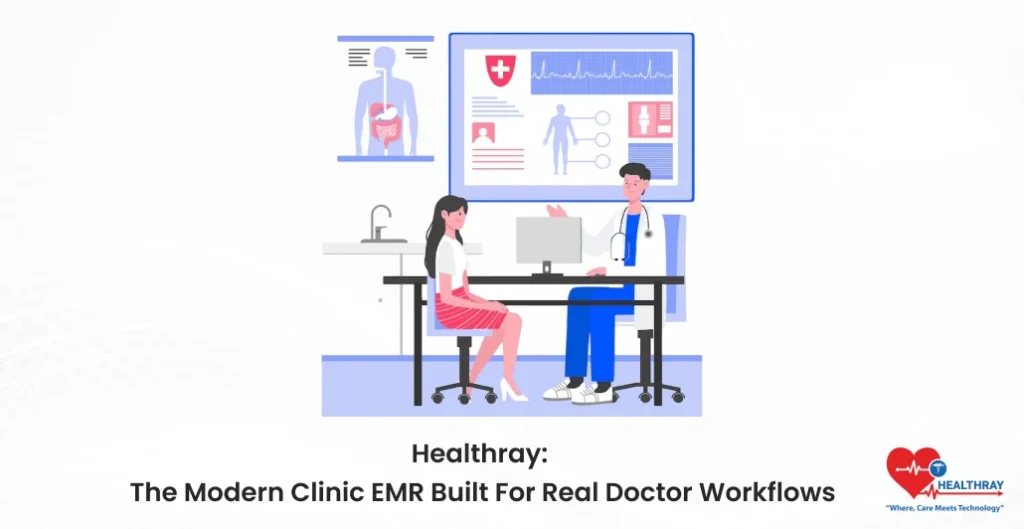
Healthray develops its EMR to operate in the manner doctors have to operate and not vice versa. The clinics of INDIA and the USA prefer to use Healthray as it corresponds to the actual flow of patients, helps to make decisions faster, and maintain the digital medical records clean and organized. Features include:
- Quick template-based medical charting.
- AI to auto-complete clinical notes by doctors.
- Combined appointment flow.
- Full drug history.
- The smooth integration between departments.
- Secure cloud storage
- Live access to patient schedules.
- Integrated EMStudio teacher planner for medical educators and clinic staff training.
Healthray also makes sure that implementation remains easy. Teams gain knowledge fast and adjust without interfering with their routine.
Conclusion
All clinics will come to a point where they cannot sustain growth using manual processes. Increase in paperwork, failure to coordinate, more delays than clarity, these are some of the indications that the clinic requires a structured system. Not only does a clinic EMR system eliminate chaos, but it also promotes accuracy, time-saving, better decision-making, and the overall patient experience.
With the increased expectations in both INDIA and the USA, clinics embracing the EMR at an early stage obtain a competitive edge. Teams serve patients faster, and the workflow feels noticeably cleaner. Errors drop because information stays organized, and decisions become quicker. With everything running in sync, the entire clinic experiences a calmer rhythm. And most of all, they provide all patients with an experience that is more confident and connected.
If your clinic feels the strain today, consider this the moment to act.
Book a free demo with Healthray and see how effortlessly your clinic can upgrade to clarity and speed.