

Quick Summary
Major healthcare chaos happened in the administrative department due to high workload and a substantial number of patient interactions. They face varied challenges in the daily routine that disrupt workflows and create inefficiency. Let’s comprehend how one can easily combat through hospital OPD automation.
Introduction
When you hear about the term “hospital administrator”, your mind went to the patient intake procedure. However, it is not merely about intake procedure, but also a mix of administrative operations like clinical planning, revenue management, and administering coordination among departments.
They try hard to administer in a more organized manner but without new healthcare technology, it is arduous to manage it well. You live in the AI era, where clunky paper management doesn’t work, you have to adopt the hospital OPD automation systems. Astonishing fact, whatever challenges you find it will easily combating and optimizing workflows in a more simplified way.
With the right clinical workflow automation, you will feel excited while working even with the mundane tasks. Not only brings you satisfaction in the daily workflows but also creates fun while doing the healthcare activities. Moreover, Automation in healthcare enhances the clinical data accuracy, slashes high costs, and improves patient experience.
7 Day to Day Roadblocks Faced By Hospital Admin
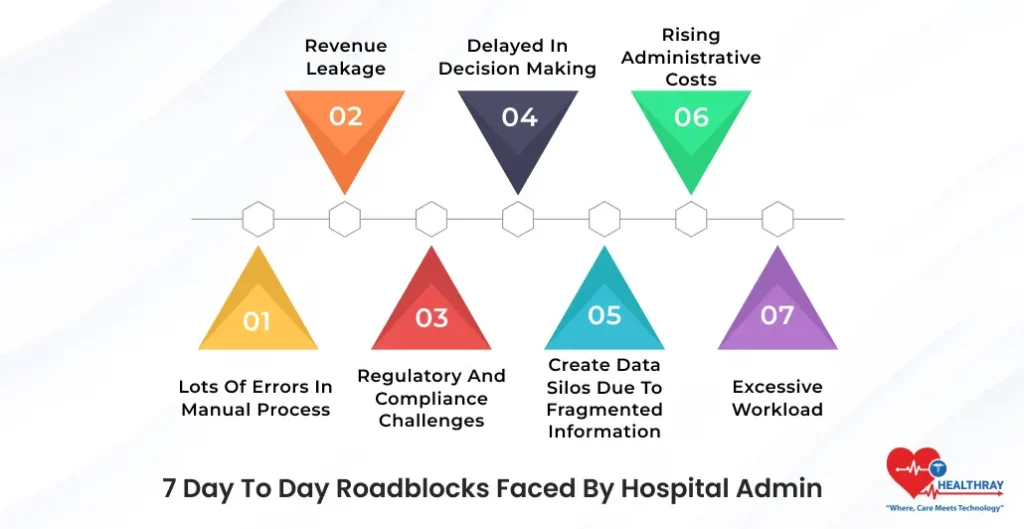
Around ¼ of the healthcare funds in the administrative department, one word error can cause an irrecoverable penalty. To get the desired outcome, they work tirelessly but still, hit by the major challenges in the daily routine. Here are the seven hurdles hospital admin often faced in the healthcare administrative department.
Lots of Errors In Manual Process
Manual processes in healthcare like a labyrinth, which waste a lot of time on simple tasks and hard to fully optimize resources. While drafting patient and clinical documents in spreadsheets, difficult to find the needed one, difficult to flag the repetitive values, and corrected medical spelling.
Countless hours invested in the file management, so they don’t have ample time for planning and executing patient care activities.
Revenue Leakage
When you don’t have the perfect tool to manage finances and healthcare tasks, there is a high chance of financial loss. Furthermore, there are a varied number of reasons for financial loss including medical coding errors, poor management of finances, or creating errors while capturing medical charges.
When claims are entirely handled by third-party and no control in the hands of hospitals, heavy loss is faced by healthcare centres.
Step towards digital era with our healthcare solution
Revamp your hospital facilities and embrace change for better healthcare management. Ease in managing and organizing large medical datasets leads to effective analysis. Seize the opportunity now!
Regulatory And Compliance Challenges
The hospital admins are very worried about the regulatory guideline, a critical factor that can save healthcare reputation or ruin it. It is hard to remember the clinical guidelines at every activity, senior managers should have traced it daily but it is impossible for them.
If you are using the spreadsheets or local files without having your private server, there is a high chance of data stealing and imposing legal expenses.
Delayed in Decision Making
Improper management of healthcare records, making it arduous to make timely decisions. If you don’t have centralized data, how do you compare different data at a time? It incurs high operational costs and time, if there is less adoption of modern day technologies.
Spreadsheets do not create that data, which you rely upon and make decisions. Hospital admins feel overwhelmed while seeing vast information without the proper guideline. With the right medical automation system, you will make any of the clinical decisions in seconds.
Create Data Silos Due To Fragmented Information
If your hospital does not use any medical software, generally they maintain information in the spreadsheet format and they create it within their division. Usually, emergency cases occur in the healthcare institution and if you won’t find the specific file at the right time, there is no use of it.
It happens when you work with the legacy system as they don’t have high-end capability to integrate with medical systems.
 NOTE
NOTE
Rising Administrative Costs
The significant part of healthcare expenses incur in the administrative department, increasing overall hospital expenses. When your expenditure is higher than your expected budget, it incurs huge losses regardless how much you earned.
There are many causes for skyrocketing operational expenses including inefficiency occurring in operational activities, delay in patient treatment, fragmented information, and the most important, higher rates of labour.
Excessive Workload
When you don’t know how to deal with massive requests and healthcare data, often employees fall into the loop of excessive workload. Main cause of enhancing dissatisfaction among employees, lack of motivation to work, and lead to errors.
Too much working pressure, causing emotional exhaustion and disrupting the life of employees. Affecting patient safety and might cause legal troubles.
How Hospital OPD Automation Resolve Challenges of Healthcare Administration – So Patients Get Advanced Care
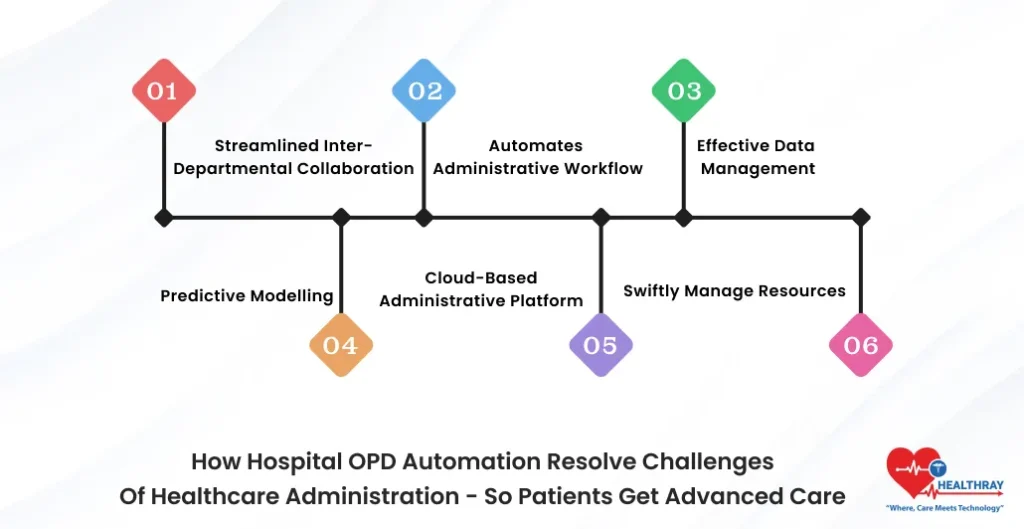
Automation gives you the wings to accomplish your long-term hospital goals. Helps in every healthcare phase, whether it is medical records, billing, administering relationships or coordinated with employees. Moreover, the Hospital OPD automation system, not responsible for streamlining operational workflows but also vanishes obstacles that occur in the path of healthcare administration services.
Streamlined Inter-departmental Collaboration
The healthcare workflow automation centralizes the medical information with adherence to standard medical protocols , getting data accessibility from one single tap. Get up-to-data that simplifies in emergency situations.
Swiftly routes big medical files from one to another clinical division, simplifying to examine each other documents and vanishes data silos. Also, helpful for better treatment planning.
Automates Administrative Workflow
Creating patient profiles and related medical documents, utilizing the drop-down interface or voice recognition tools that accelerates documentation speed and increases precision. Ability to flag medical errors and administer insurance claim processing efficiently.
In case of drafting invoices, write all patient medical details by entering the single patient word and get reminders in case of missing tasks. Also, the OPD management system smoothens patient-end services like scheduling appointments and analyzing medical records.
Effective Data Management
Each of the automation principles works well in the administrative data to simplify documentation and make more practical decisions. Furthermore, applying clinical data regulations while drafting documents.
Applying algorithms layer by layer on the medical information like machine learning helps to pre-processing information like managing null values and natural language processing help in converting words into vectors and eradicate prepositions in sentences. Moreover, utilizing deep learning to apply optimizers and activation.
 PRO TIP
Predictive Modelling
An extra step after administering data information along with specific medical guidelines, AI principles can identify past information and generate the perfect equation or model that can easily work with the new data.
In this phase, the medical information, divided into three phases, which is training, testing, and validation. The hospital workflow automation software helps in forecasting patient treatment outcomes, creates financial plans, and creates inventory plans.
Cloud-based Administrative Platform
The healthcare workflow automation system securely catches clinical and patient details in the remote server, employees get details or records from any location. Seamlessly exchanging any particular data, file, and documents to seniors experts and super-specialists.
Senior ones or medical professionals can easily access and examine healthcare details, increasing coordinated care and assisting in medical diagnosis. Additionally, it contributes to saving infrastructure costs and enhances efficiency.
Learn more: Cloud-Based Clinic Management Software: The Future of Smart Clinics
Swiftly Manage Resources
When it is about clinical resource management, no one beats the hospital OPD automation software. Seamlessly gives you the current inventory information and can anticipate how much stock must be required to meet the future demand.
Grabs the revenue and expenditure information with the proper data guidelines. Super-easy to administer insurance claims, create financial plans, and optimize the billing system. Therefore, it significantly mitigates expenses and enhances the safety level.
Conclusion
In the routine of hospital administrators, they face intense administrative chaos due to improper data management, difficult to make financial or other clinical plans, loss of financial revenue, fragmented information that creates data silos, increases the workload of healthcare workforce, rising administrative expenses, and excessive operational workload. However, the hospital OPD automation system vanishes operational hurdles, helps to tackle high expenses and forecasting needs for better clinical management.