



Summary
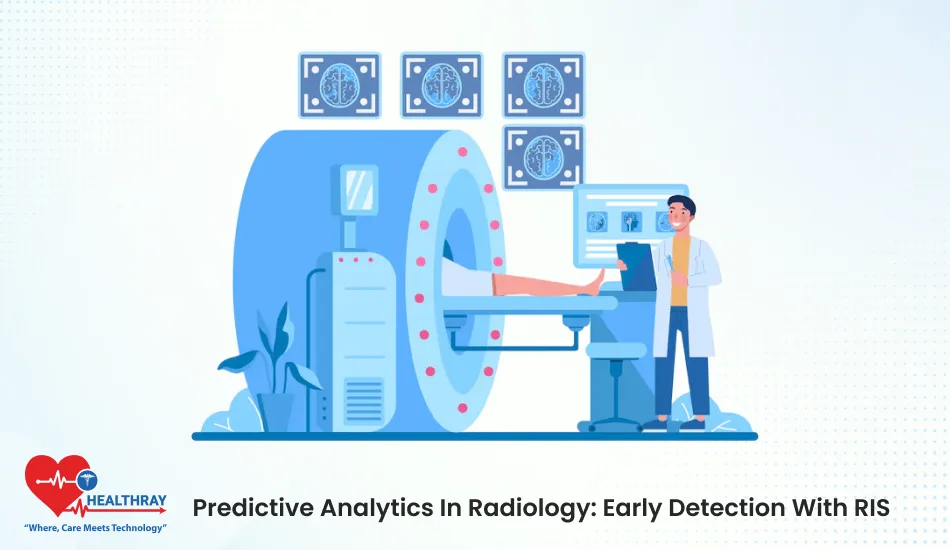
Radiology has never been left behind in the early diagnosis, but the increasing amount of imaging research has transformed the way value is delivered. Reports are received sooner, but there is greater pressure on interpretation. Predictive analytics in radiology in this setting has a higher value than efficiency. It adds foresight. Rather than responding to the results in terms of the increasing symptoms, the radiology teams can learn to detect the risk patterns at an earlier stage.
Predictive models are used to examine patterns of historical imaging, clinical circumstances, and changing datasets. Through this, minor signs are not isolated anymore. They gain meaning over time. This transition enhances the confidence of the diagnosis and facilitates proactive care planning.
In addition, radiology is no longer perceived as a downstream service in hospitals and clinics. Radiology is a layer of clinical intelligence with the appropriate systems. Historical diagnosis enhances results. The accuracy of reporting increases confidence. Pressure of the workflow decreases on its own.
This blog will discuss the functioning of predictive analytics in the field of radiology and the pivotal role of RIS and how organized systems can assist clinicians to make faster decisions without involving more complex processes.
Introduction
The working conditions in radiology departments are under a continuous pressure. There is an increase in the imaging volumes. Speed requirements are on the increase. In the meantime, clinicians utilize radiology knowledge at an earlier stage of the care pathway than it has been happening previously. In such circumstances, the isolated scans are not sufficient to exploit potential value.
The point of evolution of radiology information systems starts at this point when scheduling and reporting systems are no longer enough. The contemporary radiology information system links data points in time, modalities, and patients. They can be combined with predictive analytics to enable teams to view trends rather than snapshots.
Predictive analytics in radiology does not create pressure, but instead uncertainty. It assists the teams to put attention in priorities. It puts cases that should be examined promptly in the spotlight. This makes radiologists spend their energy on where it counts most.
Notably, expertise is not replaced in the early detection. It demands systems that bring out the wisdom unobtrusively and persistently. It is in this way that radiology assists clinicians before they get out of control.
When adopted as a way of thinking by hospitals, clinics, and specialists, radiology can be transformed into a reactive service approach, but it can evolve into a clinical partnership.
Why Radiology Needs Predictive Analytics Today
Radiology is at the crosspoint between data and decision-making. Each of the scans is a part of a bigger diagnostic picture. However, that picture is not complete until it is accompanied by analytics. Risk is hardly ever reported individually, and does not convey its change.
Predictive analytics in radiology fills this gap by analyzing data in imaging longitudinally. Systems detect abnormalities that are not in the baseline patterns rather than concentrating on the current abnormalities. As a result, the clinical relevance of early-stage indicators is acquired earlier.
Also, there are diagnostic imaging trends with increasing complexities. Repeat imaging, multi-modal studies and chronic disease monitoring give rise to tremendous volumes of data. Full value cannot always be gleaned through manual interpretation.
Predictive models are helpful since they point out the time correlations. Radiologists are given contextual information instead of raw. There is more clarity on the part of clinical teams. Results are better without slackening down work.
From Image Interpretation to Risk Anticipation
Conventional radiology focuses on the accuracy of interpretation per scan. Nonetheless, the field of healthcare is getting more anticipatory. Imaging data analysis enables this transition.
Predictive analytics identifies incremental changes that cannot be identified through single exams by conducting historical studies. As an example, minor changes in tissue density or repetitive patterns of tissue density become meaningful with a longitudinal view. This capability strengthens abnormality detection without increasing reporting burden.
Consequently, radiologists make contributions towards a clinical decision earlier. There is an earlier start of risk conversations. Informed timing is an advantage of treatment planning and not delayed response.
How a Radiology Information System Enables Early Detection
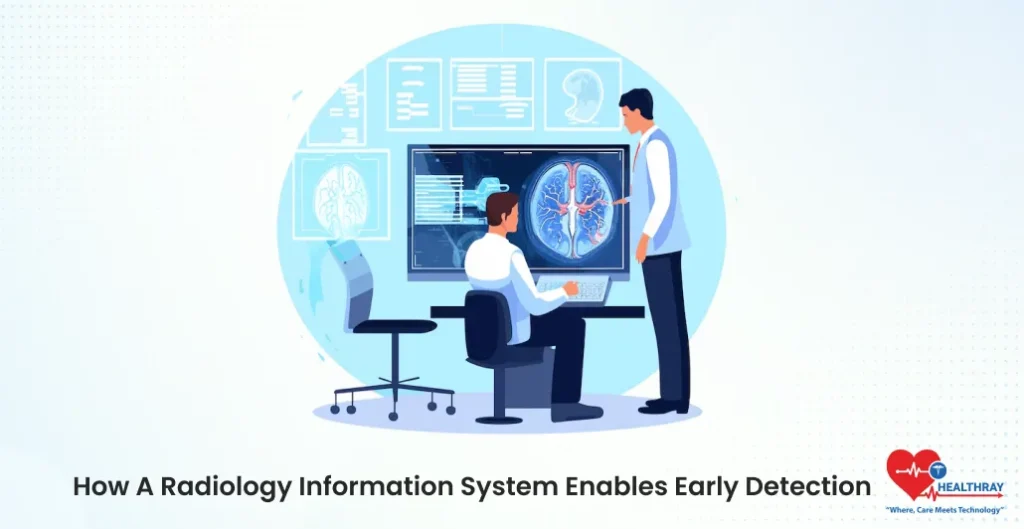
A recent radiology information system acts not only as a workflow coordinator; all in all it also acts as radiology workflow automation. It serves as the basis of analytics by organizing data in a similar way. Predictive models work well when imaging data remains in order.
RIS consolidates imaging histories of patients. It correlates metadata, timestamps and clinical settings. Therefore, analytics become reliable. Patterns emerge clearly. Noise reduces.
Notably, early detection involves continuity. RIS has longitudinal records based on which predictive analytics relies. Absence of structured systems, knowledge disintegrates within silos.
The Role of RIS in Early Disease Detection
Continuity and context RIS plays the role of continuing the detection of disease at an early stage. Only in the case when systems maintain historical integrity, predictive analytics can help to improve results.
RIS allows the use of early warnings through the tracking of patterns of progression and not isolated results. Clinicians are given valuable feedback before the symptoms escalate. This is in practice a kind of preventive intervention and not late correction.
Clinical Decision Support Radiology Teams Can Trust
Radiologists do appreciate independence and accuracy. Thus, the clinical decision support radiology tools should be of help but not overbearing. When considered carefully, predictive analytics fulfils this expectation.
Instead of sending frequent warnings, systems reveal priority insights. Radiologists are still decision-makers. Analytics is a form of reinforcement.
In addition, trust is also established when there is a correspondence between recommendations and clinical reasoning. Predictive analytics in radiology assists in this alignment based on a historic image and confirmed patterns.
Supporting Radiologists Without Slowing Them Down
Efficiency matters. When the systems lessen cognitive load, the radiologist productivity is enhanced. Predictive cues attract attention. There is no disruption of reporting.
Radiologists do not have to scan several previous reports manually, summarizing the risk indicators instantly. Moreover, accuracy and timeliness go hand in hand with this efficiency.
Imaging Data Analysis That Reveals What Single Scans Cannot
Single scans provide answers to urgent questions. However, imaging data analysis reveals progression stories. Predictive analytics prospers in this longitudinal space.
Patterns such as gradual lesion growth, density shifts, or recurring anomalies gain importance over time. Analytics joins these dots in the background. Early detection is effective when data context is changing with clinical judgment.
Predictive Analytics in Radiology Improves Workflow Outcomes
Uncertainty is the cause of workflow challenges. Prioritization delays. Case backlogs increase. Predictive analytics in radiology eliminates such problems through prioritization of risk.
Moreover, collectively with radiology workflow automation, predictive insights inform the scheduling and review order. Urgent cases receive attention sooner. Routine follow-ups proceed smoothly.
Turning Data Signals Into Actionable Alerts
Efficient alerts are precise and timely. Predictive systems flag only relevant deviations. As a result, the alert fatigue decreases. Confidence increases.
AI Assisted Radiology as an Enabler, Not a Replacement
AI assisted radiology aids knowledge and does not substitute it. Predictive analytics amplifies pattern recognition while clinicians retain judgment.
 PRO TIP
RIS Integration with EMR Strengthens Predictive Accuracy
Predictive insights are more robust when the radiology data is related to a larger clinical context. The imaging on its own tells a part of a story. It is completed by clinical history. It is at this point that RIS integration with EMR is necessary as opposed to optional.
Predictive analytics in radiology becomes clear when the radiology data is consistent with the lab data, symptoms, and treatment history. The patterns of risks are not dependent on imaging anymore. They are a mirror of a complete clinical journey of the patient.
Consequently, radiologists are able to derive findings in a more relevant manner. Clinicians get information that is compatible with the treatment plans. The process of decision making becomes joint rather than procedural.
Besides, integration alleviates repetition. Data flows automatically. All in all, the teams use less time in search of information and more time in taking action on this information.
Radiology Analytics Dashboard for Meaningful Clinical Oversight
The only thing that matters is the insights that are clear to the teams. A radiology analytics dashboard breaks down intricate information into interpretable indicators. Trends appear visually. Deviations stand out quickly.
Instead of scanning several reports, the leadership sees the performance, risk indicators, and workload allocation on a single site. This visibility helps in making strategic decisions without interfering with the daily work.
Notably, radiology analytics dashboard do not overload users. They bring to focus what is worth now. Predictive analytics in radiology becomes actionable rather than abstract.
 NOTE
NOTE
Radiology Workflow Automation Supports Early Action
Early detection becomes useless when the workflows are sluggish in responding. Radiology workflow automation helps in making predictive insights act without supporting friction.
Automated prioritization routes high-risk studies faster. Review queues adjust dynamically. Follow-ups trigger automatically when patterns persist.
This leads to increased radiologist productivity without extra efforts. Teams are concerned with interpretation and not coordination. Patients have also increased speed in intervention.
Automation serves silently in the background. Predictive analytics in radiology guides what needs attention. Automation of the workflow provides the work to the appropriate hands in time.
How Predictive Analytics Improves Radiology Outcomes
To understand the role of predictive analytics in enhancing the results of radiology, one has to look beyond efficiency. The actual effect manifests itself in patient tracks.
Early warning leads to early referrals. Minor differences are adequately followed up. Conditions advance on the gaze instead of the unexpected.
Clinicians put more confidence in findings of imaging when they have trends to believe in. Communication improves. Uncertainty is substituted by confidence.
Predictive analytics over time transforms the field of radiology into anticipation as opposed to confirmation. This transformation enhances the clinical utility of any scan.
Abnormality Detection Gains Context Through Trends
In the context of abnormality detection, traditionally, it is concerned with visible anomalies. Predictive analytics brings in context. All in all, it takes into account progression rate, recurrence and comparison between populations.
An example is that small variations acquire meaning when they are not as per expectations. Imaging data analysis relates these changes over time.
Consequently, radiologists identify risk earlier and do not overcall results. Accuracy is obtained by default.
Diagnostic Imaging Trends Inform Preventive Care
Diagnostic imaging trends provide more information than the utilization rates. They reveal trends in disease development in demography and time.
Such trends are used in predictive analytics in radiology to predict demand and clinical risk. Thus, the healthcare teams do not act in response.
This vision is in favor of population health. Screening protocols evolve. Moreover, the resources are in line with the anticipated needs.
Step towards digital era with our healthcare solution
Revamp your hospital facilities and embrace change for better healthcare management. Ease in managing and organizing large medical datasets leads to effective analysis. Seize the opportunity now!
Radiologist Productivity Improves Without Burnout
When radiologists experience an increase in volume without support, they experience cognitive overload. Predictive analytics alleviates this pressure by filtering noise.
Radiologists do not go through all of it; instead, they pay attention to the areas where analytics identifies as important. Decision-making sharpens. Fatigue decreases.
Notably, it enhances productivity without having to work more hours. There are systems that facilitate long term performance and not immediate profits.
Storage is not the only role of RIS in early detection of diseases. RIS preserves continuity. It also provides the accessibility and comparability of imaging histories.
Predictive analytics depend on this continuity. In the absence of organized information, workflowearly indicators fade away. With RIS, they surface reliably. Time, context and consistency within systems support early disease detection.
Healthray Enabling Predictive Radiology at Scale
Healthray does not consider predictive analytics in radiology as a feature of a system but as its duty. The platform designs radiology processes to facilitate forward-thinking without sophistication.
The RIS framework of Healthray has longitudinal integrity in its data. The inputs to analytics are clean and consistent. Insights remain reliable.
Instead of bombarding the teams with messages, Healthray focuses on clarity. Relevant patterns present themselves in systems without noise. Radiologists still have the control. Leadership is made visible.
Healthray assists hospitals, clinics and diagnostic centers that want to find out the early diagnosis without interruption of operations. Predictive analytics is no longer a parallel process but constitutes a part of the everyday work.
Conclusion
Radiology is at a crossroad. There will still be an increase in imaging volumes. There will be increased expectations of early diagnosis. This pressure will not take place in reactive workflows.
Predictive analytics in radiology guides what needs attention. provides a way to go. It converts imaging data into visions. It assists clinicians at the initial stages of the escalation of conditions. Another key point, it enhances interprofessional trust.
Predictive analytics is inherent with the appropriate RIS foundation. Workflows remain smooth. Decisions gain confidence.
In case you want to shift your radiology practice to the anticipation level, rather than the detection level, it is time to get ready.
Request a free demo with Healthray and pass through how predictive radiology can help in the early detection without complexity.