


Summary
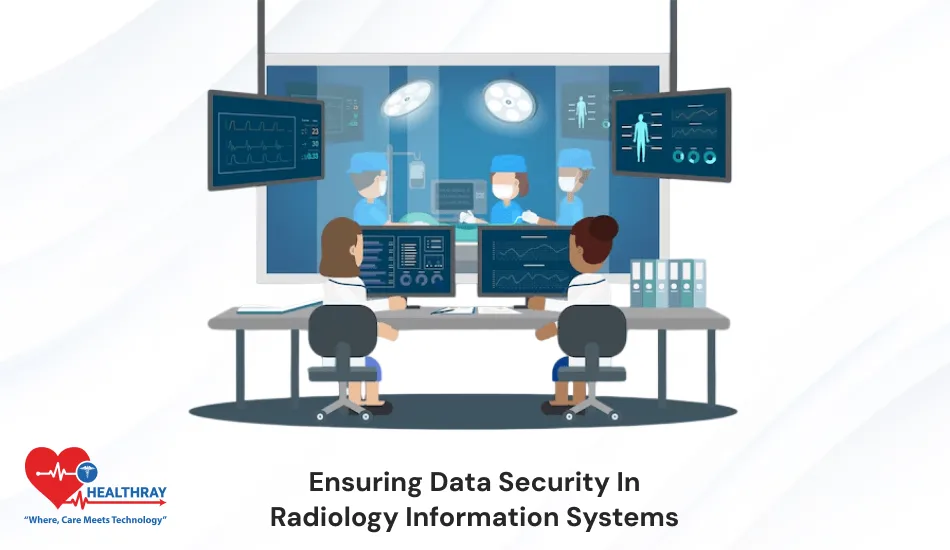
Radiology information system is not just a storage of images and reports. It is a digital backbone of patient trust. Data security functions well only if it is robust. The meaning of strong security is protected patient identity, safe clinical decisions, and uninterrupted workflows. As cloud, AI and remote access become a part of radiology software, clinics can’t take security concerns as a secondary topic. Encryption, role-based access and continuous monitoring not only make the RIS compliant but also make it a truly reliable platform. Simply put, when data is safe, then healthcare operations are trustworthy. In this blog, I will discuss why ensuring data security in the radiology information system is an indispensable aspect and how it helps clinics build a secure culture in the system. Keep reading!!!
Introduction
Data is the most precious asset of the healthcare ecosystem and in radiology, this is not just a number and images; it is the full medical story of the patient. When clinics store MRI scans or CT images in a radiology information system, patients have complete faith in it. Ensuring data security in RIS is not a technical checkbox but it’s an ethical consideration. Here, technology has both benefits and drawbacks; the only distinction is how effectively we use it. When information is stored in a system, it gains enormous power, and only strong radiology data security ensures that this power is used safely for patient care.
In the radiology department, RIS is a silent power that guides all reports, images, and diagnoses. But when a system deeply connects with the cloud, AI and remote access, then it also enhances the possibilities of risks. A small security lapse can hamper patient privacy, legal compliance and institutional reputation. That’s the reason data security is not just limited to firewalls and passwords. It is a mindset from encryption to access control tasks and audit trails to user awareness. When RIS is secure, then radiologists without any fear can focus more on diagnosis. Further, the technology functions well without producing background noise. Also, read more about the importance of PACS-RIS integration and how it helps radiologists.
RIS Fundamentals: Backbone of the Radiology Department
Lets out:
Daily Pressure of Radiology Department
Radiology departments can effortlessly handle daily high-volume data such as X-rays, MRIs, and CT scans. Further, they face difficulties with maintaining accuracy or security with every image. When a system fails to work smoothly, naturally it enhances problems of delays and confusion.
RIS and PACS: A Strong Partnership
RIS manages scheduling, reporting and workflow; PACS stores and retrieves images. Furthermore, integration of both is regarded as a backbone of radiology. Is integration enough? Don’t you think security is equally important?.
Connected with EHR
EHR is linked to AI-powered radiology software, but is it safe to use? Nowadays, RIS systems are deeply connected to EHR. Further, the user can access patient history at single dashboards. Along with that, it enhances the risks of data exposure, especially when access control is weak. Implementing radiology data security measures helps minimize these risks.
Legacy Systems: Posing the Biggest Risk
Still in 2026, many hospitals rely on outdated infrastructure to save costs, which can compromise radiology data security and leave sensitive patient information exposed. But they are not aware saving budget will not provide them long-term benefits. Undoubtedly, this system works efficiently but is still not appropriate when it comes to cyberattacks. In this case, is saving money worth the risk? You still need to take appropriate measures to mitigate risks completely.
Wireless Networks and AI Integrations
Wireless imaging devices and AI-based reporting speed up workflows, but without proper safeguards, they can create vulnerabilities that threaten radiology data security. Further, every new integration can become a new entry point if protection is not appropriate.
Understanding Data Flow is Indispensable.
Security becomes strong only when we thoroughly understand data at every step from acquisition to transmission, storage and access. Further, if any layer gets weak, then the entire system becomes vulnerable.
DICOM Standards: Helpful But Incomplete
DICOM standardizes the image exchange. However, lack of built-in encryption creates risks at the time of transfer. Further, this silent gap is usually hidden.
Real Impact of Unauthorized Access
Just consider the severity of the consequences if reports end up in the wrong hands. Patient trust, legal compliance and hospital reputation will collapse at the same time. Further, security here is not just an IT issue, but it’s a matter of patients’ safety.
New Perspective of Modern RIS
In 2026, the RIS system should be both secure and efficient. Encryption, access control aur continuous monitoring are no longer optional features. Future-ready RIS is the one that balances both speed and security. All things considered, this method turns the RIS into a foundation for safe decision-making rather than merely a system. Here, technology works quietly without creating noise. Also read our blog role of RIS in hospitals to understand how the latest trends make the hospital operations super-efficient.
 PRO TIP
Mapping Radiology Data Security Flows for Security
Let’s find out:
Understanding Data Flow
RIS security remains consistently strong when you have a clear picture about data flow. Understanding this flow is essential for ensuring radiology data security at every stage. Without visibility, vulnerabilities remain inconspicuous. Before going ahead, always make sure how securely your data moves.
Simple Text Diagram: RIS Data Journey
Imaging Device → RIS → PACS → EHR → External Sharing. This linear flow seems simple but there are risks associated with each hop.
From Imaging Device to RIS
Here are raw images, and DICOM headers are generated. Access is mostly applicable for technicians or modality systems.
Security control: Secure network segmentation, device authentication, and basic audit logs.
From RIS to PACS
This step stores full-resolution images in PACS. It involves a high volume of data, and transfers are done frequently.
Security control: TLS encryption, secure DICOM transfer, and role-based access control.
From PACS to EHR Integration
EHR synchronizes with reports, study references and key images. Further, doctors and clinicians can access it from here.
Security control: API security, MFA for users, detailed access logs.
RIS Reporting Layer
This step finalises Radiology reports, impressions and clinical notes. These are medico-legal sensitive data.
Security control: Strong user authentication, report versioning, and audit trails.
External Sharing: Teleradiology
Here, images and reports get shared with external radiologists. This step poses the highest risks.
Security control: MFA, read-only access, activity monitoring.
Logging: Silent Witness
Maintaining logs at each hop is essential to understanding the complete access status. These logs provide you a better way to deal with cyber attacks. It can serve as the foundation for future audits and help you envision features that can be problematic in the future.
Practical Perspective
Mapping RIS dataflow is not just a one-time task; it’s a meticulous process. Radiologists should thoroughly recheck flow and security at the time of new integration. Overall, security tools provide you effective results when you implement them at the appropriate place to get clear clarity in data flow mapping.
Step towards digital era with our healthcare solution
Revamp your hospital facilities and embrace change for better healthcare management. Ease in managing and organizing large medical datasets leads to effective analysis. Seize the opportunity now!
Radiology Data Security in AI-Enabled Radiology Workflows
Let’s check out:
AI is Not Just a Risk; It’s an Architectural Change
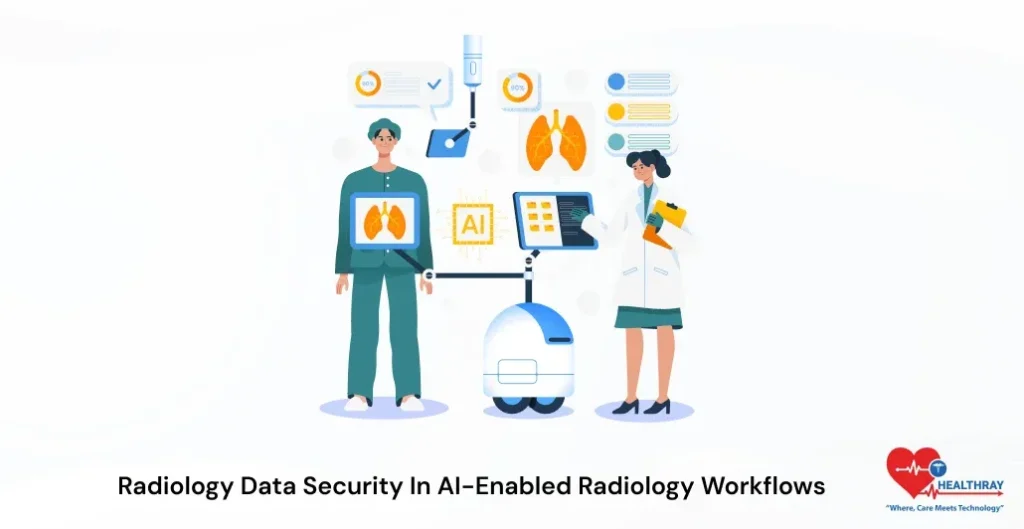
After the evolution of AI, security is not just limited to “data protection.” Now, the entire architecture has been changed. Now the question is, “Is your radiology information system ready with the new AI flow while maintaining strong radiology data security?”
Data Journey from RIS–PACS to AI Engine
When images are exported from RIS/PACS to the AI engine. Then, security becomes highly critical. This is not just a file transfer but a starting point of sensitive clinical decisions.
De-Identification: First Safety Gate
AI needs a patient image, not patient identity. Further, the initial step of secure workflow is de-identification; this keeps the privacy intact and minimizes the risk of non-compliance.
Encryption in Transit: Silent Protector
When images travel through a network, encryption provides them an invisible shield. Without encryption, data interception risk increases.
The Need of API-Level Authentication
AI engines usually connect through APIs. Strong authentication ensures only reliable systems should send or receive images, taking care of only reliable entries.
AI Model Version Tracking
Every update in AI models ensures output change. That’s why it is paramount to track the model version and their study analysis. This provides medico-legal clarity.
Input–Output Logging: Audit Backbone
Secure AI workflows capture input images and output results. Further, this is essential not just for compliance but also for future audits or clinical justification.
Raises New Questions for Accountability
If AI provides the wrong suggestion, then who will be responsible the radiologist, the hospital, or the AI vendor? Strong governance logs provide factual answers to this question.
Future-Ready RIS Perspective
AI-enabled RIS should be fast and traceable. The combination of transparency, auditability, and security makes the AI trustworthy; otherwise, the risk will grow discreetly.
 NOTE
NOTE
Securing DICOM Metadata and Hidden Risks
Let’s find out:
Images are Saved, But What About Metadata?
Is your data truly anonymous? Further, Radiology teams mostly focus on image pixels; however, the real risks are encoded in the DICOM header.
DICOM Headers: Silent Data Carriers
DICOM metadata includes patient name, ID, DOB, referring physician, device details, and acquisition parameters. Protecting these details is a core part of radiology data security. Further, this information quietly travels with the image.
Hidden Risks That are Mostly Ignored.
Even if images are blurry or anonymized, with DICOM tags, doctors can easily identify patients. However, this is a common but dangerous oversight.
Reality Check of Research And AI Training
AI models need large datasets. Furthermore, radiologists should properly clean the DICOM headers. Failing to follow this will result in a privacy violation. Clinics may encounter legal problems in the future. Before the situation gets worse, it is highly imperative to take a step forward at the very beginning level.
De-Identification vs Pseudonymization
De-identification makes the data completely anonymous. On the other hand, pseudonymization allows controlled re-linking. Both should possess clear roles as per use cases.
Practical Approach
DICOM security is not a topic of compliance. It directly impacts patient trust, AI reliability and institutional reputation. Secure images are meaningful only when they comprise secure metadata. Because it carries hidden risks beyond the pixels.
Conclusion
The radiologist’s data journey begins with acquisition and concludes with archiving. Strong control should be present at every stage, including transmission, storage, reporting, teleradiology, and AI analysis. Patient health information is not just a matter of compliance; it is a strong base of trust. Ensuring radiology data security reinforces that trust for both patients and clinicians. If PHI is secure, patients and clinicians use the system more confidently.