





Summary
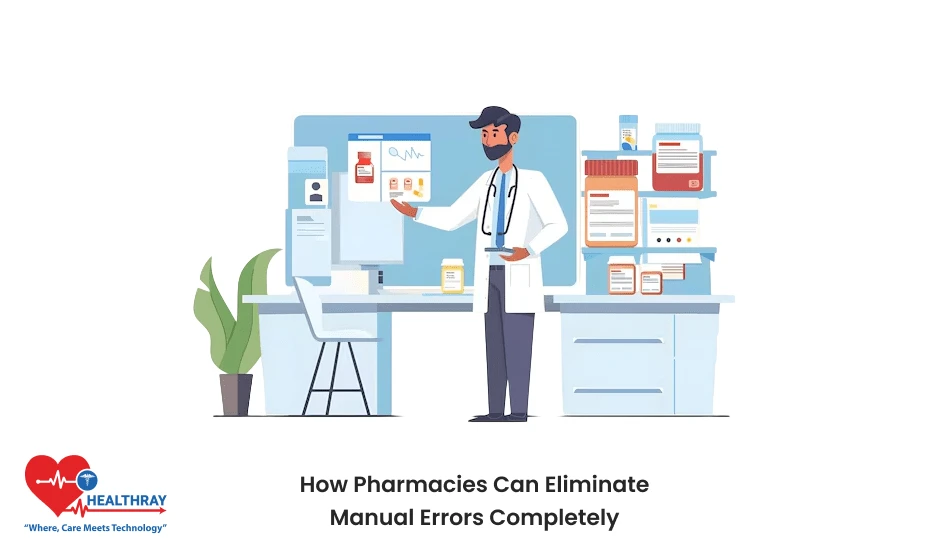
There is no occurrence of manual errors in the pharmacies as teams are not incompetent. They occur due to failure of systems when pressurized. Prescriptions increase. Inventory moves faster. Compliance rules tighten. This leads to a decrease in pharmacy operational efficiency that is silent and gradual.
This is a problem in hospitals, as well as clinics and specialist practices. Even one missed entry would slow the treatment. A stock mismatch can affect medication safety. In the course of time, these minor gaps become severe risks.
It is a blog that articulates the manner in which pharmacies can do away with manual errors altogether by enhancing the pharmacy operational efficiency. It concentrates on processes, automation and useful systems that assist doctors rather than dragging them down.
Introduction
Hand pharmacy does not seem difficult at the beginning. But volume is all different. Prescriptions pile up. Inventory shifts daily. Staff double-checks entries repeatedly. After some time mistakes creep in.
The majority of pharmacies continue to use disintegrated tools and manual reconciliation. As a result, there is poor prescription accuracy. Delays become normal. Teams compensate by working longer hours.
However, a modern Pharmacy Management System changes this pattern entirely. In effect, it consolidates information, integrates processes, and eliminates speculation in day-to-day activity. As a result, physicians are able to get correct information immediately. At the same time, there is no friction in monitoring dispensing by pharmacists. Consequently, this leads to an increase in pharmacy operational efficiency without the addition of stress.
What Breaks Pharmacy Operational Efficiency in Real-World Settings

The collapse in the pharmacy operational efficiency hardly happens overnight. Rather, it erodes with minor inefficiencies which increase with time. Verbal and manual entries and non-coherent records pose risk on each step.
Errors often appear during peak hours. Staff rushes. Systems lag. Communication gaps widen. Even skilled teams cannot cope in such a case.
Manual Dispensing and Prescription Accuracy Challenges
The use of manual dispensing adds to the pressure on pharmacists. Every prescription is to be verified. Nevertheless, repetition creates boredom. Fatigue leads to mistakes.
When prescription accuracy drops, medication safety comes under threat. Patients lose trust. Doctors receive callbacks. In the meantime, work processes slug even more.
Why Pharmacy Operations Management Fails at Scale
In contrast, conventional pharmacy operations management relies on the memorization of processes by people. In practice, that works only at low volume. As volume increases, memory-based systems are broken as more people demand them.
As a result, managers do not plan; instead, they respond without real-time visibility. Consequently, errors get discovered late. By then, damage control replaces prevention. Therefore, pharmacy operational efficiency suffers across the board.
Pharmacy Workflow Automation as the Foundation of Error Reduction
The pharmacy workflow automation eliminates the uncertainty in day-to-day operations. Instead of relying on manual checks, systems guide tasks automatically. Every step has a specific course.
Expertise will not be substituted by automation. It supports it. Pharmacists stay focused on verification instead of data entry. Doctors have faith in outputs since systems minimize variation.
 PRO TIP
In actual practice in the field of pharmacy, pressure varies across the day. The manual checks might appear to be manageable during the slow hours. Nevertheless, the processes begin to disintegrate as the volume of prescription rises. Staff rushes. Verifications get delayed. Minor errors pass through unnoticed.
Pharmacy workflow automation comes in handy here. Automated processes do not reduce in speed when pressure is on. The same rules are applicable when there is low or high volume. Orders follow pre-determined routes. Checks happen consistently. As a result, pharmacy operational efficiency remains stable even during peak hours.
Automated prescription dispensing further strengthens this flow. The system validates entries before medications reach patients. Alerts appear immediately when inconsistencies arise. Pharmacists remain in control without necessarily taking a step back.
Automation also minimizes rework as compared to manual handling. Teams spend less time correcting mistakes and more time ensuring safe delivery. In the long term, the consistency creates trust among departments and enhances the overall pharmacy operations management.
From Manual Handling to Automated Prescription Dispensing
To address this, automated prescription dispensing standardizes how medications move from order to issue. In doing so, the system authenticates entries. Additionally, it flags inconsistencies. Moreover, it prevents duplication.
Consequently, there is an increase in accuracy. Turnaround times shorten. TPharmacy operational efficiency rises without extra effort.
How Automation Improves Outpatient Pharmacy Workflow
In outpatient settings, the outpatient pharmacy workflow relies on speed and accuracy. Fortunately, automation balances both. For instance, prescriptions are in digital form. At the same time, status updates remain visible. Therefore, employees do not speculate on priorities.
As a result, there is reduced waiting time among patients. Pharmacists stay in control. Errors drop significantly.
Pharmacy Inventory Management and Its Role in Error Prevention
The problem of inventory mistakes is worse than most teams may think. Expired stock, missing items, and incorrect counts all increase risk. Pharmacy inventory management addresses this directly.
A system based solution monitors the stock movement in real-time. Alerts surface early. Rearrangement becomes foreseeable.
Modern pharmacy software will cause inventory to match dispensing automatically. Pharmacists do not reconcile manually anymore. Doctors trust availability. Pharmacy operational efficiency improves steadily.
How Pharmacy Automation Software Helps Reduce Medication Errors
The pharmacy automation software also minimizes the use of memory and manual judgment. Systems check inputs even before an error is made. That prevention matters.
When pharmacies aim to reduce medication errors, automation becomes essential. Barcode checks, alerts, and controlled workflows protect medication safety.
 NOTE
NOTE
In addition, pharmacy automation software brings about uniformity by standardization of processes. That uniformity, in turn, supports pharmacy compliance and creates trust among groups.
Hospital Pharmacy Management System for High-Volume Accuracy
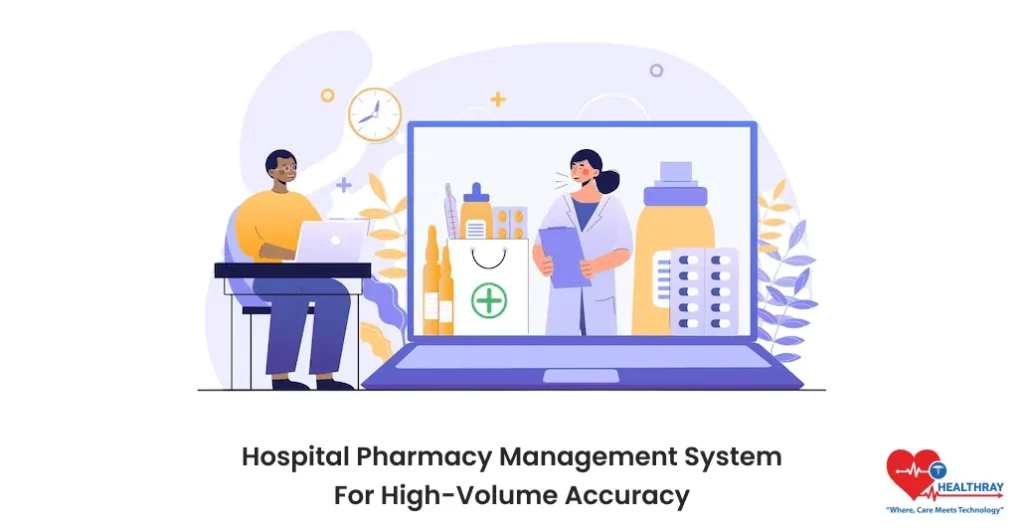
At scale, hospitals face challenges that smaller pharmacies do not. Specifically, high prescription volume and multiple departments under strict compliance requirements create constant pressure. Under these circumstances, a hospital pharmacy management system becomes necessary.
Without structure, coordination at this level fails easily through manual coordination. For example, orders are received at the same time. Meanwhile, stock moves fast. Simultaneously, check-up procedures multiply. As a result, mistakes sneak in.
To prevent this, a centralized system supports pharmacy operations management across departments. In effect, it correlates dispensing, inventory, and reporting in real time. As a result, doctors receive accurate medication status instantly. At the same time, pharmacists maintain control during peak hours.
Through hospital pharmacy management, teams become clear rather than confused. Medication safety improves. Pharmacy compliance remains unchanged. The pharmacy operational efficiency becomes consistent rather than reactive.
Pharmacy processes in hospitals are much more than just a counter. Orders are made by several departments at the same time. The cases of emergency require urgent treatment. Planned therapy needs accuracy. In the absence of structure coordination is weak.
A hospital pharmacy management system supports this complexity by aligning departments in real time. Medication requests flow digitally. Status updates stay visible. Pharmacists are responsible for giving correct responses rather than responding without thinking.
Scale is also an increment to compliance requirements. Audit trails, controlled access, and standardized documentation become non-negotiable. Systems enforce these requirements automatically, reducing reliance on memory or manual logs. As a result, pharmacy compliance strengthens without adding administrative burden.
Increased volume means that clarity is more important than speed alone. Hospitals that invest in structured systems protect medication safety while maintaining pharmacy operational efficiency across departments.
Pharmacy Compliance and Safety in Hospital Environments
Adherence cannot be based on the memory. Hospitals require traceability, audit trails, and standardized workflows. Systems enforce these rules automatically.
Consequently, there is an easier audit. Errors surface early. Employees operate without fear.
Improve Pharmacy Operations Without Increasing Staff
Understaffing is an issue in all medical environments. Hiring helps temporarily. It however does not correct broken workflows.
To improve pharmacy operations sustainably, the leadership should strive to minimize friction. Automation replaces repetition. Visibility replaces guesswork.
With systems leading day to day work, teams work in a hurry free manner. OPharmacy operational efficiency also increases since the focus is no longer on correction but prevention.
This approach is beneficial to hospitals, clinics, and specialists. Workloads feel lighter. Accuracy improves. The confidence of patients increases gradually.
How to Eliminate Manual Errors in Pharmacy
Here’s the reality. Removal of errors needs organization and not punishment. Human beings already do their best. Systems must support them.
To know how to do away with manual errors in pharmacy, consider the points of mistakes. Manual entries. Verbal confirmations. Disconnected tools.
The prescriptions, dispensing, and inventory are linked through a central platform. It checks data during every step. It flags issues early. As a result, mistakes are prevented before patients.
Workflow remains on track between teams with Pharmacy Software Solutions. Pharmacists are concerned with verification. Doctors trust outputs. The pharmacy operational efficiency increases automatically.
Learn more: AI Inventory Forecasting for Pharmacies
How Healthray Improves Pharmacy Operational Efficiency Across Hospitals and Clinics
Healthray is centered on actual smart pharmacy procedures. It does not subject teams to preset processes. Rather, it is adjusted towards the real operation of the pharmacies.
The system links dispensing, inventory, and billing with compliance. Data stays synchronized. Errors lose space to hide.
In the case of pharmacists, Healthray decreases the cognitive load. In the case of the doctors, it enhances confidence in drug supply and precision. To the administrators, it enhances visibility in the pharmacy operations management without manual reporting.
Scalability is also supported in Healthray. Clinics build services in a natural manner. The hospitals do not handle volumes chaotically. The efficiency of pharmacy works without the need to hire more staff or strain.
Healthray assists in the cooperation of doctors and pharmacists in maintaining information alignment. Prescriptions, status of availability, and dispensing status is seen by all authorized users. This openness minimizes the back and forward communication and unnecessary delays.
The platform is also scalable with the organizations. Expansion of services by a single clinic is possible without systems. It is possible to add departments in hospitals without interfering with the workflow. Information is constant across sites and this makes pharmacy operations management scalable.
It is not technical but rather intuitive in everyday use. Pharmacists operate under a directed workflow. Physicians have a blind faith in medication status. Manual reporting is not done by administrators when it comes to tracking performance. The simplicity of the system assists in quick adoption of the system by teams.
Healthray will enhance the operational efficiency of pharmacy by minimizing cross-functional friction and helping to maintain accuracy, safety, and long-term growth.
Conclusion
Training does not eradicate manual errors. When systems eliminate possibilities of errors, they vanish. Structurally-invested pharmacies safeguard patients, employees, and future expansion.
Efficiency cannot be relying on manual effort in case you are running a hospital, specialty center or high volume pharmacy. Consistency, transparency and manageable processes become more important as demand rises. Arrange a free demonstration of how Healthray can assist pharmacies to be more accurate and more helpful without creating an extra burden on the functioning.
Select according to where your organization is going, not the present position. Your workflow depends on it.