



Summary
Running a pharmacy today feels very different from even five years ago. Rules are continually evolving, patient demands increase and stock levels are maintained at low levels. Concurrently, teams are slowed down by manual procedures and local servers, rather than assisting in growth. This is a gap that justifies the reason why most pharmacies are reconsidering the way they are handling daily operations.
One of the ways through which a cloud pharmacy management system is able to cope with this pressure is by providing security, scalability, and operational clarity on a single platform. Pharmacies instead of having to contend with spreadsheets, disconnected counters and fragile backups can visually see and control their situation in real-time. Consequently, there is no firefighting but rather teams work with confidence.
Overall, this blog describes how the operations of pharmacies in the cloud can secure sensitive data and at the same time facilitate growth. It further demonstrates how the right system enhances accuracy, compliance and stability in the long term of pharmacies of any size.
Introduction
The pharmacy sector is still leaving behind the workflow based on paper and embedded systems on-premise software. Conversely, online systems have become capable of making quicker choices and data management that is safer. This change occurs not due to the fact that cloud tools are modern but rather they address actual pain in the operations.
Cloud pharmacy management system is a web based system that enables pharmacies to handle prescriptions, billing, inventory and reporting anywhere in an authorized system. In contrast to the conventional systems, it eliminates the reliance on local servers and physical storage. Therefore, teams obtain information safely regardless of the number of outlets they have or multiple locations.
More to the point, the adoption of clouds enhances control and not diminishes it. Pharmacies can be seen, compliance assists are utilized and flexibility is not added to the IT overhead. In the case of most organizations, the initial step of such transition is the replacement of a traditional pharmacy management system which may no longer be able to achieve scale or security requirements.
The cloud-based operations are beneficial in the long term in terms of serving more patients and ensuring business continuity.
Why Pharmacies Are Shifting to a Cloud Pharmacy Management System
Pharmacies are under the pressure of doing it faster and remain compliant. The software of traditional type tends to fail on one or the other. Thus, the adoption of the cloud is increasing rapidly in the retail, hospital and chain pharmacies.
One of the primary reasons is accessibility. A cloud pharmacy management system enables the owner and managers to observe the operations at any time, where they are. Through this, decision-making becomes better as people do not have to wait till the end of the day to get a report.
Cost structure also plays a significant role. The cloud-based pharmacy software has eliminated the use of costly servers and frequent maintenance unlike the legacy setups. Rather, pharmacies enjoy a stable subscription business that has a growth opportunity.
The other significant aspect entails the accuracy of the data. Live updates will help keep the stock level, billing records, and prescription history at par across counters. This way, teams do not cause duplication and unnecessary expenses are avoided.
Altogether, the use of the cloud is not a technology trend but it is a sensible reaction to current pharmacy needs.
Security and Compliance in a Cloud Pharmacy Management System
The issue of data security has been a priority among pharmacies that deal with personal details of patients. Luckily, the new cloud platforms focus on protection yet do not complicate the workflows.
Cloud pharmacy management system employs secure data storage when transmitting and at rest. This strategy will make sure that patient records and transaction data remain secure against unacceptable accessibility. Additionally, role-based access limits system visibility based on staff responsibility.
Audit trails also enhance compliance by keeping track of all systems activities. Pharmacists, managers, and auditors can trace changes easily, which supports regulatory checks and internal accountability. Consequently, pharmacies minimise the compliance stress in their inspection.
Reliable secure data backup also plays a crucial role. Cloud systems automatically save the information, and make it resistant to hardware malfunction or theft. In contrast, local systems often rely on manual processes that increase risk.
Scaling Operations Without Complexity
Growth opens opportunities but it also comes with risk in case systems cannot keep up. Cloud solutions can solve this problem by making expansion uninterrupted.
Multi-location management enables pharmacies to manage multiple locations using one dashboard. Inventory, billing, and staff access are always in check, and this enhances consistency among branches. Consequently, management decision-making is not based on piecemeal reports.
Cloud-based POS software also makes it easier to transact across the localities. Product pricing, discounts and billing policies remain the same so that there is no confusion at the counter. In addition, efficiency in inventory management because of centralization helps in enhancing planning and minimizing overstocking.
Growth also is accelerated. There is no longer need to invest in infrastructure to add new users or branches. Pharmacies, instead, increase their operations based on configuration but not on hardware acquisition.
Simply put, with cloud systems, it is possible to grow without complexity, which is conducive to long-term sustainability.
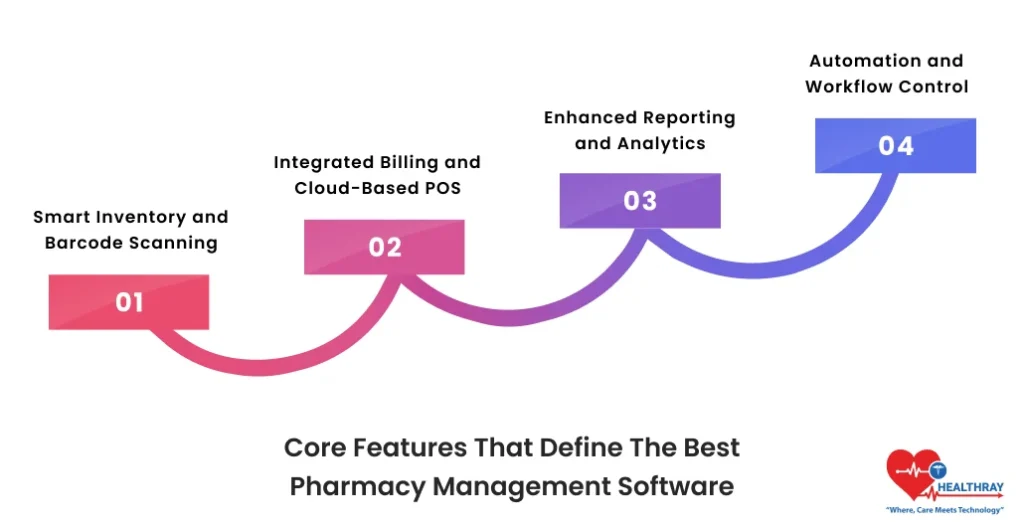
Core Features That Define the Best Pharmacy Management Software
Selection of the best pharmacy software is not only based on simple billing. Pharmacies in modern times require tools that are easy to use and enhance control.
These are the characteristics that are of most important:
Smart Inventory and Barcode Scanning
The stock is maintained at all times through real-time inventory tracking. Barcode scanning minimizes error in manual dispensing and accelerates dispensing. Consequently, pharmacists would waste less time rectifying errors and more time attending to patients.
Patient safety is also enhanced through batch and expiry tracking. Teams are alerted when medicines are expired or their quantities are low.
- Smart inventory management:
These systems also support compliance with
healthcare regulation
Real-time inventory tracking helps pharmacies monitor stock levels accurately. Barcode scanning reduces dispensing errors and speeds up workflows. Expiry and batch warning also avoid losses.
Integrated Billing and Cloud-Based POS
Billing, discounts and tax compliance are all managed by a cloud-based POS. The data is synchronized on the spot, and it adds up with sales throughout the system.
Further, cloud billing enhances quicker checkout that enhances pharmacy customer retention on the busiest hours.
Enhanced Reporting and Analytics
There are clear dashboards displaying sales trends, fast moving items and compliance indicators. The knowledge gained here can be used to make informed choices without complicated analysis.
Automation and Workflow Control
The pharmacy automation software eliminates repetition like stock reconciliation and daily reports. Consequently, staff productivity increases without additional hiring.
- Pharmacy automation software:
Billing and prescription processes are automated and this minimizes manual work. As a result, employees give more attention to serving patients, as opposed to documentation.
 PRO TIP
How to Migrate to a Cloud Pharmacy Management System
The process of migrating towards a cloud pharmacy management system, should not seem perilous or daunting. When you break the process into clear steps, the transition becomes structured, predictable, and far less disruptive for daily pharmacy operations. Let’s walk through each step in detail.
Step 1: Assess Current Needs and Data Security Requirements
Pharmacies require transparency before they can make any technical move. Begin with a review of your existing workflows, including prescription entry and inventory management and billing. This action will assist you in knowing what is working well and the place of delays or mistakes.
Meanwhile, estimate your data security requirements. Electronic patient records, billing and auditing logs should always be secure. As such, determine compliance needs, access privileges, and backup expectations at an early stage. When you determine these needs, then you can make the migration process not reactive but goal-driven.
In brief, this move preconditions the step. In its absence, the finest cloud solution will not give the anticipated outcomes.
Step 2: Choose a Compliant Cloud Provider
Once requirements are clear, the next move involves selecting the right provider. Not every cloud platform is within the compliance of pharmacy, hence due diligence is an issue.
Find providers that comply with healthcare data requirements and provide secure data storage, encrypted access, and elaborate audit trails. Furthermore, it is necessary to check whether the system is scalable, integrates and is reliable with uptime. An already experienced provider in the operations of the pharmacy minimizes risk in the future.
Assess the quality of vendor support equally. It has powerful onboarding and supportive features that guarantee easier adoption. After all, technology should simplify operations, not add dependency stress.
Step 3: Data Migration and Staff Training
The transition includes the phase of data migration as the most sensitive. Prescription records, inventory data, supplier details, and financial information must move accurately into the new system.
During this phase, teams should clean and validate data before migration. This practice helps to avoid the entry of an obsolete or a duplicate record into the new environment. In the meantime, data movement should be accompanied by staff training as opposed to post-go-live.
Training would make sure that pharmacists and counter staff are comfortable using the cloud platform from the beginning. Consequently, the level of resistance is lowered, and adoption enhances. In most instances manuals are not as effective as hands-on demos.
Step 4: Go-Live and Ongoing Support
The actual switch is Go-live and it must never be abrupt. Ideally, pharmacies plan this stage at the times when there is low volume to reduce disruption.
The continuous monitoring is necessary after launch. Accuracy of transactions, inventory and user feedback need to be monitored by the teams. Above all, the continued support by the vendors means that any arising issues will be resolved quickly.
In the long run, pharmacies will be able to optimize work processes, enable more functions, and expand the use across locations. The cloud pharmacy management system will develop along with the business growth instead of restraining it when properly supported.
Step towards digital era with our healthcare solution
Revamp your hospital facilities and embrace change for better healthcare management. Ease in managing and organizing large medical datasets leads to effective analysis. Seize the opportunity now!
Security, Audit Trails, and Compliance in Daily Operations
Security and compliance: Secure data storage and secure data backup protect patient and transaction data, while audit trails record every action for transparency and regulatory compliance. Role-based access further reduces internal risk.
Multi-location control: Multi-location management becomes easier with a centralized dashboard that tracks inventory, pricing, and performance across branches, enabling faster stock transfers and consistent service delivery.
Operational intelligence: Built-in analytics reveal sales trends, fast-moving items, and seasonal demand, helping pharmacies improve inventory management and achieve better pharmacy operational efficiency over time.
 NOTE
NOTE
Healthray: Supporting Secure and Scalable Pharmacy Operations
Healthray also plans its cloud pharmacy management system to replicate the real-life pharmacy processes. It remains concentrated on clarity, security, and scalability instead of unneeded complexity.
The platform enables real-time inventory tracking, barcode scanning and audit trails on the first day. At the same time, secure data storage and automated backups protect critical information.
Healthray is also compatible with other healthcare systems and this is suitable to make pharmacies run within an integrated ecosystem. This integration is able to support long-term growth without changing the system regularly.
Get to know more about the way Healthray can assist the teams of pharmacies nowadays by providing them with a scalable and practical technology.
Conclusion
Everything said and done, a cloud pharmacy management system is much more than just convenient. It also offers security, scalability, and control to an ever-stressful healthcare set up.
The pharmacies which use cloud-based pharmacy software decrease operational risk and enhance the quality of the services. In addition, AI-powered pharmacy software and real-time information can assist teams to remain proactive rather than reactive.
Instead of considering cloud adoption as a technological improvement, pharmacies cannot but regard it as a strategic step. When systems scale smoothly and data stays secure, teams focus more on patient care and business growth.
Book a free demo and know how Healthray makes you walk on the way in which a cloud pharmacy management system can allow your next stage of operations to be confident.