



Summary
AI-powered pharmacy software makes the medication distribution and billing workflows more streamlined, trustworthy, and functional. Pharmacy software validates the drug prescription online. Track inventory in real time. Also, it flags errors such as wrong dosage and stock mismatch before they happen. Along with that, it automatically applies billing, taxation, insurance rules, and pricing logic in the practices. This reduces errors and expedites the operational process. Simply put, pharmacy software standardizes the pharmacy operations and improves compliance and regulation in the system. In this blog, I will discuss how AI automation lightens the mundane workloads of pharmacists. Also, I will cover how software helps them focus more on clinical verification or patient assistance. Keep reading!!!
Introduction
Could you imagine a pharmacy without chaos behind the counters, only a steady rhythm? AI-powered pharmacy software makes this possible!!!!
AI-powered pharmacy software simplifies every step of pharmacy operation and makes it accurate. Plus, it expedites the workflow and makes the practices highly dependable. As we know, traditional pharmacy procedures are heavily contingent on human audits and mundane routine tasks. On the other hand, AI-powered software simplifies dispensing and billing regimens and provides instant relief to pharmacists. It makes the pharmacy practices clear, direct, and without unnecessary embellishment. At the dispensing level, the pharmacy management system digitally interprets the prescriptions.
Pharmacy software cross-verifies the drug database and instantly flags potential errors like wrong dosage, duplicate medicines, and stock mismatch. Pharmacy software handles inventory management in real time. It minimizes the risks of out-of-stock situations and expiry losses. This system maintain consistency in all the situations, whether prescription volume is high or during peak hours Billing automation is another critical pillar of pharmacy operations.
Pharmacy software automatically applies AI-based software taxation, insurance rules, discounts, and pricing logic. It minimizes billing delays and improves financial accuracy. It reduces the need for human commonality. And provides a foundation to conformity. Overall, pharmacists free themselves from repetitive operational loads. They can divert their efforts to medical approval and patient supervision.
The Pharmacy Workflow Crisis: Why AI is Essential
When Slow Systems Slow Down Patient Care
Traditional pharmacy workflow still depends on manual verification. Furthermore, doctors are still reliant on writing notes for prescriptions. They spend considerable time on manually corresponding every medicine. It takes a significant amount of time and is highly susceptible to flaws.
Speed That Transforms Pharmacy Economics
According to the McKinsey 2025 study, AI workflow expedites the workflow processing up to 90%. Also, cut system errors by up to 70%.
From Chaos to Controlled Operations
Every prescription is traceable, and every transaction is auditable. Further, it naturally improves the operational efficacy.
The Future of Pharmacy Is Intelligence-Driven
Artificial intelligence is not merely an optional technology. Furthermore, it is the fundamental of scalable, compliant and viable pharmacy operation.
The Real Cost of Human Error
According to the HIMSS report 2025, US pharmacies lose $5.6 billion every year due to dispensing and billing delays. Furthermore, an error rate of 1-2% per prescription creates a serious impact for healthcare.
India’s High-Volume Pharmacy Challenge
India has more than 800,000+ pharmacies, serving more than 1.4 billion. Further, High patient load and fragmented regulations make the workflow sophisticated and more prone to errors.
AI as the Operational Game Changer
Artificial intelligence substitutes conventional functions with intuitive automation. Further, it makes the workflow planned, probable and optimized.
Smart Billing and Compliance Automation
AI can predict reimbursement, warn about claim denials and maintain compliance with HIPAA, NABP standards and the India DPDP Act 2023.
Protip: When implementing AI pharmacy software. Automated dispensing, billing and inventory should be integrated into a single system for better preciseness and quicker service.
Revolutionizing Billing with Predictive AI
When Billing Becomes the Biggest Bottleneck
In pharmacy workflows, handling billing is a highly critical task. Further, laborious coding, insufficient evidence, and payer-particular rules disrupt the smooth workflow. Thus, pharmacists face frequent challenges with claims rejection. According to the CAQH Index 2025, 40% of pharmacy submissions are disapproved at the first initial attempt. This enhances the revenue delay and elevates rework in the system. Pharmacy management software resolves these challenges and removes the roadblocks for business growth.
Smart Coding for Higher Approval Rates
AI-based machine learning models choose the billing codes manually. Furthermore, pharmacy software automatically assigns medical codes to every claim based on medical condition, prescription specifications and payer-specific standards. System learn contuinity from past claim rejections and approvals. Thus, it makes the future submission more accurate and precise. It fills the gap of codes, missing modifiers and compliance requirements. Overall, this learning-focused approach elevates the approval rate. More importantly, it completely evades the traditional hypothesis-based billing technique.
Learn more: Using Analytics to Improve Pharmacy Margins
High-Volume Automation for Pharmacy Chains
Large pharmacy chains encounter more than a thousand transaction processes. In this situation, manual billing becomes practically unsustainable. Pharmacy networks such as Healthray intelligently use AI-driven automation throughout their entire billing cycle. Furthermore, from invoice compilation to payment redemption, it dramatically simplifies processing time. Minimize human errors. And strengthen operating transparency through real-time financial visualizations. Overall, in a large-volume workplace, automation is not just a utility. It is a pillar of scalable achievement. And a great platform for financial viability.
AI That Thinks Before It Bills
Predictive AI billing converts the unviable strategies into proactive ones. Further, pharmacy software thoroughly analyzes the historical reimbursement figures, payer usage and rejection behaviors. It determines which claim will be smoothly approved and which claims are at high risk of rejection. Through this intelligence, pharmacists don’t just blindly submit the bill. Instead, they deliver pre-approved assurances where the possibility of success is outstanding.
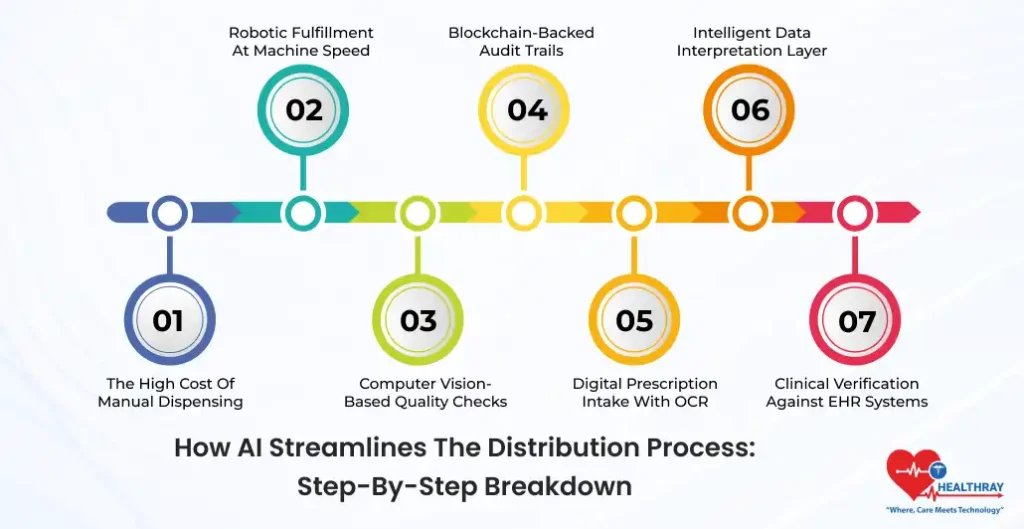
How AI Streamlines the Distribution Process: Step-by-Step Breakdown
The High Cost of Manual Dispensing
Dispensing error is the predominant reason for mortality in many developed countries like India and the USA. Further, a silent crisis that is hidden behind numbers. A manual crisis is highly reliant on human focus, fatigue and time pressure. This becomes highly risky for high-precision healthcare environments. A small slip can cause a chain reaction and lead to wrong dosage, delayed correction, and patient harm. Moreover, speed and accuracy here move in opposite directions. It naturally drops the quality when the workload increases. That’s the reason manual workflow becomes inefficient and highly unsafe.
Robotic Fulfillment at Machine Speed
AI-enabled robotic dispensing systems, such as Healthray, convert the pharmacy storefront into a highly accurate production line. AI bots, through the barcode scanning and smart inventory mapping, pick the accurate medicine as per the symptoms. Further, it measures the exact quantity and automatically packs the system with an accurate label. Thus, it completely evades diverting factors such as human fatigue, rush-hour pressure, and distraction from the system. Overall, with a high speed of 300+ prescription hours, it creates a dependable and structured system.
Computer Vision-Based Quality Checks
Upon completion of the dispensing process, AI-powered cameras inspect every medicine with microscopic attention. Further, hospital pharmacy management software matches pill size, shape, color, imprint code, and packaging alignment with reference images in real time. Additionally, if there are any uncertainties, like an incorrect tablet, a broken strip, or a labeling error that goes beyond the predetermined parameters, the system sends out alerts.
Blockchain-Backed Audit Trails
AI-driven dispensing workflows automatically load every step from patient intake to final handover in a blockchain-compatible digital database. Further, these logs are tamper-proof. No one can change or delete data in the system. Additionally, timestamps, user activity, and transaction history create a secure culture and make the compliance audits effortless. Whether it’s about a regulatory inspection or an internal quality review. Every step is transparent and accessible. This approach provides strong legal protection to pharmacists. Enhances operational accountability and builds intrinsic trust at the system level.
Digital Prescription Intake with OCR
The AI-powered OCR pharmacy system becomes a smart filter for workflow. Further, whether it’s about a handwritten or a digital prescription, the system immediately scans the text and converts it into readable data. NLP algorithms analyze medicine names, dosage patterns, and timing instructions thoroughly and extract them into a structured format. In this situation, human mistakes are commonly common, but AI helps pharmacists maintain consistency. This process drastically reduces misinterpretation, processing times are less, and it makes the dispensing foundation extremely accurate.
Intelligent Data Interpretation Layer
When data is captured from OCR and NLP, AI converts this raw prescription data into a clean, structured and system-ready format. Furthermore, Pharmacy software solutions automatically normalize the medicine codes, dosage units, frequency schedules and patient identifiers. Thus, it helps the pharmacy department follow a standardized workflow. This layer eliminates repetitive manual tasks. Slows down the processing delays. And, ensure seamless integration with downstream systems such as inventory, billing and verification. Overall, it results in more rapid response times, uniform record keeping, and minimal disorientation.
Clinical Verification Against EHR Systems
The AI dispensing process activates the most critical safety layer. Furthermore, the modern pharmacy software retrieves histories such as adverse reactions, continual drugs, chronic ailments, and past dosages from the patient EHR. AI cross-checks the vast drug databases. And instantly give warning signs of potential connections, overdose complications, and duplicate therapies. As we know, manual review consumes time, and often clinics lose potential opportunities coming along their way. On the other hand, AI takes just a mere minute to wrap up the verification process. This not only enhances compliance in the system. However, it also looks at patient safety diligently, without impeding the process of care.
 NOTE
NOTE
Conclusion
In 2026, a massive-volume, highly regulatory healthcare environment will not be sustainable with traditional pharmacy software. AI-powered pharmacy software is not a luxury add-on. It controls dispensing errors. Slow down billing delays. More importantly, it minimizes operational stress. Overall, it expedites the payment cycle and naturally stabilizes cash flow.