




Laboratories make the backbone of healthcare diagnostics. They provide necessitated patient management. On the other side, laboratory operations, especially billing, are complex, balancing all operations in a financially sound manner. Laboratory billing services ensure accurate claims to prevent errors and delays in reimbursement. The very process bridges laboratories to insurers and allows them to stay focused on their core mission-delivering precise test results.
This article essentially seeks to provide perspectives on how the Laboratory Information Management billing services have changed the game in modern healthcare today in terms of efficiency, compliance, and financial performance.
Enhancing Operational Efficiency through Laboratory Billing Services
Any successful lab would depend on efficient operations as its backbone. Billing services are therefore key contributors to the general straightforward process that translates into decreasing administrative burdens. Automating the repetitively performed tasks such as submitting claims, following up on payments, and reconciling such payments would free time for laboratory staff to devote attention to assessing patient care or ensuring the accuracy of those diagnoses.
Also, laboratory billing services help in reducing bottlenecks in the billing cycle. For example, these services use advanced software to identify errors before the submission of claims. This approach reduces, if not eliminates, denials while speeding up payment cycles.
Furthermore, laboratories outsourcing billing services give them benefit access to trained experts who are well versed in keeping updated with the latest regulatory changes in the industry and current industry best practices. This secured condition allows laboratories to effectively maintain their smooth workflows without constant worries of compliance challenges.
Validating Laboratory Bills Compliance and Accuracy
Healthcare regulations are constantly changing, and with them comes the expectation that laboratory billing will comply. Failure to adhere to such requirements can mean denial of claims, financial penalties, or even legal trouble. Laboratory billing services help manage this complicated regulatory landscape well.
These services have the tools and trained personnel who ensure billing codes are in sync with the most current healthcare regulations such as CPT and ICD and all that’s included under HCPCS. These advising efforts help avoid the typical mistakes that lead to rejected claims by instituting proper coding practices in the laboratory.
Robust billing services also take on regular audits to identify discrepancies or inconsistencies in the billing processes, thus ensuring that all claims meet payer requirements. This proactive approach will increase accuracy and build trust with insurers and patients.
Today, it’s not about “not paying penalties”; rather, it is about being seen as very virtuous and trustworthy a thing which delay-free laboratory billing services are easily enabled.
Optimizing Financial Performance with Laboratory Billing Services
Financial health is critical for laboratories to sustain operations and invest in better technologies. Laboratory billing services are designed to maximize revenue while minimizing losses due to errors or inefficiencies.
Claim denials rank as some of the greatest financial challenges labs face. A good billing operation recognizes the true elements behind claim denial; coding errors, missing documentation, and sometimes stale payer guidelines are the culprits. Once identified and resolved, laboratories can expect a quicker reimbursement yield from the billing operation.
Improvement programs also target end-to-end revenue cycle management (RCM). Billing services approach RCM holistically, from patient registration through insurance verification and on to final payment collection. This end-to-end oversight reduces the risk of delayed payments and revenue leaks.
Lastly, laboratories receive detailed financial reports from billing services, showing the trends and areas to improve, helping managers in making informed decisions on resource utilization.
When done right, billing isn’t merely a prop to keep a laboratory alive-it can turn that laboratory into a thriving enterprise, fit to scale up from providing basic but vital services to offering higher value to health care providers and their patients.
Harnessing Technology in Laboratory Billing
Technology is heralding change in every aspect of healthcare, and laboratory billing is no exception. The modern billing services use advanced tools to make everything simpler, more accurate, and insightful regarding financial performance.
In the contemporary billing ecosystem, laboratory information systems (LIS) are dovetailed. These would play a crucial role in streamlining the data flow between electronic health records (EHRs), insurance platforms, and billing software. Within such an integrated network, there is little manual data entry, thus reducing the chances of errors and speeding up the claims process.
Automation is definitely another game changer. It has taken over a range of tasks, including coding, claim submissions, and payment tracking, leaving them to intelligent algorithms. Such automated solutions then flag errors in real time, ensuring claims submitted are accurate. Data analytics tools also provide insight into the billing gangways with a detailed breakdown of billing trends for laboratories to optimize their strategies.
Cybersecurity also comes in this category. With sensitive details of both patient and financial information at stake, modern billing services install brick walls to keep breaches from happening in terms of encryption and compliance with requirements such as HIPAA.
By adopting cutting-edge technologies, laboratories not only improve their billing practices but also set the stage for long-term growth and sustainability.
Best Practices In Lab Billing
By itself, effective laboratory billing will require more than just technology. It calls for strategic planning and implementation of best practices to improve the scope of the billing process and achieve the expected accuracy and efficiency that will engage some consistent financial performance.
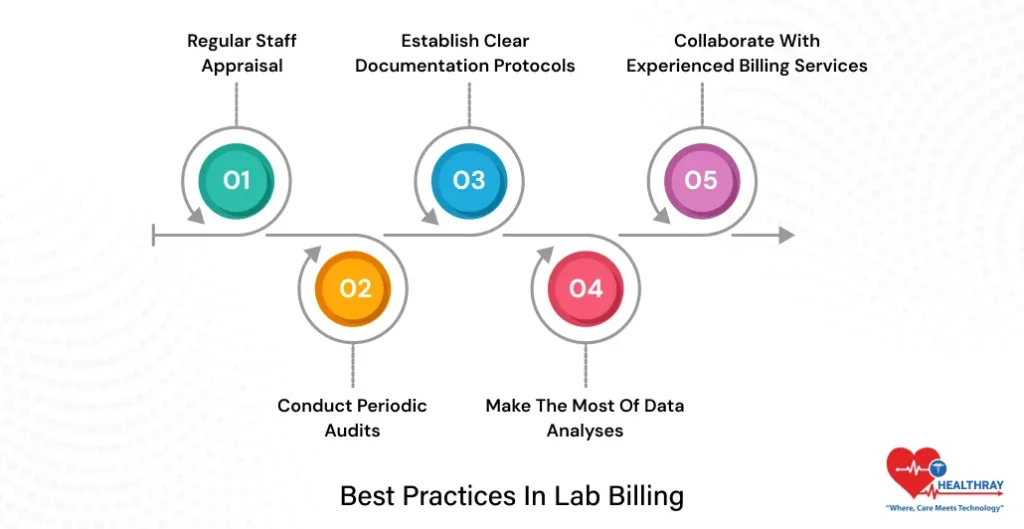
Regular Staff Appraisal
The regulations and codes for billing are dynamic, and training for the updates such as the CPT codes and payer policies aligns any billing process with the industry standards. Continuous learning minimizes errors and hence increases the rates of claims’ acceptance.
Conduct Periodic Audits
Periodic audits reveal areas of potential divergence in billing practices. These weigh them down and help laboratories learn before their inefficiencies result either into denial of claims or compliance issues. Strong auditing is necessary to keep the patients and insurers feeling secure.
Establish Clear Documentation Protocols
Documentations act as the origins of successful billing. It is important that labs actually record patient information including the test orders and results with the proper payer guidelines. Proper documentation minimizes the back and forth exchanges with insurers and gets completed sooner.
Make the Most of Data Analyses
Inside billing data, there are rich sources of performance metrics. Analytical tools to monitor trends such as denial rates and reimbursement timelines are applied to help laboratories find areas to improve and inform decisions for increasing revenues.
Collaborate with Experienced Billing Services
Outsourcing to such professional billing services would give the labs skill and resources they may not have in-house. The providers are completely aware of evolving regulatory changes, new payer trends, new technology, and related information so that labs never get into becoming non-competitive.
Such best practices will ensure that a strong billing structure is in place to usher in better financial security and operational efficiency in the labs.
Conclusion
Laboratory billing services are one of the key pillars in the operational business of healthcare. Streamline the workflow in an attempt to manage the complex regulatory framework and fortify the financial backbone within laboratories. With the indentation of advanced technologies and the best practices within these services, these facilities can place more focus on their core mission-the provision of accurate and timely diagnostic results.
Efficient processes in billing are going to be more significant as the Hospital Management System evolves. Initiatives in professional billing services enable laboratories to achieve quality workflows and long-term financial growth, positioning them within the industry’s leadership. Effective billing is not relegated to the back-office function, but creates a strategic edge.