




Quick Summary
In today’s time, it’s inanity if you solely depend upon the handwritten records. Doesn’t provide contribution to increase income level nor do anything for making right decisions. Maintaining compliance in case of physical records is tougher to do. For that, you should adopt modern-day lab technologies like a LIMS system that reduces laboratory expenses and shields you from killing laboratory efficiency. Let’s elaborate.
Introduction
Traditional lab approaches are based upon the physical reports and manual entry system, which disturbs the entire workflow and makes it more cumbersome. You should embrace the right method to do work, which assists you to improve lab productivity. On the other hand, it increases patient coordinated care and accelerates treatment outcomes.
Maintaining voluminous lab information is harder than anything. However, the right lab system makes this procedure smoother. Furthermore, it handles challenges of entire laboratory divisions, whether it’s related to patient desk support to the calibration department. It controls the lab data quality and streamlines lab operations.
The LIMS system is far better than the handwritten records. Facing a number of hidden challenges, merely because of physical records such as creating errors while generating documents, time consuming for fetching the specific medical document, hard to amend lab documents, and high cost issues.
How Paper-based Reports Affect Lab Environment?
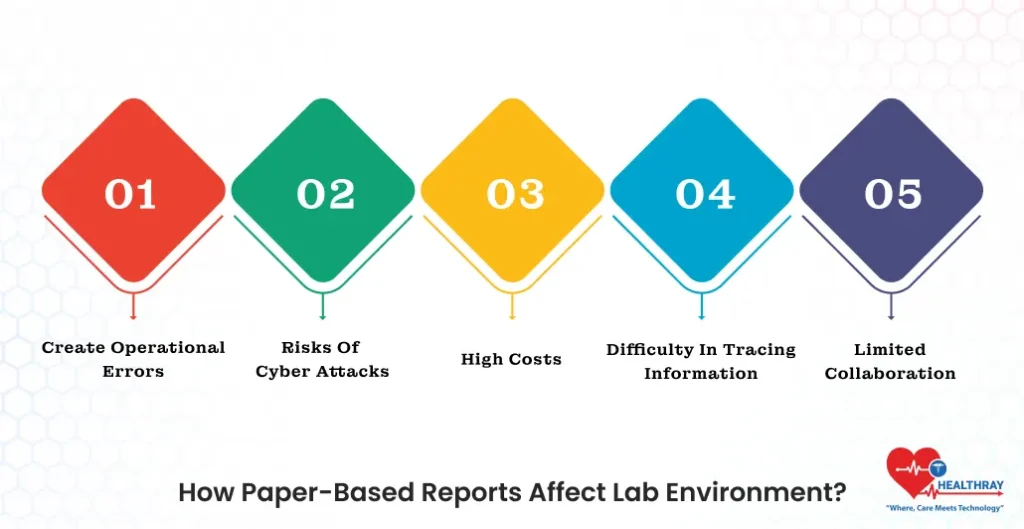
Do you want to optimize lab data and enhance operational performance? However, it is not at all possible with the handwritten records. Affecting all internal lab departments, slashing their productivity level and increasing expenses. Invites a varied number of hurdles that can’t even be seen, increases laboratory costs and decreases workflow efficiency.
Create Operational Errors
Laboratory, one of the sensitive departments and its one error can deteriorate the lab reputation, treatment plans and high possibility of big consequences. Moreover, create a complicated lab environment that minimizes speed and enhances precision.
Hard to label on the paper records and organize them, even harder. Spend hours fetching the correct lab documents and improper management of lab documents. Difficult to draft a clear procedure of recording and maintaining lab files, how to dispose with the correct regulations.
Risks of Cyber Attacks
When you have the high-end detail information, there is a lot of risk roaming on the physical records. If it happens in laboratories, the consequences can be worse. A single breach affecting the lab reputation, responsible for diagnostic error, and reduces patient safety. Forgery and stealing information, easy to happen when maintaining handwritten records.
If you don’t take seriously to shield patient and lab information, then it is considered poor lab management practice. Difficult to apply lab regulations over patient and client records. Affecting the lab reputation and augmenting the operational downtime.
With the physical records, it is impossible to take the appropriate security measures, it happens only with the LIMS system solution.
 NOTE
NOTE
High Costs
Maintaining physical records can be more troublesome and not at all easy to manage. Required the number of staff for maintaining lab files, embed labels on it, and need sufficient amount of cabinets to store it accurately. Moreover, large investment on maintaining physical records rather than the lab information system.
In case of physical files, it is required for multiple investments including stationary and other office supplies. You should appoint the specific person for retrieving the right laboratory file and patient records. Additionally, it takes more time to create records and number of professionals appointed for organizing lab files.
Difficulty in Tracing Information
With physical documents, it is impossible to trace laboratory details and fail to get the desired file at the specific time. Impossible to have the perfect organized system with laboratory records, most of the files replaced with new ones because of old paper records. Handwritten records are easily vanished in case of contact with fire and water.
Physical lab records are prone to mistakes and cannot be easily moved from one branch to another one. Moreover, un-organized information makes it harder to locate the exact lab and patient file. Forgetting to implement regulations over the physical lab documents and taking lots of time to find the single lab document.
Limited Collaboration
If another lab division requires a document from another department, it is hard to pass lab documents. One single cannot be visualized and analyzed by the whole team at the same time, creating difficulty in making laboratory decisions.
A large administrative effort has been taken to find the single file. Cannot create multiple copies and ones it made, you cannot edit much on the physical records.
Ditch The Traditional Lab System : Embracing The Modern LIMS System
The traditional lab system, a big obstacle to enhancing productivity and increasing profitability in laboratories. You should abolish the norm of maintaining the physical records and take the initiative towards the lab information management system. Let’s leap what the laboratory information management system can do :
Complete Management of Lab Samples
In clinical laboratories, sample management is itself a wide procedure and takes numerous steps to do it. Has the power to administer a complete sample lifecycle, starting from sample collection to the final disposal with regulations.
Eliminating manual lab intervention, reduces human errors and supports improving sample efficiency.
Integration With Lab Instruments
Seamless connectivity of laboratory devices and other instruments to accumulate information and get a flag in case of any deviation figure, which is an unexpected and abnormal one. Quickly get instrument details, reduce manual data entries.
Easily highlighted the critical lab details, helps in improving the lab output without investing much, and decreases human mistakes.
E-invoicing and Claiming
When your lab continuously grows, it is difficult for you to handle patient billing services due to a handful of customers. Moreover, it simplifies to build electronic invoicing with right regulations, reducing errors and decreasing legal penalties.
One can print with the barcode scanning, downloaded whenever required and can seamlessly share with another division. Also, the best laboratory systems help in providing reimbursement on time.
 PRO TIP
Automated Reporting And Analytics
Merging different laboratory documents and applying the right algorithms to create the detailed business intelligence reports. A flexible one, anyone gets any critical details through slightly changing the inputs.
Render analytical data to inspect early issues, make better clinical decisions, and easily catch errors or any treatment mistake.
Document Management
Laboratories have a number of documents, which are not easy to manage in case of handwritten records. However, you can swiftly administer the electronic laboratory documents and also, compliance with standard rules.
Safely administer the SOAP along with the standard regulations like HIPAA, data protection, and GDPR guidelines.
Breakdown The Actual Difference Between Lab Software And Paper Based Records
| Factors | Physical Records | Lab Software |
| Analysis Details | Not possible to create | Automatically build |
| Scalability | Low | High |
| Expenses | High | Low |
| Security | Low | High |
| Reliable Information | Difficult to have | Ease to maintain |
Advantages of Lab Management System Over Physical Records
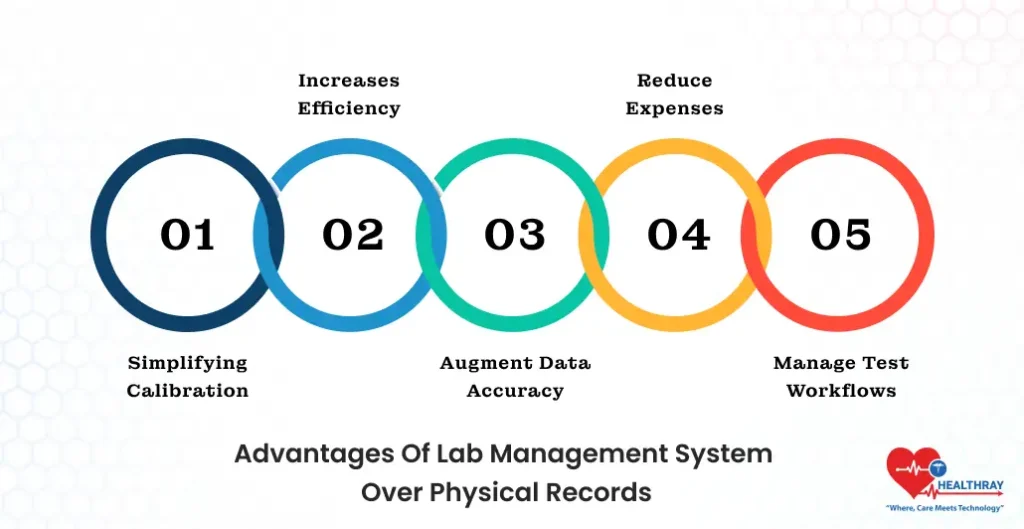
The lab management information system is the modern approach and succeeds in all lab divisions whether it is operational work or related with patient collaboration. Not considered as a trending one but it is needed in the laboratories. Let’s carefully glance how the best laboratory systems affects labs operations:
Simplifying Calibration
Checking each lab instrument manually, it is a labour intensive and costly procedure. Most laboratories forget the calibration time, easily examining whether it is ISO 17025 as per standard or not.
Therefore, it optimizes the calibration procedure, increases client service quality, and reduces calibration errors.
Step towards digital era with our healthcare solution
Revamp your hospital facilities and embrace change for better healthcare management. Ease in managing and organizing large medical datasets leads to effective analysis. Seize the opportunity now!
Increases Efficiency
The laboratory information system centralizes lab details that can easily comply with standard protocols. Streamlining to control sample information, trace sample details with one click, and manage a number of lab resources effectively.
Furthermore, it helps to optimize lab operations, improves workflow efficiency, increases productivity, and improves staff performance.
Augment Data Accuracy
Physical records are used by laboratories from a number of years, creating a number of errors while documenting, maintaining, and complaint lab documents. Multiple lab documents create a lot of errors and inconsistencies.
On the other hand, the LIMS system complies with standard lab data protocols while drafting laboratory documents.
Reduce Expenses
In the case of LIMS systems, create as many laboratory and patient records when needed and you don’t have to worry in case of peak demands. On the other hand, if you don’t want some functionalities at any time, you can request it.
Physical records initially have minimal investment but in the long term, it creates huge expenses and lots of risks.
Manage Test Workflows
Controlling the entire sample management workflows, from generating to maintaining lab regulations. Moreover, it monitors every step of laboratory samples and helps to create test reports with standard regulations.
Generates customizable reports that helps to flag the critical points, it controls sample quality and adheres with the standard laboratory rules.
Lab Information System : Augmenting The Level of Lab Efficiency and Patient Safety
A tremendous innovation in the field of laboratory technology, a lab information management system is one of the needed lab investments in today’s era. Moreover, one of the spectacular lab tools for optimizing lab information, reducing human errors, easily adjusting with the lab growth, decreasing long-term expenses, and streamlining calibration management.
Handling intricate hurdles such as administering lab information, instrument calibration, sample processing, and maintaining data reliability. From clinical laboratories to large research facilities, this LIMS Software solution is for everyone. Therefore, it improves lab activities, augments efficiency, and automates routine tasks.
Conclusion
The word “handwritten reports” is itself traumatizing and laboratories face countless challenges that cannot be vanquished without the proper laboratory technology. Furthermore, if you need long-term success, the LIMS system is one for you. It accumulates lab details, manages complete sample details, simplifies to trace lab data, applies regulations, enhances data reliability, optimizes test workflows, decreases expenses, creates automated BI reports, improves collaboration, and improves document efficiency.