



Summary
LIMS pricing models are not just limited to software. There are other essential parameters that clinics usually fail to recognize. Clinics should also consider subscription plans, customization, integrations, training, and maintenance factors before making a long-term decision. LIMS implementation can automate all your basic tasks. But there are some essential parameters that clinicians should consider to get 100% benefits. Clinics should also pay attention to ROI. If your LIMS selection is appropriate, naturally it will boost your lab efficiency. In the blog I will discuss LIMS pricing in simple and practical ways. Keep reading!!
Introduction
Spreadsheets and manual paperwork are impractical in 2026, particularly when the lab is dealing with large sample volumes, stringent regulations, and quick reporting. That is why the use of LIMS, or Laboratory Information Management System, is increasing dramatically. LIMS is a smart software system that helps labs in sample tracking, data management, reporting, workflow automation, and compliance management. But whenever clinics think about implementing LIMS, the question comes to mind, “What’s the actual cost of LIMS?” Many labs get confused, as the LIMS pricing model does not depend on fixed cost standards.
LIMS costs depend on multiple parameters; clinics should evaluate it as per their lab needs. Parameters such as lab size, number of users, customization requirements, integration requirements, or deployment model (cloud or on-premise). Just relying only on the pricing model is not sufficient. Labs should also analyze the ROI (Return on Investment) before starting out on this journey. Many times labs just look for software prices, but knowing about the total cost of ownership is equally essential. By reading this guide, you will understand how LIMS pricing works, what the different subscription models are, and how labs can make informed decisions.
LIMS Pricing Models
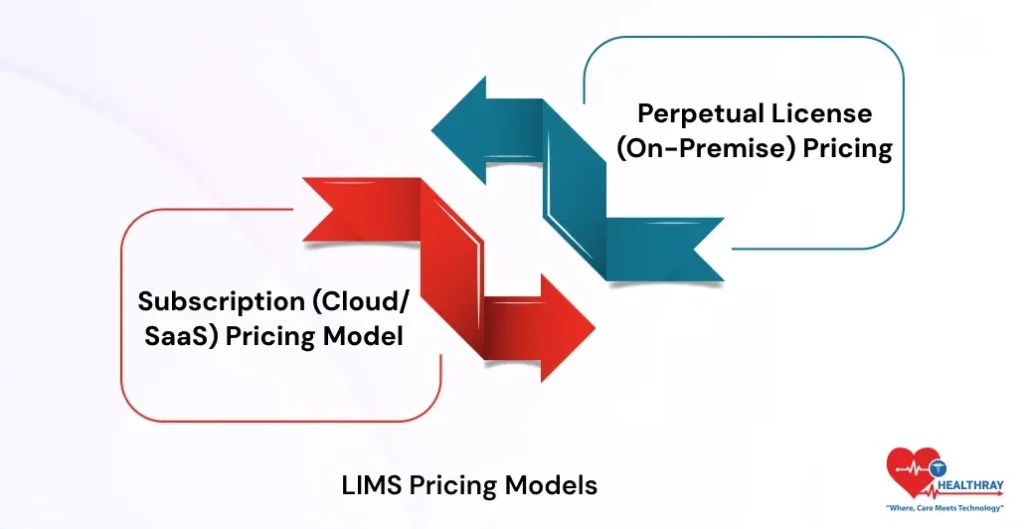
LIMS pricing models are of two types: subscription (SaaS / cloud) and perpetual license (on-premise). Both pricing models are different and exhibit different cost structures and payment methods. Further, labs can customize the plan as per their technical needs, lab size and financial constraints.
1. Subscription (Cloud/SaaS) Pricing Model
In a subscription model, labs purchase software on a monthly or yearly basis. Further, cost varies for every service provider. But typically, it will cost you around $25 to $1,600 per user per month. This model is perfect for small and mid-size clinics, as initial investments are lower.
2. Perpetual License (On-Premise) Pricing
Perpetual license model is basically a one-time purchase. The software can be purchased once and used indefinitely by clinicians. Further, the initial cost is high, ranging from $10,000 to $500,000. Additionally, clinics have to pay an annual maintenance fee of 20–25% for updates and support.
Cost Reduction as per Team Size
One of the main advantages of Cloud LIMS is that costs decrease when user numbers rise. Further, it provides immense pricing benefits to large labs.
- Bulk user pricing: if a lab hires many users, then vendors usually offer a discounted per-user price. For example: In the case of 50 users, the cost gets minimized to around $66 per user.
- Better scalability: As the LIMS system grows, clinics can easily scale the features.
- Budget-friendly: Lab becomes manageable and affordable for large teams.
LIMS Pricing Guide: Cost Breakdown
1. Total Cost of Ownership (TCO)
LIMS total expenses are not just limited to software pricing. Further, TCO is usually calculated in the period of 5-6 years. It includes software, implementation, training, support and infrastructure costs. It is crucial for labs to thoroughly understand TCO to avoid any ambiguities in the future.
2. Software License and Subscription Cost
Software licenses and subscription fees account for 40–60% of LIMS’s total cost. Further, if a lab relies on a cloud-based LIMS then they need to pay monthly or yearly subscriptions. It gets changed according to cost features, number of users and vendor.
3. Small Labs vs Enterprise Pricing
Pricing varies for different sizes of labs. For small labs, LIMS subscriptions are usually $500–$1,000 per month. Further, for large enterprises or research labs, cost may go up to $50,000 per year or more. As clinics require advanced analytics and integration features in LIMS, this will increase the cost as per lab standards.
4. Hardware and Infrastructure Cost
If clinics use cloud-based laboratory systems, then the hardware upfront cost is almost zero, as the entire system runs on the vendor’s server. Further, if clients purchase an on-premise LIMS, then they need to buy their own servers and IT infrastructure setup that costs more than $50,000 per year.
What are the Common Hidden Costs in LIMS?
There are some hidden costs included in the budget of LIMS implementation. The reasons behind these hidden costs are services, downtime, integrations, and scalability requirements. Let’s understand more about it:
1. Implementation and Customization Cost
To align the LIMS system with the actual lab workflow, implementation and customization are highly critical. This will cost clinics around $10,000 to $100,000+. Further, simple onboarding can be around $15K but if clinics add integrations or data migration, then the cost will increase up to 20–50%.
2. Training and User Adoption Cost
To successfully implement LIMS adoption, clinics should provide practical training programs to lab staff. Furthermore, initial training cost will include $5,000–$20,000 and yearly refresher training cost will increase up to 5-10%. If training is not proper, clinics may face challenges with user adoption.
3. Data Migration and Integration Cost
Transferring data from old spreadsheets and legacy systems is an unavoidable step. Further, data migration can cost $10,000–$50,000, simply because it includes data cleaning and mapping.
4. Compliance and Validation Expenses
Regulated labs mostly follow NABL and FDA standards. Further, they need to do additional validation and audit processes as well. Compliance or validation activity costs can range from $20,000 to $100,000, especially when clinics include GAMP 5 validation.
Step towards digital era with our healthcare solution
Revamp your hospital facilities and embrace change for better healthcare management. Ease in managing and organizing large medical datasets leads to effective analysis. Seize the opportunity now!
How to Calculate Total Cost of Ownership?
Labs should evaluate initial cost + yearly operational cost (OPEX) to evaluate TCO for 5 years. Further, cloud-based laboratory systems are usually 20-40% cheaper than on-premise systems, as hardware and maintenance costs are substantially lower.
How to Reduce the Hidden Cost?
LIMS for pathology labs can use some smart strategies to reduce hidden costs. Let’s check out:
- Choose a no-code saas LIMS that provides an easy customization option.
- First implement a small pilot project, then focus on full rollout.
- Stay clear of vendor SLAs and service limits.
- Add a 20% contingency buffer in the budget.
Additionally, by following the above strategies, clinics can conveniently control their budget and set themselves to attain a long-term ROI.
 PRO TIP
What are the Common pitfalls in LIMS budgeting?
1. Leaving out Total Cost of Ownership (TCO)
Many labs just discover the initial price of software and make long-term decisions. However, actual cost includes implementation, training and maintenance. This enhances the project budget.
Solution: While selecting the LIMS, evaluate 5 years of TCO models. Cloud SaaS systems are 20-40% cheaper than on-premise systems.
2. Underestimate Implementation and Hidden Fees
Many labs just focus their budget on software licenses but ignore data migration ($10K–$50K), integrations ($5K–$25K), and customization costs. Further, if clinics further integrate new features into the lims software, this can raise the budget up to 30%.
Solution: Define your lab requirement at the initial stage and introduce each implementation in sequential order.
3. Calculating wrong cost of On-Premise and Cloud Platform
Few labs think on-premise solutions will cost them less as compared to cloud platforms. They ignore IT upgrades and hardware costs. They need to refresh the server in 3 to 5 years; this costs them more.
Solution: Compare cloud LIMS operational cost (OPEX) models that provide flexibility and scalability for the long term. Also read our blog, data analytics in LIMS to know more.
 NOTE
NOTE
What are the Top Practices to avoid LIMS Scope Creep?
Sometimes, clinics add extra features and deliverables without planning in the LIMS project. This results in scope creep. This problem increases the project budget by up to 30-50% and also prolongs the ROI. Let’s check some best practices to avoid it.
1. Define project scope initially
Clinics should clearly define lab workflows, data requirements and KPIs before LIMS implementation. Map the entire process from sample intake to reporting. This minimizes the incorporation of unnecessary nice-to-have features in the LIMS project.
2. Use MVP (Minimum Viable Product) Approach
Initially, clinics should begin with implementing high-priority features such as sample tracking and reporting. Clinics can integrate advanced features such as analytics in the later part of project development. This helps clinics to keep the project development simple and feasible.
3. Make Formal Change Control Process
If clinics receive a new request in the middle of the project, evaluate its impact on the timeline, budget and resources. Note down all the change requests that happened during the development phase and get approval from the project manager. This reduces uncontrolled changes in the project development cycle.
Conclusion
When investing in LIMS implementation, clinics should also consider pricing models, vendor selection and implementation planning. If planning is right, then clinics can achieve a higher ROI in just 1-3 years. A lab’s actual cost is not just about software price. Factors just as Implementation, training, support and integrations affect the Total Cost of Ownership (TCO).
The Healthray platform provides flexible pricing and easy scalability and it is a popular cloud solution for all business sizes. Connect with Healthray to know more.