


Summary
In pathology labs, collecting samples is one of the most crucial steps. A small trust can impact the patient’s trust. Furthermore, the LIMS system makes the daily workflow simple and organized. Laboratory software tracks everything digitally from sample gathering to final report submission. This minimizes the delays, reduces the errors and expedites the reporting process. Lab staff get relief from unnecessary paper workloads and managers get real-time visibility of entire operations. Simply put, LIMS makes the pathology lab operation productive, dependable and oriented toward patients and helps professionals deliver the reports confidently. In this blog, I’ll go over how integrating LIMS in pathology labs streamlines intricate lab procedures and makes it easier for experts to compose reports quickly. Keep reading!!!
Introduction
Healthcare and diagnostic industries are rapidly transforming. Laboratories are now not just limited to generating test reports. Lab specialists have to manage accuracy, speed, conformity and data integrity at the same time. Traditional on-premise systems are barely capable of enduring such pressure. Infrastructure costs were high, maintenance were complex and data access was also restricted. It is high time for lab specialists to adopt LIMS for pathological labs
Laboratory management information systems eliminate manual documentation and fragmented records; this minimizes manual errors in the system. LIMS provides a centralized digital ecosystem that is adept at handling sample tracking, reporting, billing, inventory management and compliance. Laboratory software eliminates the need for maintaining the server independently. This minimizes the administrative burden and operational cost of the lab departments.
Smart automation streamlines the sample lifecycle from registration to testing and final report delivery. For multilocation labs, cloud LIMS accessibility is a major advantage, as authorized users through secure login can access the data from anywhere. LIMS is not just a technological upgrade; beyond that, it’s a strategic step for improving operational productivity, regulatory adherence and financial accuracy. Next, I will discuss why pathology labs are adopting LIMS platforms and how this shift helps them achieve fruitful outcomes.
Key Workflow Optimization Features
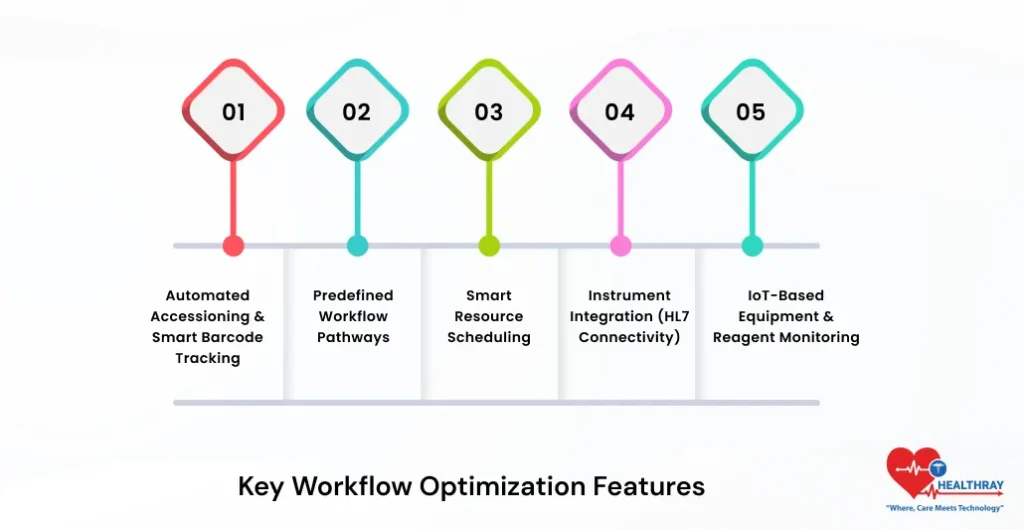
Automated Accessioning & Smart Barcode Tracking
In a lab environment, every sample is a responsibility. Further, it is crucial for lab specialists to accurately track the sample. In the traditional system, lab specialists have to manually check all the sample tracking which causes delays and increases the possibility of error. LIMS, through the automated accessioning process, makes the sample tracking faster and free of errors. Once the specialist receives the sample, the LIMS system automatically assigns an RFID tag and barcode to that sample. Moreover, lab software automatically logs all the movement from collection and testing to final delivery. Thus, it eliminates the need for maintaining registers manually and prevents sample misplacement or mix-up.
Predefined Workflow Pathways
In pathology labs, consistency is highly important. Furthermore, every test has to follow a proper process before delivering the final reports to patients. LIMS sets a standard workflow procedure; every sample of patients, from sample registration to validation, automatically moves to a fixed sequence. This minimizes unnecessary confusion and helps specialists maintain strong SOP compliance in the practices. If anything relevant accidentally skips out, lims system automatically sends alerts to notify specialists to address the issues beforehand.
Smart Resource Scheduling
In the lab department, workloads are never stable. Sometimes routine samples are high; sometimes urgent oncology or critical cases show up. Furthermore, LIMS through smart resource scheduling features assigns technicians, instruments and priority samples. In the traditional system, it becomes difficult for the lab department to assign samples to the right specialist. Moreover, lims system can instantly identify high-priority cases and flag them in the system. This minimizes delays and maintains balance between human and machine workloads. Overall, it improves throughput and assists labs in maintaining predictable operations. Also, read our blog on lab cost reduction strategies to get a comprehensive idea about LIMS.
Instrument Integration (HL7 Connectivity)
Modern pathology uses multiple instruments such as microscopes, hematology analyzers, biochemistry machines and sequencers. Furthermore, LIMS interfaces with these devices through bidirectional HL7 connectivity. Once the test results are completed, lims system automatically updates them in the system. It relieves the work pressure on staff to enter data separately in the system. This minimizes transcription errors in the system. Overall, this smart automation makes the reporting fast, comfortable, reliable and accurate.
IoT-Based Equipment & Reagent Monitoring
Lab operation works smoothly only when the machine operates smoothly and reagents are available timely. Furthermore, IoT-based monitoring systems constantly log equipment uptime and reagent levels. If any analyzer requires maintenance, then reagent stock becomes low. System automatically sends alerts to specialists. Moreover, this proactive approach circumvents sudden interruptions and testing delays. It avoids last-minute panic of staff. Beyond that, it makes the overall workflow intuitive and highly effective.
Advanced Reporting Capabilities
SMART & Customizable Reports
Pathology reports are not just a single document type; instead, they are a reflection of lab credibility. Furthermore, LIMS boasts smart features and helps lab clinics to present the reports to patients in a professional and simple way. The lab department can add their letterhead, headers, footers and branding elements to make the reports consistent and trustworthy. Moreover, in complex cases such as Oncopathology ,lab specialists can attach embedded micrographs that visually support the diagnosis. Structured data and written interpretation automatically get aligned to make the report more concise, comprehensive and suitable for auditing. Meanwhile, labs can efficiently make social media posts to share insights and updates online.
Structured Interpretation with Compliance
In a pathology report, compliance is highly important along with accuracy. The LIMS system efficiently follows WHO and NABL guidance and provides a structured reporting format to lab specialists. As a test result enters the system, interpretation sections automatically get loaded on the basis of relevant data. Furthermore, this helps lab specialists maintain coherence and uniformity in the report. Doctors get clear, standardized and audit-capable reports without doing any manual presentation or repetitive editing. Additionally, it saves considerable time and avoids the pitfalls of compliance complications in the future.
Instant Sharing via SMS, Email & WhatsApp
In today’s digital era, patients are expecting fast results. In the traditional system, patients have to wait long to collect their test results. They have to call or visit hospitals several times to get the reports and seek consultation with doctors. Furthermore, LIMS allow lab specialists to instantly share the patient report through SMS link, Email and WhatsApp. This minimizes the unnecessary lab visits. In critical cases or urgent cases, these fast services directly impact patient care. Moreover, reports come with a digital signature and QR code that ensure authenticity and impermeable verification.
Easy Addendums & Bulk Updates
In the pathology department, sometimes specialists need to add additional findings or perform corrections to existing information. Through addendums, features of AI-powered LIMS system software, you no longer need to edit the entire report again. In the traditional system, lab professionals have to prepare the reports multiple times or rectify errors if an issue arises. This consumes considerable time and delays the process. Further, the LIMS system attaches a secure update with existing reports. This allows specialists to maintain transparency and record continuity. Moreover, specialists can make corrections in multiple reports through lims software. Additionally, Lims automatically processes such bulk data, which minimizes the administrative workload and properly organizes the documents.
 PRO TIP
Analytics-Driven Dashboards
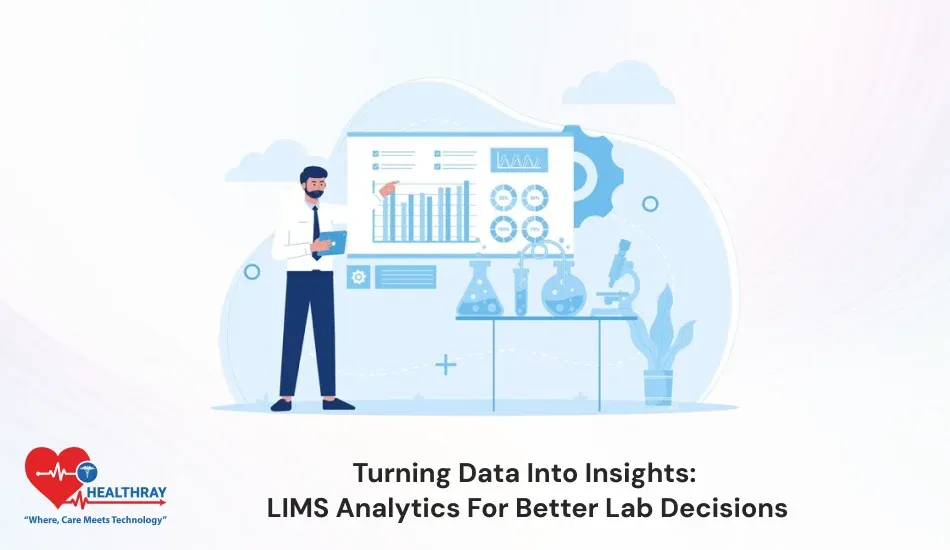
Data is not sufficient to understand the lab operation thoroughly. Clinics need clear visibility to derive powerful insights from them and plan next actions accordingly. LIMS visual dashboards present all the lab data, such as TAT (Turnaround Time), error rates and daily test volumes into simple charts and graphs. Furthermore, the manager can easily see the delay points and which tests are creating high workloads. Additionally, predictive analytics help lab specialists to know more about future no-shows and estimation of revenue trends. This helps lab departments make the strategy concrete and tangible.
Step towards digital era with our healthcare solution
Revamp your hospital facilities and embrace change for better healthcare management. Ease in managing and organizing large medical datasets leads to effective analysis. Seize the opportunity now!
AI-Enhanced Quality Assurance Loops
AI-Driven Quality Validation
Quality control is the backbone of pathology labs. Traditional QC is just limited to basic checks. Sometimes, manually qc overlooks subtle issues. On the other hand, AI LIMS automatically compare strain quality with predefined golden standards. Furthermore, if any uncertainties, such as uneven staining and blurry artifacts, are detected on the H&E slide, lims immediately flags the issue and reports it to a pathology specialist. Moreover, this proactive validation minimizes rework and avoids reporting delays. It improves the final diagnosis accuracy and trustworthiness.
Proficiency Testing (PT) Auto-Integration
Quality improvement is a continuous journey. And proficiency testing is an important part of it. LIMS automatically imports the external PT programs, such as CAP surveys. Lab performance benchmark with peer laboratories through z-score. Additionally, this gives management a clear picture of their performance in the cutthroat market. Moreover, the system suggests targeted retraining if underperformance is detected in these parameters. This makes the learning more focused and gradually improves the diagnostic quality.
Inter-Pathologist Consensus Platform
Few pathology cases are highly complex; they require experience and multiple opinions. LIMS in-app consensus platform automatically routes the complex and ambiguous cases to senior panels. Furthermore, experts can easily record their observations and votes in a structured format. Furthermore, this makes the discussion more transparent and ensures that all points of view are properly documented. Final diagonsis become more optimistic, balanced and clinically resilient.
 NOTE
NOTE
Conclusion
In 2026, pathology labs are not just software; they are the core engine of lab transformation. Smart automation streamlines sample collection and reporting. Patients receive quick reports, and doctors can make concrete decisions. Healthray pathology-based software incorporates business automation, telepathology hubs and revenue blocker features to provide an end-to-end operational ecosystem. It helps pathology labs to achieve operational efficacy as well as financial growth.