



Brief Summary
In the evolving fast-paced landscape, attaining efficiency is incredibly challenging. Modernizing the lab environment is equally important for patient retention and satisfaction level. These advancement aids to optimize lab processes, multiply productivity rate, and strengthen information. From specimen, reporting to billing, every task is managed like a master. Catch a glimpse on the blog below.
Introduction
Laboratories require precision in work, otherwise their hours of work are wasted. All ranges of labs have one mission, improving lab workflows. Each type of laboratory has its own reason like medical laboratories want lab process efficiency for maximizing return and environment labs for in-depth discovery that benefits the society in large.
However, the medical laboratories have already taken the steps to reinvent ways of accomplishing efficiency and upgrade lab workflows. Based on 2023 research, 65% medical research organizations and 70% pharma companies are harnessing a LIMS system.
It combines fragmented laboratory details into a single one, processing with advanced principles for forecasting needs.
The advanced way to deal with the steps of lab workflows, helps in accurate reporting, accuracy in collecting payments, generates compliance-based reports, and creates instrumentation reports. Furthermore, the AI-based algorithms and electronic medical record in labs helps in analyzing subtle patterns in reports, suggesting medical technologies while creating reports, and aids in operational excellence.
Enforcing LIMS Solution For Improving Diagnostic Lab Workflows
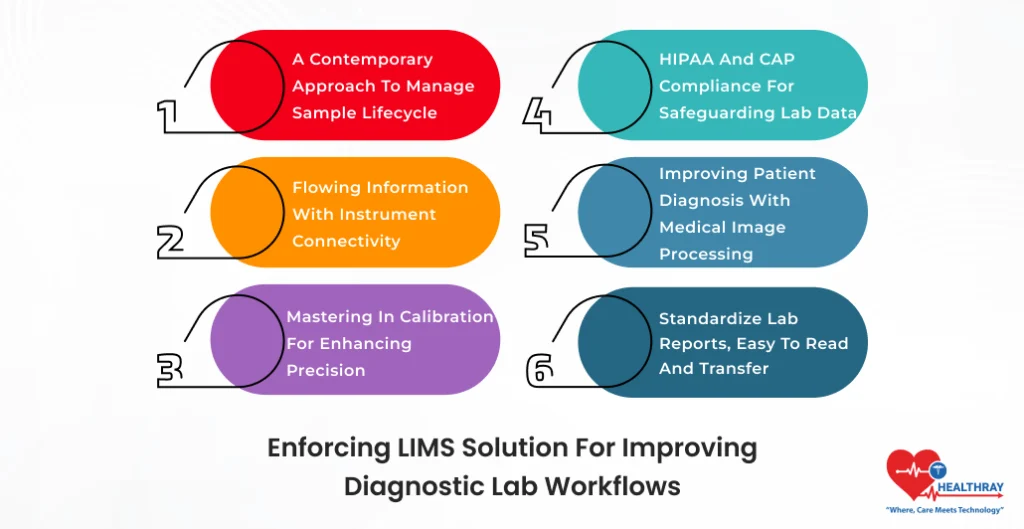
Thinking about efficiently expediting the diagnostic lab workflows? But, unable to do so. Here is a simple hack for you, the laboratory information management system that turns complex activity to simple duty. Let’s understand how LIMS system helps in optimizing diagnostic workflows efficiency :
A Contemporary Approach To Manage Sample Lifecycle
A sample management in the laboratory is an intricate process, requiring utmost precision while conducting it. Furthermore, the LIMS system helps to know where your sample is or which one is in the testing process now. Check it below for how :
- Assimilating sample information with label ID
- Record the movement of lab samples
- Creating barcode that embed on sample tube
- Have rules for safely disposing of samples
The sample management requires high-precision in the lab results, simplifies to adhere with lab standards, easily shares the sample workflow report to senior professionals, and increases patient confidence.
Flowing Information With Instrument Connectivity
The lab information management system easily connects with the available lab instruments, helps to quickly flow information from instruments into a platform. Let’s evaluate the benefits of instrument connectivity in laboratories :
- Quickly get data in the platform
- Minimizes workforce efforts
- Support in real-time monitoring
- Improving output and efficiency
It helps in generating automatic instrument reports that abides with protocols, transferring to public health departments. Therefore, it improves test results and efficiency.
Mastering In Calibration For Enhancing Precision
If your laboratories are involved in labs, you may realize the calibration importance. There are several LIMS systems in the market, which help in calibrating instruments. Let’s check how it helps in calibrating instruments :
- An electronic register stores all details from barcode to location
- Records calibration process, ensure it follows by each staff
- Easier to tally instruments readings, whether it follows standards
- Analyze calibration past data to know future maintenance needs
Additionally, it provides reminders for instrument calibration and aids to tracing the calibration procedure for instantly checking the real-time status.
HIPAA and CAP Compliance For Safeguarding Lab Data
Storing the large laboratory information in the excel is not safe any more. You have to go for the lab automation management system that completely reinventing the diagnostic lab workflows, abiding with regulations throughout the process. It is mandatory for various reasons :
- Increasing confidentiality and gain patient confidence
- Preventing data fraud, wastage, and reduces risks
- Tightens the security even for the internal team
- Accuracy in examining hidden information patterns
With these security laws, governments want to increase faith among patients to use an e-lab system. Also, it generates standard laboratory bills and other documents to reduce risks and enhance efficiency level.
Learn more: Digital Labs 2026: Zero-Paper Future
Improving Patient Diagnosis With Medical Image Processing
Archives different types of healthcare images including X-rays, CT-scan, and MRI’s.
Moreover, lab managers and assistants can oversee stored medical images from anywhere and any digital device.
Stores images sequentially as the track continues in the workflows. You can do more with medical image beyond seeing :
- Seamlessly edit, crop, and annotate medical images
- Highlighting in the radiology with the diverse range of shapes
- Leveraging convolutional neural networks for inspecting any anomalies
- Easily downloaded, shared, and get a hard copy of medical images
In case of transferring a patient case, the other clinical provider easily comprehends its medical condition and swiftly initiates for next steps.
 NOTE
NOTE
Standardize Lab Reports, Easy To Read and Transfer
Flexible templates that are easily shuffled based on the necessity, applying made it more simpler. Moreover, it minimizes human errors, increases consistency, and enhances data reliability.
- Digital lab templates are easily stored and shared
- Record lab information with 3x speed and accuracy
- Attend more patient beyond the traditional lab setting
- Support in collecting information and fetching faster
These templates increase lab efficiency, saves workforce time, preserves energy, and helps in analyzing quickly.
Using AI, Ml, and DL Algorithms For Predicting Lab Outcomes
There are many ML and DL algorithms, utilized for creating models such as support vector machines (SVM), random forest, logistic regressions, K-means clustering, gradient boosting, and decision trees. Moreover, these models help in anticipating lab outcomes. Let’s understand what is the use of AI and ml in the smooth laboratory workflows :
For Examining High-dimensional Information
When you work in the scientific research laboratories, an enormous diverse range of information is available. Moreover, the right AI and ML algorithms utilized for dimensionality reduction and understand data in the simplest format.
- Converting image information into the machine readable format
- Reducing the high dimensional images into lower using t-SNE algorithms
- Understanding the subtle patterns of high-end information
- Examine large samples for decision-making procedure
Analysis Lab Data For Meaningful Conclusions
- Create the smart lab workflows with the progressive AI and ML algorithms
- Examining any kind of laboratory information, regardless of its length
- Generating meaningful conclusions after sorting and analyzing large sets of data
- Easily examine experimental conditions for anticipating results
Combines Multiple Data For Navigational Aids
Modern laboratories are able to handle complex diagnostic lab workflows due to properly controlling meta clinical lab details. Moreover, AI in LIMS software creates an impressive exhaustive e-lab environment, vanquishing mistakes, and retrieving any past or current data while conducting experiments.
This lab information is placed in the structured format, which makes it more smoother to fetch details.
Learn Past Information For Anticipating Future Results
- AI and ML algorithms have beyond one’s imagination capabilities
- Applies varied principles to comprehend the insightful data
- Learn from the past patterns that helps in forecasting future patterns
- Specific conditions have been applied on new data before inspecting
Seamless Incorporation With LIS and EMR System For End-to-End Workflows
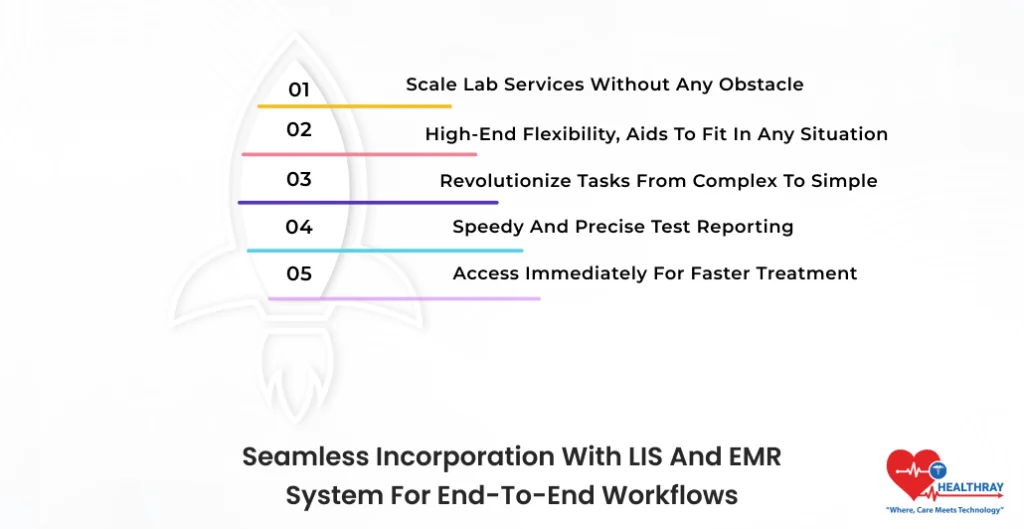
Want to manage end-to-end lab workflows? And, terribly confused, how it is possible to do. Might this be your unfulfilled wish? No worries, the merging of lab information system and electronic medical record system remove these problems :
Scale Lab Services Without Any Obstacle
- The electronic medical record reaches a wide network where professional service is not available.
- Enable to store varied kinds of meta details in the structured format, easily monitored from distant locations.
- Patients, physicians, and lab technicians seamlessly connect at the same time, transferring information with ease.
 PRO TIP
High-end Flexibility, Aids To Fit In Any Situation
When you combine LIS+ EMR, you will get unmatched efficiency. There are multiple reasons for that, undoubtedly flexibility is the primary one. Furthermore, the main indication of flexibility, smoothly transfers lab details across lab systems.
Therefore, it speeds up the lab workflows, improves laboratory performance, protects data silos, and enhances lab practice.
Revolutionize Tasks From Complex To Simple
In laboratories, you will find 70% complex tasks, the rest are simple ones. When you use the electronic medical record with cloud-based LIMS software, it becomes easy for you to conduct entire diagnostic lab workflows because it supervises variety of tasks such as :
- Automates scheduling service
- Quick alerts and reminders
- Manage instrument information
- Drafting medical invoicing
- Properly track lab information
- Ease to abide with lab protocols
Speedy and Precise Test Reporting
Electronic medical records have the custom template module, which helps in creating documents with the drop-down click. Furthermore, it generates long formats of test reports, which have negligible errors and eradicate duplicate terms.
You will need the electronic medical record system from order processing, billing, sample tracking to results.
Access Immediately For Faster Treatment
- Lab personnel create reports in the LIS system, instantly shared to the physicians
- Fetching the right lab information at the perfect time, swiftly conducted next steps
- Exchanging information with one click, minimizes confusion and saves time
- Complete handling of documents and finding speedily for faster treatment.
Conclusion
All ranges of laboratories have a single objective, maximizing workflow efficiency. For this, the modern lab optimizes their procedure from specimen management, report management, compliance, calibration to medical billing. Moreover, this can be done with enforcing the LIMS solution, integrating AI and ML algorithms for predicting outcomes, and merging LIS + EMR for improving end-to-end workflows. Therefore, it improves efficiency level, increases lab performance, and enhances productivity. Also, it enhances patient engagement or attrition rate.