


Summary
It is imperative to maintain regulation at every single approach to lab practices. Do you think a manual system is capable of ensuring data security or accountability? Who will take the responsibility if any unauthorized user accesses the sensitive records? To combat such stressful scenarios and build a risk-free culture in lab systems, LIMS provides a smart solution by automating audit trails, encrypting data, and controlling user access while strengthening LIMS compliance and standards.
Are you still governing the operation with outdated approaches of maintaining compliance? In 2026, maintaining compliance with manual approaches will not give you efficient outcomes. It’s the right time to upgrade your software with automation and cutting-edge digital tools. In this blog, I will discuss how LIMS software helps you follow strict regulations and standards in every phase of lab practices. Keep Reading!!
Introduction
Compliance is not just a regulatory formality. It has become a foundation for establishing patient safety, data confidentiality, and laboratory trustworthiness. Sensitive patient data is linked to the numerous samples that each laboratory processes on a daily basis. It is highly imperative for clinics to keep the patient data accurate, discrete, and properly documented. If clinics fail to ensure LIMS compliance and standards, it increases the risks of incorrect documentation, legal possibilities, or regulatory fines.
Therefore, laboratories should strictly follow NABL, CAP, and other healthcare standards to maintain a smooth culture and build friendly environments. In a traditional system, clinics rely on manual paperwork, fragmented documentation, and restricted access and control. Additionally, clinics find it challenging to monitor and retrieve every single detail of an individual using the system, making and removing changes. This lack of visibility creates compliance gaps. Enhances the risks of data breaches and regulatory violations.
Laboratory Information Management Systems provide dependable and digital solutions that support LIMS compliance and standards. By implementing lab compliance, laboratories can easily follow compliance standards at every phase of their practices without taking on hardships and incurring expenses of execution. Overall, LIMS provides a secure platform to deliver high-quality diagnostic services at optimal expenses.
Key Global LIMS Compliance and Standards
1. FDA 21 CFR Part 11
FDA 21 CFR Part 11 compliance ensures keeping the laboratory’s electronic records and digital signatures fully encrypted on a password-protected server. In a traditional paper-based system, clinics face high possibilities of record tampering.Through FDA 21 CFR Part 11, clinics can properly authenticate electronic entries while aligning with LIMS compliance and standards and record the entire workflow with audit trails. Further, laboratories can easily track all the service action, time, data and changes being made. Additionally, it helps lab divisions maintain strong integrity, regulatory conformity, and legal reliability.
2. ISO/IEC 17025
ISO/IEC 17025 compliance helps lab centers to meticulously comply with dependable, trustworthy, or empirically approved testing approaches. Furthermore, traditional systems face challenges with inconsistent protocols and documentation gaps. This increases the quality risks in the system. Through ISO/IEC 17025 standards, laboratories can maintain proper calibration, procedure evaluation, and result traceability while ensuring LIMS compliance and standards. Moreover, these standards ensure test results remain legitimate. Help laboratories demonstrate competence and thoroughly comply with regulatory and accreditation necessities.
3. GLP, GMP, and GxP guidelines
GLP, GMP, or GxP guidelines ensure that laboratory or pharmaceutical centers strictly adhere to standardized, controlled, or fully documented approaches. In manual systems, clinics face challenges with insufficient documentation and process deviations. Further, this enhances the risks of data integrity in lab practices. Through GLP, GMP, and GxP guidelines, lab centers can properly monitor and record operations in line with LIMS compliance and standards. Moreover, this ensures research and testing data remain reliable and readily identifiable and conform to regulatory guidelines.
4. CLIA and CAP
CLIA or CAP standards ensure that clinics’ laboratories should perform accurate, consistent, and high-quality diagnostic testing. Conventional systems have problems with quality control and documentation gaps. This increases the risks of inaccurate results. Through CLIA and CAP standards, laboratories can thoroughly observe quality checks, proper confirmation, and continuous monitoring. Furthermore, CLIA and CAP ensures patients’ reports remain dependable. Clinics can effectively maintain diagnostic accuracy while confidently meeting regulatory standards through LIMS compliance and standards.
5. HIPAA compliance
HIPAA compliance ensures patient health information remains secure and protected from theft and third-party applications. Traditional software often faces risk with unauthorized access and data leakage due to the absence of appropriate access surveillance. Through HIPAA compliance, laboratories can implement stringent data security protocols, encryption, and access limitations aligned with LIMS compliance and standards. Further, they ensure only authorized persons can log in to the dashboards and make access to sensitive information. Additionally, clinics can maintain complete patient confidentiality, data integrity, and regulatory enforcement in the lab practices.
6. NABH and NABL accreditation
NABH and NABL accreditation ensure Indian laboratories should comply with the practices with standardized specifications and compliance procedures. In conventional software, inconsistent operations and documentation gaps enhance the risks of regulatory rules and regulations. Through the NABH and NABL frameworks, the lab division can efficiently assure proper documentation, quality management, and process accountability in the practices. Additionally, it ensures lab operations remain reliable under LIMS compliance and standards. Laboratories become fully compliant and credible by obeying national regulatory necessities.
 PRO TIP
How LIMS Compliance and Standards Ensures Data Integrity?
1. ALCOA+ Principles Provide Strong Data Integrity
ALCOA+ principles are critical in ensuring the reliability and transparency of laboratory data. Manual systems often face uncertainties with entries; sometimes lab specialists enter duplicate records and sometimes they forget to enter relevant information. Additionally, improper tracking creates confusion and fails to obey compliance at every approach. LIMS helps clinics maintain transparency in the system while supporting LIMS compliance and standards. It properly records all the user actions. Further, it supports clinics to properly maintain the data and they can easily approve it whenever necessary. Laboratories can conduct their day-to-day activities peacefully and simultaneously maintain regulation.
2. Tamper-Proof Records
Tamper-proof records guarantee that the operations of your laboratory are safe and that no one can alter the data without permission. In a manual system, it is highly challenging for lab clinics to detect data manipulation.Further, LIMS automatically maintains secure and immutable logs in accordance with LIMS compliance and standards. Whatever changes are being made by the user are permanently recorded in the system. Moreover, this helps laboratories easily track any major updates. Overall, lab software ensures complete data confidentiality, visibility, and regulatory adherence. Read our blog to know more about the importance of sample tracking software and how it efficiently eases lab practices.
3. Version Control
The LIMS’s version control features assist clinics in making sure that modifications are accurately tracked and validated. If the record is inadvertently altered, is it possible to restore the original version? In a manual system, this process is highly difficult. However, with LIMS , the lab team can easily recover the original records. Further, Lims automatically preserve the previous versions. This helps laboratories to easily compare, investigate, or reconstruct. Additionally, Lims helps lab sections maintain transparency and improve accountability. It naturally improves the patient satisfaction and makes them feel comfortable engaging with your services.
How do Audit Trails and Reporting Maintain transparency in the system?
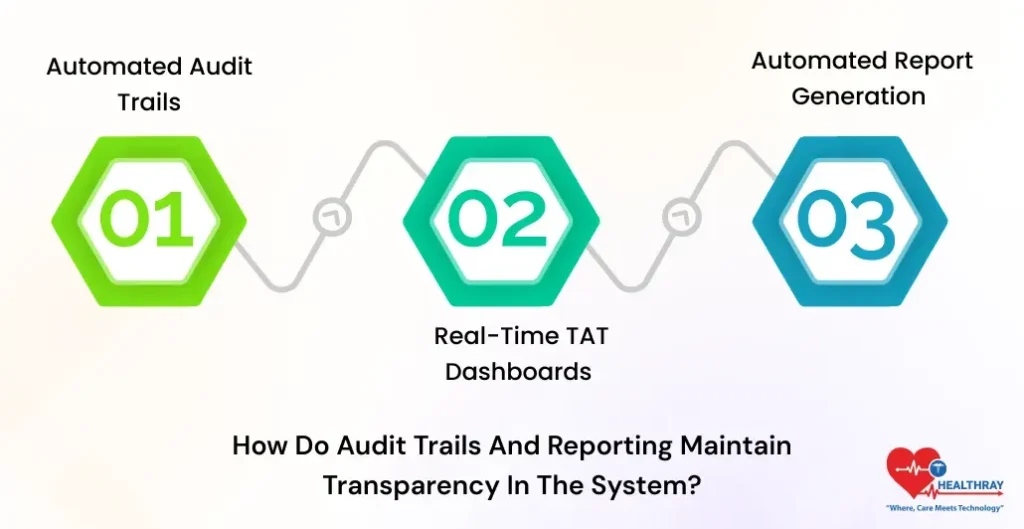
1. Automated Audit Trails
Automated audit trails play a critical role in maintaining compliance and transparency in the system. Traditional software records every activity manually. It makes it difficult for clinics to maintain proper records. Furthermore, LIMS automatically records every system interaction, such as data registration, adjustments, or approvals. Lab sectors can now conveniently observe all user behaviors, including their name, date, and time. Overall, automated audit trails ensure:
- Provide complete traceability.
- Ease compliance management
- Minises errors
- Reduces the burden of regular evaluation and quality checks.
2. Real-time TAT dashboards
Real-time TAT dashboards enable clinics to continuously monitor the laboratory workflows. This helps clinics improve operational visibility. In traditional software clinics, track the turnaround manually. Further, this makes it difficult for clinics to identify delays. The LIMS dashboard clearly displays sample evaluation progress, pending tests, and completed reports. This helps laboratories easily identify the following:
- Help the lab identify bottlenecks that are barriers to progress.
- Optimise workflow
- Ensure reports get delivered timely.
- Improve the efficacy of practices
- Provide quality services to patients.
3. Automated Report Generation
Automated report generation makes the lab approaches more accurate and reliable. In a manual, paper-based system, staff have to prepare the entire reports manually. They fetch data from different sheets to extract useful information and present it to management. This was a time-consuming process and the risks of human error are higher. Furthermore, lab management software automatically generates test evaluations, compliance assessments, and audit documents. This helps lab departments:
- Significantly reduce manual workloads
- Maintain document consistency
- Improve efficacy
- Minimise errors
- Laboratories can easily fulfill regulatory standards.
 NOTE
NOTE
How does EHR Integration Ensure Secure and HL7-Compliant Data Exchange?
EHR integration ensures secure, fast, and fully standardized data exchange among laboratory and healthcare systems. Further, in conventional systems, the lab shares reports manually. This increases the risks of delay and mismatched entries. LIMS software can smoothly incorporate with ehr system and ensure every approach follows HL7-Compliant standard rules. Thus, it makes the data exchange among different departments more accurate and consistent. Clinics no longer need to gather information via emails or through paper records. Additionally, it helps lab departments:
- Patient information is easily accessible.
- It ensures seamless collaboration.
- Expedite the report generation process
- Reduce waiting time of patients
- Ensure compliance in every step.
Conclusion
LIMS prevents unauthorized access and compliance gaps and provides complete data protection in the system while reinforcing LIMS compliance and standards. Further, automated compliance provides stress-free operations and long-term regulatory confidence. Platforms like Heathray make the laboratory practices secure, practical, and ready to thrive in the evolving regulatory landscape.