


Summary
No hospital can function without interoperable systems anymore. Interoperability in HMS ensures that all departments – from ER to billing offices – operate using just one single platform for instant and accurate data transfers. The result is more secure healthcare services provided to patients since everyone uses only one set of current data. It means no more manual chaos in managing data across isolated platforms, no mistakes caused by delays in information exchange, and quicker access to any data required to make decisions.
Introduction
Consider this scenario: A patient comes into the emergency room, and the physician must be provided the laboratory reports from last week, along with a copy of the medications prescribed currently, and the patient’s list of allergies all of this within a short period of time. But alas, the laboratory information system, the pharmacy application software, and the patient database are not all integrated, and chaos ensues. This is the everyday occurrence in many medical facilities that have failed to integrate their systems seamlessly.
In the year 2026 and onwards, the health sector will be in an era where there is a need for instantaneous information sharing. National mandates like NPHIES in Saudi Arabia and NHIS in Ghana have made interoperability a legal requirement, not just a best practice. Hospitals are under growing pressure from regulators, patients, and insurers to adopt modern Hospital Management Software that communicates seamlessly – inside and outside their walls.
The purpose of this blog is to explain the meaning of HMS interoperability, its role in connecting hospital departments and external systems, the technology behind it, and finally, its importance to any HMS.
What Is HMS Interoperability?
HMS achieves interoperability when it can transfer and exchange information between departments, programs, and organizations without manual intervention or data loss. Interoperability in an HMS is achieved when the pharmacy, radiology, billing, and outpatient clinic modules all use the same updated patient data.
These are the four levels of interoperability in Healthcare IT:
- Foundational – Capabilities to exchange data (connectivity)
- Structural – Consistency in the structure of the data exchange between both
- Semantic – Semantic consistency in interpreting data
- Organizational – Policies, procedures and governance structures for continuous information exchange
An interoperable healthcare management system works at all the four levels. Not only does it exchange data, but it exchanges data that has real meaning and application to everyone from the nurse in ICU to the CFO of the hospital..
According to the ONC interoperability data only about 43% of U.S. hospitals routinely engage in full interoperability across the core functions of sending, receiving, finding, and integrating electronic health information and highlighting the ongoing need for interoperable systems.
How HMS Interoperability Bridges Hospital Departments
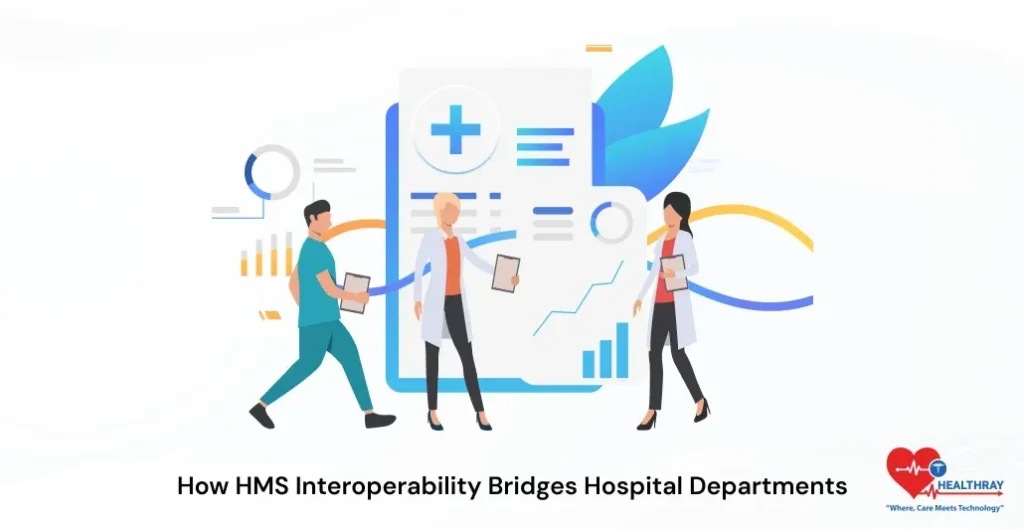
Seamless system integration allows hospitals to enjoy significant internal benefits even before sending data to the laboratory or health insurer.
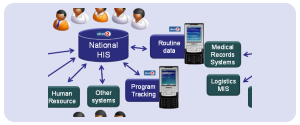
A modern hospital runs many parallel processes every minute: admission, diagnostics, surgeries, dispensing of medicines in the pharmacy, payments, and others. When there is no interconnection, each department works in isolation; but when the system integrates them all, they start functioning in harmony. Let us see how seamless system integration connects different hospital departments:
Emergency & Outpatient to Inpatient: Units As soon as a patient is admitted to an inpatient ward from the Emergency Department, all their medical records are transferred. There is no need for re-admission, no need for waiting periods.
Radiology & Lab Tests to Treating Physicians: The results of radiology and lab tests will immediately pop up in the dashboard of the treating physician as soon as they are signed off. There is no need for the doctor to call on the lab as the system does the work automatically.
Prescription to Pharmacy: The integration of the prescription module into the overall system allows real-time drug interaction checks to take place. Once a prescription is written, the system automatically checks whether the prescribed medicine interacts with existing drugs.
Billing to Clinical Departments: Each step of the procedure performed is automatically billed. There is no revenue loss due to missed coding or billing.
HR & Scheduling for All Departments: Staff rosters, certifications, and shift information are accessible across the hospital, enabling administrators to make real-time staffing decisions without relying on phone calls or spreadsheets – all through a centralized Hospital Workforce Management Software system.
This leads to a more efficient hospital that wastes fewer resources and offers better patient safety.
 NOTE
NOTE
Key Standards Powering HMS Interoperability
A seamlessly integrated healthcare system does not emerge on its own. Successful Hospital Management System integration relies on internationally recognized standards, ensuring HMS data interoperability across departments.
HL7 (Health Level Seven)
HL7 is the most traditional health data exchange standard. It provides for message structures exchanged by various systems, such as the automatic creation of a new record after admitting an incoming patient via the front-desk system.
FHIR (Fast Healthcare Interoperability Resources)
Developers created this more advanced version of HL7 for the digital age. As it operates using RESTful APIs, the integration of HMS platforms with apps, patient portals, insurance carriers, and other healthcare organizations becomes much simpler. The 21st Century Cures Act makes it mandatory to implement FHIR R4 API in certified hospital systems.
Open APIs (Advanced Solutions)
Today’s HMS systems use open APIs, letting hospitals combine advanced solutions without relying on a single vendor. An open-API approach enables seamless integration of EHR, PACS, LIS, billing, and telemedicine. This eliminates the need for extra middleware.
DICOM (for Imaging)
When it comes to radiology departments, DICOM provides standards for interoperability between different imaging systems and HMS systems in order to ensure the correct exchange of images such as X-rays, MRIs, CT scans.
Implementing these standards allows hospitals to achieve the benefits of hospital system integration, making interoperability scalable, manageable, and future-ready.
Real Benefits of System Integration: Clinical, Operational and Financial
System integration proves its significance when it delivers real benefits in three key aspects.
Clinical Benefits
- Reduced medical errors: With access to the current medical history of every patient, medical errors will be reduced, and the possibility of medication errors and allergy errors, unnecessary laboratory tests will be minimized.
- Quick diagnosis and treatment: Lab and specialist consultation reports will be instantly accessible in the doctor system; this will decrease the time taken to decide to several hours to minutes.
- Improved continuity of care: The patient will take his records everywhere since he can change doctors, departments or even a healthcare facility between hospital and outpatient clinic.
- Better management of chronic diseases: The integrated system enables longitudinal monitoring of patients and thus, it is easier to diagnose chronic diseases.
Operational Benefits
- Removal of data silos: The inefficiency that happens most in the operations of the hospital is the existence of data that is locked up in one system but not accessible by another system. Integrated systems eliminate such silos so that information can move freely through the departments.
- Less administrative workload: Employees do not spend as much time on handoff by using manual records, making phone calls, and paper-based handoffs. A Medscape study found 45% of doctors link burnout to poorly integrated digital systems. Implementing HMS interoperability simplifies workflows and reduces unnecessary tasks.
- Quick discharge operations: Discharge operations go through in minutes as opposed to hours when all the above are intertwined in billing, clinical documentation and pharmacy clearance.
- Real-time reporting: Hospital administrators can generate an HMS report or real-time dashboards covering all departments, enabling informed decisions based on staffing, inventory, and patient care capacity.
Financial Benefits
- Revenue leakage prevention: Automated charge capture that is associated with clinical workflow makes sure that all services are billed. Highly integrated hospitals record substantial decreases in unbilled or undercoded procedures.
- Sharper claims: Live eligibility checks and submit clean claims- only possible with interoperable billing and clinical modules- cuts down the rate of denials and speeds up payments.
- Reduced IT expenses: A highly integrated HMS with open APIs, backed by an effective Hospital Contract Management Software, will cost much less to maintain than a collection of fragmented systems with costly and fragile custom integrations.
- Less duplication: With real-time data sharing across the departments, duplicated lab tests and unnecessary imaging, one of the main cost drivers, are reduced by a certain measure.
Step towards digital era with our healthcare solution
Revamp your hospital facilities and embrace change for better healthcare management. Ease in managing and organizing large medical datasets leads to effective analysis. Seize the opportunity now!
What Makes System Integration Difficult – and How to Fix It
Although it has obvious advantages, seamless integration of systems is still a problem with most healthcare organizations. The first step to overcome such barriers is to understand them.
Challenge 1: Legacy Systems
Many hospitals still use older HMS platforms that were never designed for interoperability. These systems often require expensive middleware to connect with newer tools. Even then, data quality remains compromised.
Solution: Push HMS platforms that go beyond FHIR R4 support and have a robust API documentation. If replacing your entire HMS isn’t possible, adopt an integration engine like Mirth Connect. It enables communication between old and new systems.
Challenge 2: Data Standardization
Different departments may use varying terminologies, coding, or data formats. This makes it hard for systems to interpret similar data.
Solution: Implement common clinical terminologies (SNOMED CT, ICD-10, LOINC) in all departments. Select an HMS which implements standards on data entry, not only on data export.
Challenge 3: Security & Privacy Concerns
Increased connectivity equates to increased vulnerability to attacks. HIPAA, GDPR, and many other laws increase compliance headaches associated with each integration process.
Solution: Implement Role-based access in HMS along with end-to-end encryption and comprehensive audit logs as non-negotiable requirements in any integrated system architecture.
Challenge 4: Staff Resistance
Clinical and administrative employees often resist new systems, especially when they change workflows. Poor adoption can sabotage even the best-planned system integration efforts.
Solution: Pre-go-live investment in change management and role-specific training. Engage department heads early in the implementation process in order to create buy-in.
Challenge 5: Poor Implementation Planning
Industry statistics make this clear: most HMS failures are not due to poor core system construction. Poorly designing integration with existing EHRs, lab systems, and payers causes failures. Proper integration planning from the start is essential.
Solution: Integrate the systems into the design solution – not afterwards. Identify all integration points and choose a suitable vendor. Ensure your implementation partner has strong experience in healthcare IT.
The Future of HMS Interoperability
Seamless system integration isn’t a destination – it’s an ongoing journey. And the rate of development is continuing to pick up.
AI-Powered Interoperability: Machine learning models now resolve inconsistent data across systems in real-time. They automatically fix discrepancies in patient identifiers, coding, and terminology differences.
 PRO TIP
Wearables & IoT Integration: Real-time data from wearable health trackers and smart devices enter HMS platforms. They form a live, expanding patient health record. This record is accessible beyond hospital walls.
National Health Information Exchanges (NHIE): Governments across the globe are establishing health data networks centrally. Hospitals that have well-connected systems can more easily integrate into these networks – and have access to population level health data.
Patient-Control Data: FHIR-based patient portals are providing people with the option to access, download and share their own health records. Interoperable HMS made it possible
Today, hospitals investing in the seamless integration of their systems are not only addressing existing issues. But also they are creating the base that will run the future of healthcare.
Conclusion
HMS interoperability is what makes up the foundation of a hospital that operates efficiently and effectively today. It is the thing that allows a series of fragmented departments and systems to become one cohesive system. Whether it is decreasing drug administration errors within the ICU unit or cutting down. On time it takes for financial records to get processed, the effects of seamless integration can be felt throughout all aspects of hospital operation.
The last thing that remains to be asked is whether your hospital is prepared ? Connect the dots, or whether your systems will remain siloed, resulting in costly mistakes. Including inefficiencies, and revenue losses. Continue by assessing the capabilities of your existing HMS with respect to FHIR and HL7. Determine which systems produce the most data silos. Hire a partner who understands system integration within the healthcare field. Finally, make HMS interoperability a cornerstone of your system architecture right from the start. Instead of leaving it until last, build it into the core of your technology setup.