



Summary
Can decisions be made quickly using delayed or outdated reports? Making decisions in 2026 using manual files and excel sheets is no longer a productive endeavor. To stay ahead in competition, hospitals should use the HMS analytics dashboard in their practices.
With the help of HMS, hospitals can transform their operations from scattered data to clear, clean information. In this blog, I will discuss how hospital software analytics help practitioners make concrete decisions. Also, I will cover how efficiently the hospital operation grows if they use data in the right way. Let’s begin!!
Introduction
Have you ever wondered why making educated decisions is so hard for medical facilities? Data such as reports, billing, and patient records are available on all platforms, but still hospitals lack transparency.
The answer is simple. The problem is not about data; it’s all about understanding it. Every day hospitals generate a huge amount of data. OPD patients, admissions, discharges, lab reports, revenue, and staff performance are all recorded. But when these data are scattered on different systems, such as excel sheets or manual files, then it becomes highly challenging for clinics to make concrete decisions. Doctor gets a late update. Meanwhile, the admin gets confused and management doesn’t get a clear picture on that.
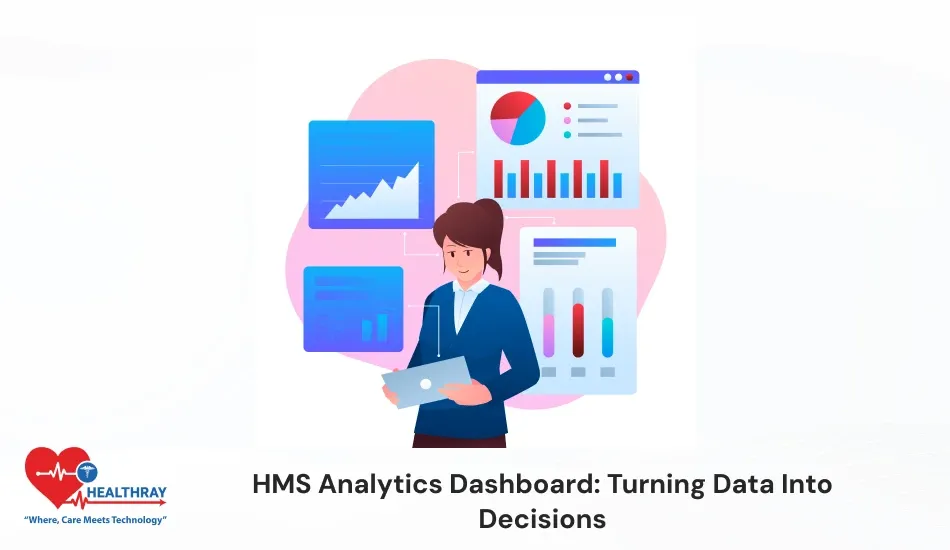
Clinics are utilizing an HMS analytics dashboard, which has evolved into a revolutionary platform for healthcare facilities, to address such situations. Hospital management software dashboard analytics points out daily problems like long waiting periods, staff overburdens, delayed hospital discharges, and sudden patient influxes. Clinical automation software is not just a specialized tool; it’s a highly intelligent standard system that optimizes the way hospitals make decisions in their practices.
How To Design Action Triggers For The HMS Analytics Dashboard?
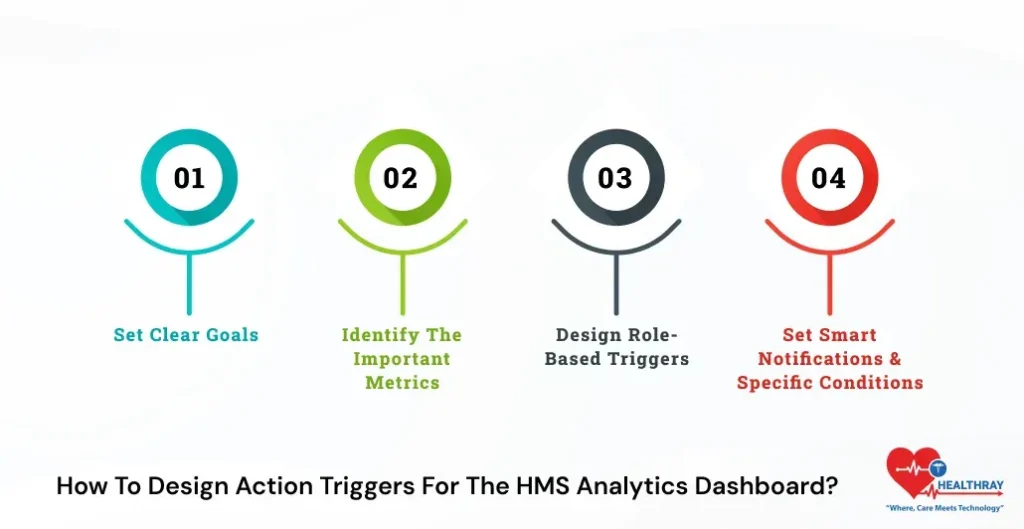
1. Set Clear Goals
Firstly, clinics should focus on the main objective behind designing dashboards. Whether they need to:
- Improve patient flow
- Track revenue
- Raises efficiency.
Additionally, if hospitals set clear goals, triggers will instinctively become centered and valuable, not arbitrary.
2. Identify The Important Metrics
Next, select the key metrics that impact the daily operations. Such as:
- bed occupancy >90%
- Wait time should be less than 30 minutes.
- claim denial rate >5%
Additionally, these metrics are the fundamental base of triggers.
3. Design Role-Based Triggers
Hospitals should design unique triggers for every user. For example, the admin needs operation alerts, and the CFO needs revenue alerts. In this way, every medical practitioner will get relevant information that is essential in their practices. This helps reduce the chances of overloading the system.
4. Set Smart Notifications & Specific Conditions
Firstly, hospitals should define conditional rules. If it hits the threshold, then alerts naturally get activated. Further, use color coding such as red to notify critical scenarios and send the notification via email/SMS. Hospitals should use AI based triggers for a faster response.
 NOTE
NOTE
Key Metrics For Hospital Management Analytics
1. Clinical Metrics (Patient Care Quality)
These metrics reveal the effectiveness of the treatment. Further, it measures the care quality through readmission rate (<15%), mortality rate, and hospital-acquired infections (HAIs). ALOS, Average length of stay (4–5 days), can conveniently identify the delay.
2. Operational Metrics (Daily Workflow)
These key metrics determine whether the hospital operation is running smoothly or not. Further, bed utilization (75–85%) and emergency queue time (<30 min) facilitate patient flow.
3. Financial Metrics (Revenue & Billing)
It is highly crucial for hospitals to track revenue. Additionally, claim denial rate (<5%), days in accounts receivable (<40), and cost per discharge billing issues assist hospitals in figuring out the profit ratio. Also, read our blogs on patient billing & revenue cycle management to know more deeply about it.
 PRO TIP
What Are The Biggest Challenges In Turning Raw HMS Data Into Decisions
1. Data Silos Problem
The biggest challenge that hospitals face is scattered data of all the departments, such as EHR, billing, lab, etc. Moreover, when data is not clear, then insights become misleading.
2. Poor Data Quality
Duplicate information, incomplete records, and outdated data create confusion in the practices. Further, if data is not properly clean, then insights become wrong.
3. Real-Time Access
The legacy system lacks real-time data. Delays slow down the decision-making, especially during critical cases.
How Does a Modern Hms Analytics Dashboard Mitigate Challenges With AI-Driven Messages?
1. AI-Driven Healthcare Business Intelligence Dashboard
Modern hospital data management software systems use AI to assemble data in a single place (ETL pipelines). Moreover, hospital operations analytics provide clean and real-time insights without having to invest in any manual efforts.
2. Smart Alerts & Automation
Healthcare analytics dashboards automatically detect anomalies such as an increase in readmissions or AR days > 45. Additionally, alerts are sent via email or SMS, enabling the possibility for immediate action.
3. Priority-Based Decision Making
HMS analytics dashboard prioritize alerts; for example, green = normal and red = critical. Further, a hospital data analytics system eliminates unnecessary time and clinics can concentrate exclusively on vital issues.
Step towards digital era with our healthcare solution
Revamp your hospital facilities and embrace change for better healthcare management. Ease in managing and organizing large medical datasets leads to effective analysis. Seize the opportunity now!
How Does Predictive Analytics In HMS Help Hospitals Predict Revenue Shortfalls and Patient Surges?
Predictive analytics works as a crystal ball in HMS medical analytics software. Additionally, it thoroughly examines past data, machine learning and real-time inputs and properly determines future challenges. Let’s elaborate more about it:
1. Revenue Shortfall Prediction
Hospital KPI dashboard deeply analyzes claims history, denial patterns or billing intervals. Further, if AR delays cross 45+ and the denial rate crosses 5%, then the HMS system automatically sends early warning signs.
2. Smart Financial Actions
AI alerts help the CFO decide which claims should be given top priority, whether automated appeals are necessary, and how to enhance the payer’s contract. Moreover, this minimizes the revenue leakage up to 20–30%.
3. Patient Surge Forecasting
Patient Record Management Systems thoroughly examine admission patterns, seasonal diseases (such as flu), weather and ER traffic. Further, the system is fully capable of predicting patient surge within 24-48 hours.
4. Resource Planning Made Easy
Predictive dashboards send alerts when ICU occupancy reaches 90%. Further, this helps staff take timely action on scenarios such as staff increases, elective surgeries delay and ambulance diversions.
How Can Integrating AI Chatbots With HMS Dashboards Accelerate Decisions?
1. Accelerate Symptom Triage
Chatbots ask for all the relevant details from patients, such as symptoms, severity and history. Further, it matches the cases with HMS data and categorizes them as urgent (ER) and normal (teleconsultation).
2. Instant Alerts & Doctor Assignment
Triage results are displayed on the HMS analytics dashboard in the form of a notification. Further, it automatically assigns doctors in just one click. This reduces the ER waiting time by up to 40-50%.
3. Smart Resource Allocation
Chatbots check real-time data (bed availability, staff schedule) and provide suggestions on that, such as low ICU beds and sudden surges in 6 hours. Additionally, this helps admin teams take quick actions.
How Can A Healthcare Analytics Dashboard Simplify Patient Data For Hospital Administrators?
The hospital sector comprises a large amount of patient data, including EHR, lab, and billing in many different locations. The HMS analytics dashboard converts this overload into intuitive and valuable conclusions. Let’s understand more about that:
1. Gather All Data To A Centralized Location
HMS Dashboards brings all the data to a single platform. Further, it utilizes AI to clear all duplicate and messy data. It provides hospitals a clear “single source of truth.”
2. Easy Visuals & Real-Time View
HMS dashboards display complex data in the form of charts, graphs and heatmaps. Further, admin can conveniently evaluate bed occupancy, ER wait time and claim denials in real time.
3. Understanding Root Cause
The HMS dashboard not only displays data, but it also reveals the reason behind the challenges in medical practices. Let’s understand with the help of an example. HMS dashboards reveal the actual reason for the delays, whether it’s a staffing issue or patients rushing. Additionally, it provides clear visibility on all the underlying issues.
What Actions Should A Cfo Take In A 15% Drop In Collections And Increased Patient Wait Times?
Firstly, the CFO should deep dive into the dashboard data. Further, cfo should properly check the 15% drop, whether it is related to denial challenges, billing lapses, or delayed payments. Let’s understand more about it:
1. Fix Denials & Billing
The CFO should identify the top denial reasons and should take action on that. Further, they should thoroughly review claims reprocessed, appeal files, and payer contracts to reduce revenue loss.
2. Improve Patient Payments
CFOs should initiate with flexible payment options, digital billing and reminders.
3. Optimize Revenue Cycle
The CFO should focus on streamlining the billing process if AR days are less than 40. Moreover, they should put an emphasis on reducing unnecessary costs.
Conclusion
Hospital data visualization tools convert raw patient data into simple and meaningful insights to make informed and high-impact decisions. HMS analytics dashboard can conveniently track claim denials and AR days, enabling medical organizations to identify revenue losses and take proactive action on that. Platform-like Healthray enables hospitals to make innovative decisions and accomplish healthy and sustainable progress. Healthray analytics transform the data overload into a potent advantage.